What does merchandise brand consistency really mean?
Merchandise brand consistency means every branded item you put into the world, whether it’s a tote bag at a trade show, a drink bottle in a welcome pack, or a polo shirt on your team, delivers the same colours, quality, tone, and visual identity. It’s not just about slapping a logo on a product. It’s about ensuring that every physical touchpoint reflects your brand with the same intention and care as your website, your social media, and your advertising.
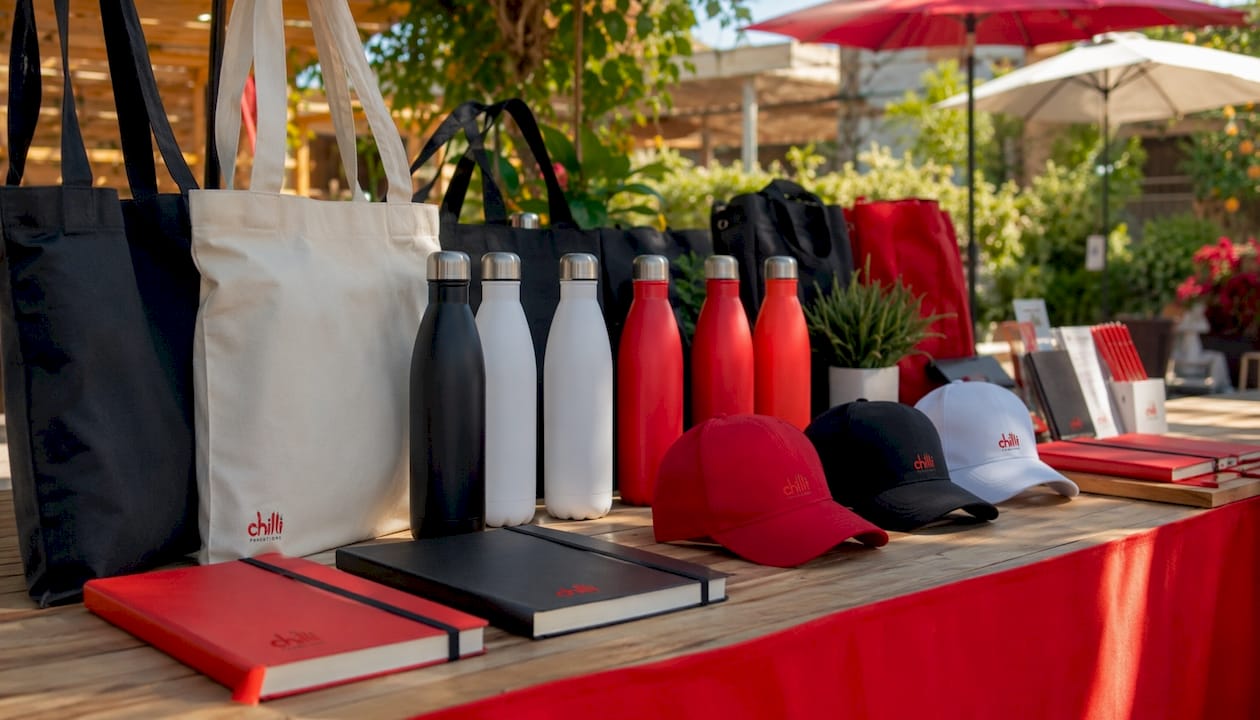
The role of merchandise in branding is often underestimated. Physical products carry your brand into spaces digital channels simply cannot reach: a kitchen bench, a gym bag, a colleague’s desk. When those products look and feel cohesive, they reinforce your brand identity every time they’re used. When they don’t, they quietly erode the credibility you’ve worked hard to build.
Here’s why merchandise consistency matters for branding, in plain terms:
- Trust: Consistent merchandise signals that your organisation is professional and attentive to detail.
- Recognition: Repeated exposure to the same colours, logo, and style builds familiarity faster than most digital formats.
- Loyalty: Recipients who receive quality, well-designed merchandise are far more likely to advocate for your brand.
- Revenue: 77% of recipients have made a purchase from a brand after receiving a promotional item.
- Digital engagement: Merchandise drives people online, extending your brand’s reach beyond the physical item itself.
The Australasian Promotional Products Association (APPA) and The Uniform Edit both point to the same truth: branded merchandise communicates your values whether you intend it to or not. Intentional consistency amplifies that signal. Inconsistency undermines it.
How consistent merchandise builds trust, recognition, and loyalty
Customer trust is built through repeated, reliable experiences. Every time a recipient uses a branded item that looks and feels exactly as your brand promises, that trust deepens. The reverse is equally true: a poorly printed logo on a flimsy product tells a story you didn’t mean to tell.
Brand recognition follows a similar logic. Consistent merchandise creates repeated visual exposure across different contexts and environments, which is exactly how memory works. The more often someone encounters your brand in a familiar, coherent form, the more readily they recall it.
81% of recipients can recall the brand on a promotional item they received, outperforming digital and print recall benchmarks.
— APPA, 2025
That recall figure is striking when you consider how crowded the digital advertising environment has become. A well-made branded item cuts through in a way a sponsored post rarely can. And the loyalty data is just as compelling: 84% of recipients have advocated for a brand after receiving promotional merchandise. Advocacy at that scale doesn’t happen by accident. It follows from merchandise that genuinely reflects the brand’s quality and values.
The branded merchandise and trust connection is particularly strong in sectors where credibility is a primary driver of conversion, such as financial services, healthcare, and professional services. In those contexts, a cheap or inconsistent branded item can do measurable damage.
How to maintain merchandise consistency across your brand
Maintaining consistency across all branded merchandise requires more than a style guide sitting in a shared drive. It demands active management, clear processes, and trusted supplier relationships.
Start with a centralised brand guidelines document that covers more than just your logo. Specify:
- Approved colour codes (Pantone, CMYK, and RGB values)
- Logo placement rules, including minimum sizes and exclusion zones
- Approved typefaces and how they apply to physical products
- Tone of voice guidelines for any text on merchandise
- Quality standards and material preferences
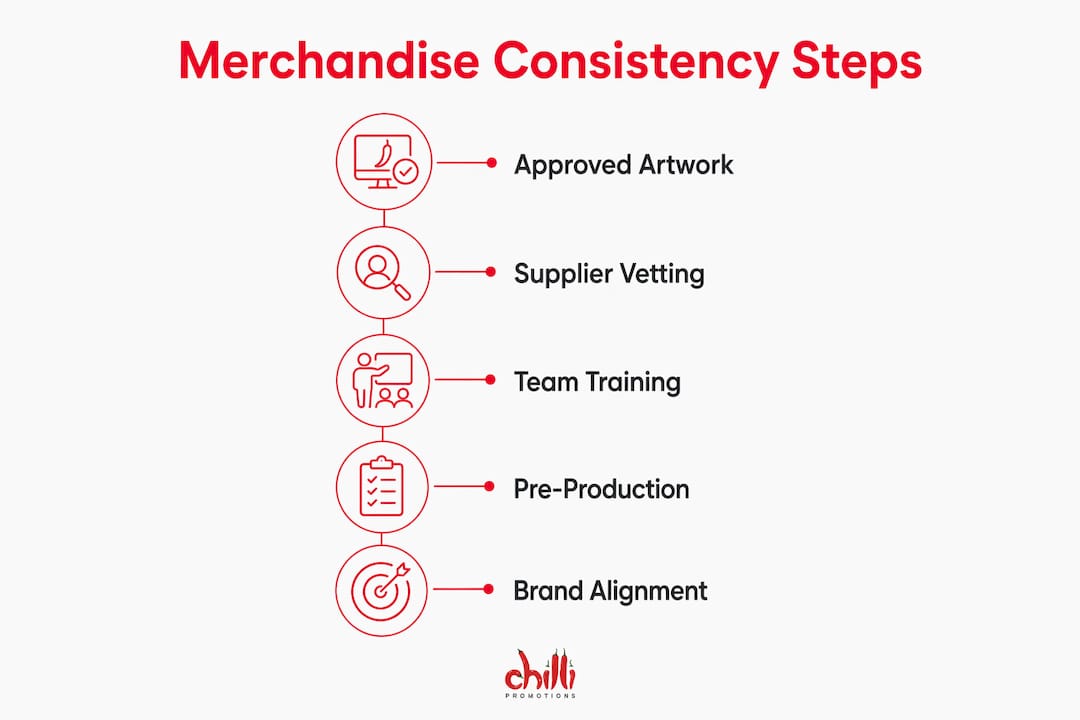
Build an approved artwork library that suppliers can access directly. This removes the risk of someone recreating your logo from memory or using an outdated file. Every artwork file should be print-ready and version-controlled.
Vet and consolidate your supplier base. Working with fewer, trusted suppliers makes consistency far easier to maintain. The APPA Fast Facts research shows that 79.5% of buyers rate quality as equal to price when selecting promotional merchandise. A supplier who understands your brand and consistently delivers to your standards is worth far more than a cheaper alternative who doesn’t.
Train your internal team. Anyone who orders or approves merchandise should understand your brand guidelines and know how to apply them. A brief onboarding document or a short internal workshop goes a long way.
Implement a pre-production approval process. Always request a physical sample or a digital proof before a full production run. Colour variation between screen and print is common, and catching it early saves both budget and brand equity.
Pro Tip: Align your merchandise choices with your digital brand presence. If your website and social channels use a clean, minimal aesthetic, your merchandise should reflect that same restraint. Over-branded, logo-heavy products can feel inconsistent with a brand that presents itself as refined online.
Common pitfalls that damage merchandise brand consistency
Inconsistency in branded merchandise rarely happens through deliberate neglect. It creeps in through rushed decisions, budget pressure, and a lack of clear ownership. The result is a fragmented brand experience that confuses customers and wastes investment.
The most common pitfalls include:
- Choosing items without a brand lens. Selecting merchandise based on price or novelty alone, without asking whether it fits your brand’s quality standards or aesthetic, produces items that feel disconnected from your identity.
- Using outdated or incorrect artwork. An old logo version or a colour that’s slightly off might seem minor, but recipients notice inconsistency even when they can’t articulate it.
- Over-branding. Covering every surface with a large logo doesn’t reinforce your brand; it often repels the recipient. The Uniform Edit notes that subtle, well-placed branding tends to perform better because people are more comfortable using it.
- Treating merchandise as an afterthought. When merchandise is ordered at the last minute to fill a gap at an event, it rarely aligns with the broader campaign. Planned merchandise, designed alongside other brand activity, always delivers better results.
- Ignoring quality thresholds. Low-quality items get used once, or not at all. They don’t build brand recall; they build brand indifference. As The Uniform Edit puts it, if you wouldn’t be proud to use it yourself, it’s not something you want your name on.
- Inconsistent supplier management. Using multiple suppliers without shared standards means your brand can look subtly different across product categories, undermining the coherence you’re trying to build.
The financial cost of these mistakes is real. Wasted production runs, reorders, and the reputational cost of merchandise that reflects poorly on your brand all add up. Intentional planning, guided by clear brand standards, prevents most of these problems before they start. For a practical starting point, a promotional product checklist helps teams work through the key decisions before committing to production.
Merchandise as a strategic brand asset in the 2026 Australian market
The most important shift in how Australian marketers think about branded merchandise is the move from treating it as a giveaway to treating it as a brand asset. APPA’s 2025 research, drawing on 399 promotional product recipients and 228 end-user buyers across Australia and New Zealand, makes the case clearly.
66% of promotional product recipients visit a brand’s website or social media after receiving a physical item — the physical-digital bridge in action.
— APPA, 2025
That figure reframes the entire conversation. Branded merchandise isn’t competing with digital marketing; it’s feeding it. Two-thirds of recipients go directly to a brand’s digital presence after receiving something physical. A well-chosen, consistently branded item becomes the catalyst for a deeper brand relationship that plays out across multiple channels. This is what APPA calls the Physical-Digital Bridge, and it’s one of the most compelling arguments for treating merchandise with the same strategic rigour as any other marketing channel.
Sustainability is the other defining trend in 2026. Eco-friendly promotional products are delivering above-average return on investment because they align with recipient values, which increases both retention and positive brand association. Branded drinkware and apparel generate the highest impressions per item, and when those items are made from recycled or sustainable materials, the brand association strengthens further.
The role of merchandise in marketing has never been more clearly defined. Chilli Promotions works with Australian brands as a strategic partner, not just a supplier, helping clients select merchandise that aligns with their brand identity, their sustainability commitments, and their campaign objectives. When merchandise is chosen with that level of intention, it builds long-term brand equity rather than short-term noise.
Understanding why brand consistency matters for business growth is increasingly central to how Australian marketing teams plan their annual programmes. Merchandise is no longer a line item; it’s a brand investment.
How do you measure whether your merchandise consistency is working?
Measuring the effectiveness of consistent merchandise branding requires a mix of quantitative tracking and qualitative feedback. Neither alone gives you the full picture.
Brand recall surveys are the most direct method. Asking recipients whether they remember the brand on an item they received, and whether they can describe the brand’s colours or logo accurately, gives you a baseline for recall performance. APPA’s research benchmarks recall at 81% for promotional merchandise, which provides a useful industry reference point.
QR codes and unique URLs on merchandise allow you to track digital engagement directly. If 66% of recipients typically visit a brand’s digital presence after receiving an item, a QR code lets you measure whether your specific campaign is hitting that benchmark or exceeding it.
Post-campaign surveys can capture advocacy intent, purchase behaviour, and sentiment. Asking recipients whether they’ve recommended the brand, visited the website, or made a purchase after receiving merchandise connects your physical investment to measurable business outcomes.
Internal brand audits are equally valuable. Periodically reviewing all merchandise in circulation, checking for colour accuracy, logo consistency, and quality standards, catches drift before it becomes a problem. A simple audit checklist, reviewed quarterly, keeps your brand coherent across every product category.
Supplier scorecards help you track quality consistency over time. Rating each order against your brand standards, delivery accuracy, and print quality creates a record that informs future supplier decisions and holds partners accountable.
Key takeaways
Consistent merchandise is one of the most measurable and cost-effective ways to build brand trust, recognition, and loyalty across the Australian market.
| Point | Details |
|---|---|
| Recall outperforms digital | 81% of recipients recall the brand on a promotional item, exceeding digital recall benchmarks. |
| Advocacy follows quality | 84% of recipients have advocated for a brand after receiving well-made promotional merchandise. |
| Merchandise drives purchase | 77% of recipients have made a purchase from a brand after receiving a promotional item. |
| Physical drives digital | 66% of recipients visit a brand’s website or social media after receiving a branded item. |
| Quality equals price in selection | 79.5% of buyers rate quality as a key factor when selecting merchandise, equal with price. |
FAQ
What does merchandise brand consistency mean?
Merchandise brand consistency means every branded product you produce, from uniforms to giveaways, shares the same colours, logo treatment, quality, and tone. It ensures your physical touchpoints reinforce the same identity as your digital and print channels.
Why is merchandise consistency crucial for brand trust?
Consistent merchandise signals professionalism and attention to detail, which builds customer confidence. APPA’s research shows that the quality and intentionality of branded items directly influence how recipients perceive and trust a brand.
How does branded merchandise affect customer loyalty?
84% of recipients have advocated for a brand after receiving promotional merchandise, demonstrating that well-chosen, consistent items drive genuine loyalty and word-of-mouth referrals.
What are the biggest mistakes in merchandise branding?
The most common mistakes are choosing items without a brand lens, using outdated artwork, over-branding with large logos, and treating merchandise as an afterthought rather than a planned brand investment.
How can you measure the impact of merchandise on your brand?
Use brand recall surveys, QR code tracking, post-campaign surveys on purchase and advocacy behaviour, and internal brand audits to assess whether your merchandise is delivering consistent, measurable brand outcomes.
Ready to put consistent, high-quality branded merchandise to work for your brand? Explore Chilli Promotions’ range of corporate giveaway products or browse the full promotional products catalogue to find merchandise that genuinely reflects your brand.