TL;DR:
- Maintaining brand consistency across promotional items requires clear asset management and a single approval process. Proper guidelines, vector files, and physical samples ensure logos and colors match your brand standards. Consistent branding builds trust, recognition, and can increase revenue significantly.
Brand consistency across promotional items is the deliberate alignment of logos, colours, typography, and messaging across every physical touchpoint to reinforce a unified brand identity. Done well, it turns a tote bag or a branded pen into a trust signal. Done poorly, it sends contradictory messages that erode the credibility your marketing budget works hard to build. Consistent brand presentation across all touchpoints can increase revenue by up to 33%. That figure alone makes the case for treating promotional merchandise as a serious brand asset, not an afterthought. The Australasian Promotional Products Association (APPA) confirms the physical-to-digital connection is real, and the opportunity for brand managers who get this right is significant.
What does brand consistency across promotional items actually require?
Maintaining consistent brand identity on promotional products starts with having the right assets in place before a single item goes to production. Without them, every supplier interaction becomes a guessing game, and guessing games produce off-brand results.
The foundation is a brand guidelines document. Brand guidelines should be living documents with precise use cases and examples for print, digital, and physical branding, regularly updated and easily accessible online. A static PDF filed away on a shared drive does not count. Your guidelines need to cover:
- Logo variants: primary, reversed, monochrome, and minimum size rules
- Colour specifications: Pantone Matching System (PMS), CMYK, HEX, and RGB values for every approved colour
- Typography: approved typefaces, weights, and size hierarchies
- Clear space rules: the minimum breathing room around your logo on any surface
- Tone of voice: how your brand speaks, even on a product tag or packaging insert
Colour specification deserves particular attention. Consistent use of PMS or Pantone colours for merchandise ensures accurate colour matching across different production methods and materials. A colour that looks correct on screen can print entirely differently on a cotton tote versus a hard plastic bottle. Specifying Pantone codes removes the ambiguity.
Artwork file format matters just as much. Vector artwork files such as .ai, .eps, and .pdf prevent blurry or pixelated logo applications and ensure scalability for various merchandise. A raster PNG that looks fine at business card size will fall apart when embroidered on a jacket or printed on a banner.
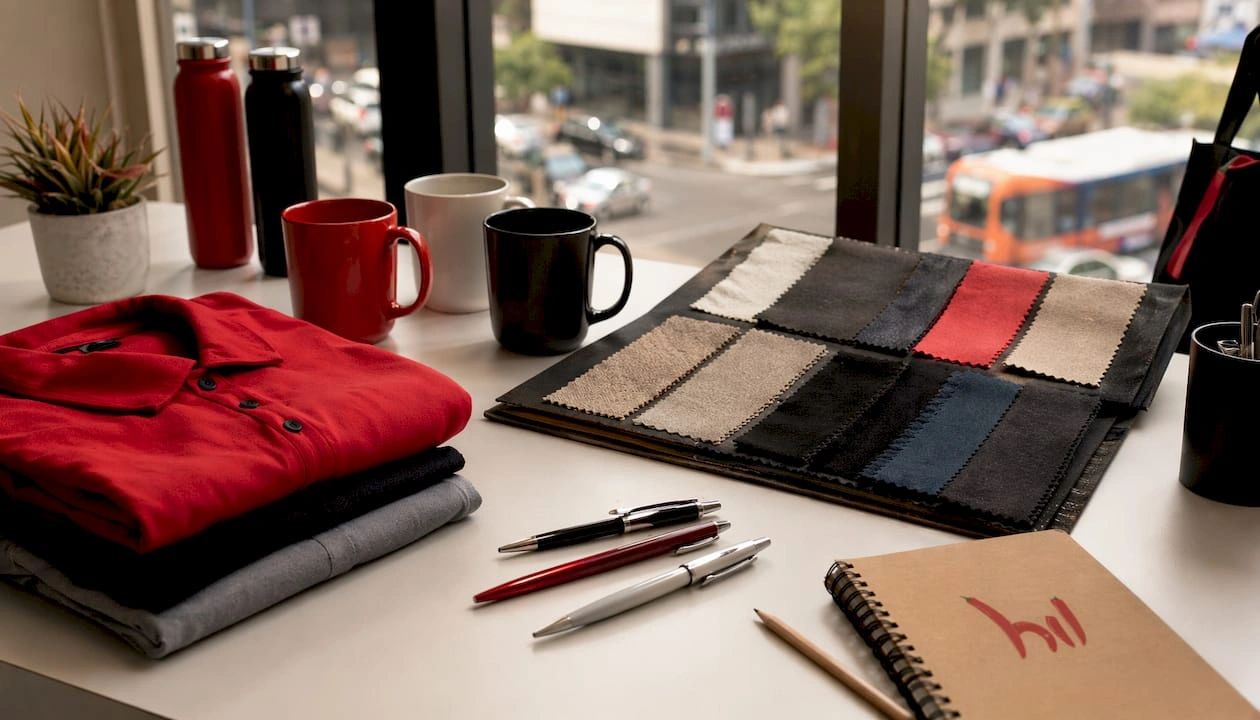
Pro Tip: Build a centralised brand asset library on a cloud platform your suppliers can access directly. Include approved logo files, colour specs, and a one-page brand summary. This single step eliminates the most common source of inconsistency: suppliers working from outdated or incorrect files.
How do you keep branding consistent during sourcing and production?
A clear process protects your brand at every stage of production. The following workflow gives marketing managers and brand managers a reliable structure to follow.
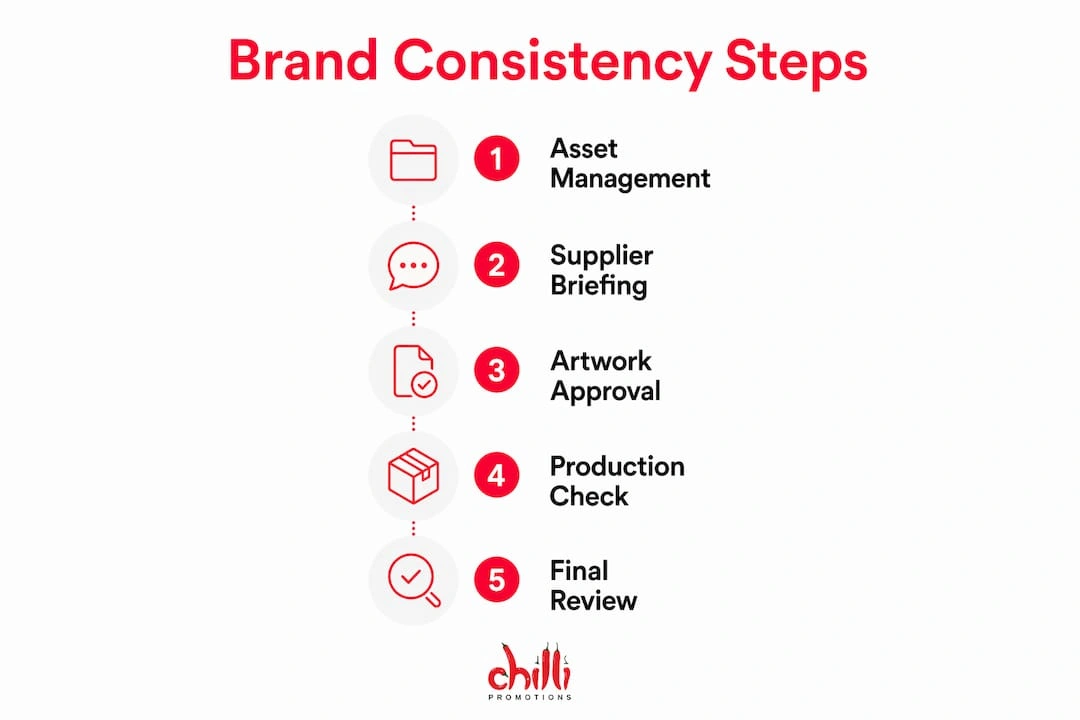
- Brief suppliers with complete brand files. Send your brand guidelines document, vector logo files, Pantone codes, and any product-specific placement instructions at the start of every engagement. Never assume a supplier has retained files from a previous order.
- Request a digital proof before production begins. A digital proof shows logo placement, sizing, and colour intent. Review it against your brand guidelines, not just your memory of what the logo looks like.
- Assign a single point of approval. A single point of approval, handled by a trained brand manager, reduces errors and conflicting feedback during artwork approval. When three people can approve artwork, you get three different opinions and no clear standard.
- Request a pre-production physical sample. Pre-production physical samples allow verification of colour accuracy, logo placement, and material interaction, which digital proofs cannot fully reveal. A navy that reads correctly on screen may appear purple on a recycled fabric. The physical sample catches this before a full production run.
- Conduct a final quality check before distribution. Compare the finished goods against the approved sample and your brand guidelines. Check logo placement, colour, and print quality on a representative selection from the batch.
| Production stage | Brand consistency check |
|---|---|
| Supplier briefing | Brand guidelines and vector files supplied |
| Digital proof | Logo placement, size, and colour reviewed |
| Physical sample | Colour accuracy and material interaction confirmed |
| Final production | Finished goods checked against approved sample |
Pro Tip: Create a one-page artwork brief template that your team fills out for every order. Include logo version, Pantone code, placement coordinates, and the name of the single approver. Attach it to every supplier communication.
What mistakes most often undermine promotional item branding?
The most damaging errors in promotional product branding are not dramatic. They are quiet, cumulative, and entirely avoidable.
- Using low-resolution or outdated logo files. A JPEG saved from a website is not a production file. Outdated logos, including old colour versions or superseded taglines, create inconsistency that recipients notice even if they cannot name it.
- Incorrect Pantone usage. Specifying “close enough” colours or leaving colour choice to the supplier produces merchandise that does not match your brand standards. Always specify the exact PMS code.
- Multiple conflicting approvers. When marketing, sales, and the CEO all have sign-off authority, the result is contradictory feedback and a final product that satisfies no one’s brief.
- Treating promotional items as isolated giveaways. Poorly chosen merchandise can damage brand perception, while intentional, well-designed items build brand equity. A cheap pen with a smudged logo says something about your brand. So does a quality, sustainably sourced item with a crisp imprint.
- Ignoring local market variation in distributed teams. Regional offices and franchise networks often source their own merchandise, producing wildly inconsistent results. Approved merchandise catalogues and centralised asset libraries solve the tension between head office control and local marketing autonomy.
“Top brands treat promotional merchandise as permanent infrastructure within their brand identity system rather than one-off giveaways, planning design and distribution months in advance. The brands that struggle treat every order as a fresh start.”
For franchise and multi-location businesses, franchise marketing strategies that centralise approved product catalogues while allowing local customisation within defined parameters are the most effective way to maintain brand uniformity at scale.
How does promotional item branding connect to your wider marketing strategy?
Physical promotional products and digital brand experiences are not separate channels. They reinforce each other when managed with intention. 66% of ANZ promotional product recipients visit a brand’s digital platforms after receiving merchandise. That statistic reframes the humble branded item as a lead-generation and engagement tool, not just a goodwill gesture.
The concept of “phygital” marketing, where physical and digital brand experiences are deliberately connected, is now standard practice for well-run marketing programmes. A branded item at a trade show should carry the same visual identity as your event landing page, your email follow-up, and your social media posts from the same event. Inconsistency at any point breaks the chain of recognition.
Recipients keep promotional items for over a year on average, making quality merchandise a long-term brand exposure tool. That extended lifespan means your brand standards need to hold up not just on the day of distribution, but for every day the item sits on a desk or in a bag.
Sustainable promotional products add another dimension to brand alignment. When your brand values include environmental responsibility, your merchandise choices need to reflect that. Recycled materials, certified supply chains, and carbon-neutral production are not just ethical choices. They are brand consistency choices. You can read more about this in Chilli Promotions’ guide to sustainable promotional products for Australian businesses.
| Channel | Brand consistency requirement |
|---|---|
| Promotional merchandise | Logo, colour, and tone match brand guidelines |
| Event presence | Visual identity aligns with merchandise and digital assets |
| Email follow-up | Messaging and tone consistent with physical touchpoint |
| Social media | Same campaign visuals reinforce merchandise design |
| Website landing page | Colour and typography match the physical item received |
Coordinating these channels requires a campaign brief that covers all touchpoints from the start. Brand managers who brief merchandise suppliers at the same time as their digital and design teams produce the most consistent results.
Key takeaways
Maintaining brand consistency across promotional items requires structured asset management, a single approval process, and physical sample verification at every production stage.
| Point | Details |
|---|---|
| Build living brand guidelines | Update guidelines regularly with print, digital, and physical use cases, and make them accessible to all suppliers. |
| Use vector files and Pantone codes | Supply .ai or .eps logo files and exact PMS codes to every supplier to prevent colour and quality errors. |
| Assign one approver | A single trained brand manager as the final approver eliminates conflicting feedback and protects brand standards. |
| Request physical samples | Pre-production samples reveal colour and material interactions that digital proofs cannot accurately predict. |
| Connect physical to digital | Treat promotional items as part of your wider campaign, not standalone giveaways, to maximise engagement and brand recall. |
What we have learned from 20+ years of branded merchandise
After more than two decades working with marketing teams across Australia and New Zealand, the Chilli Promotions team has seen the same pattern repeat itself. Brands that invest in the process, not just the product, get the best results. Brands that treat promotional items as a last-minute line item get last-minute outcomes.
The most common mistake we see is the approval shortcut. A busy marketing manager skips the physical sample to save a week, and the finished goods arrive in a colour that does not match the brand. The reprint costs more time and money than the sample ever would have. The second most common mistake is the asset gap. Teams brief suppliers verbally or send a low-resolution logo from a website, then wonder why the embroidery looks wrong.
The brands that get this right share one habit. They treat their brand guidelines as a working document, not a founding document. They update them when products change, when colours are refined, and when new merchandise categories are added. They share those updates with every supplier in their network. That discipline is not glamorous, but it is what separates brands that look consistent from brands that merely intend to.
Our advice to brand managers expanding into new markets or product categories: build your approved merchandise catalogue before you need it. Waiting until a regional team places an urgent order is too late to enforce standards.
— Chilli Promotions Team
Chilli Promotions: your partner in consistent branded merchandise
Chilli Promotions has worked with marketing teams across Australia and New Zealand since 2001, and brand consistency is at the centre of every project we take on.
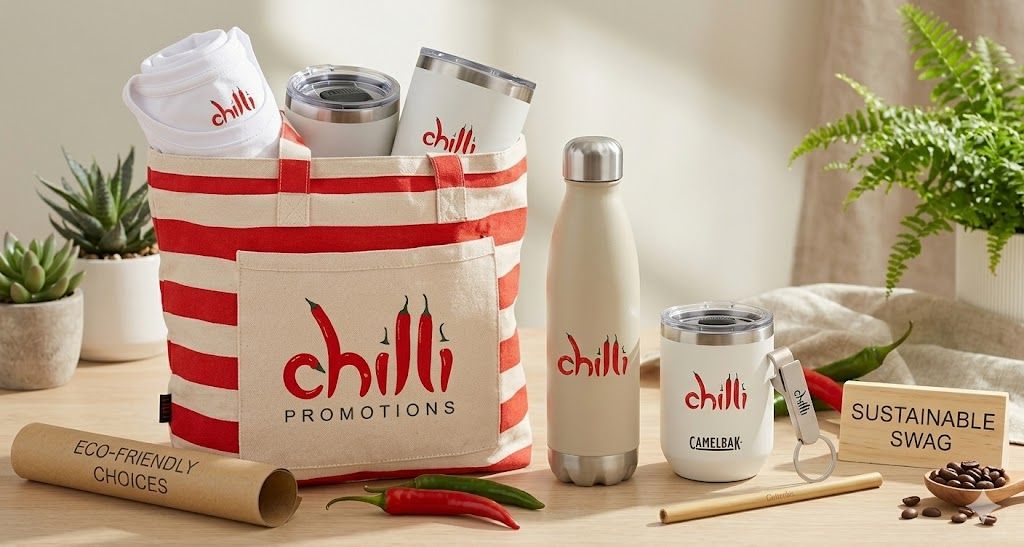
We manage artwork, approvals, and production to your brand standards, not ours. Our team works directly with your guidelines and files to produce merchandise that holds up against your brand identity at every stage. Whether you need corporate giveaways that reflect your brand values or a full merchandise programme for a national campaign, we bring the process discipline that protects your brand. Explore our full range of promotional products or speak with our team about building a consistent, on-brand merchandise programme for your next campaign.
FAQ
What is brand consistency in promotional products?
Brand consistency in promotional products is the accurate and uniform application of logos, colours, typography, and messaging across all physical merchandise. It ensures every item a recipient touches reinforces the same brand identity.
Why does brand consistency matter for promotional items?
Consistent brand presentation can increase revenue by up to 33%, and 66% of ANZ promotional product recipients visit a brand’s digital platforms after receiving merchandise. Inconsistent items undermine both recognition and trust.
What file formats should I supply to a promotional product supplier?
Supply vector files in .ai, .eps, or .pdf format along with exact Pantone colour codes. These formats ensure logos remain crisp and scalable across all merchandise sizes and production methods.
How do I prevent colour mismatches on promotional merchandise?
Specify the exact Pantone Matching System (PMS) code for every brand colour and request a physical pre-production sample before approving a full production run. Digital proofs cannot accurately predict how colours will appear on different materials.
How many people should approve promotional product artwork?
One trained brand manager should hold final approval authority. A single point of approval eliminates conflicting feedback and reduces the risk of costly reprints caused by inconsistent direction.