University-branded merchandise increases engagement by turning students and alumni into visible brand ambassadors. It works through three connected forces: psychological ownership (people invest more in what they physically hold and wear), social identity signalling (a hoodie or drink bottle tells the world “I belong here”), and usable incentives that reward participation instead of just decorating it. Recent industry analysis on branded merchandise psychology confirms tangible branded items still outperform digital-only touchpoints for building lasting loyalty, even in a market saturated with apps and social feeds.
Social identity theory explains why this matters for a campus specifically. Students who identify strongly with their institution are measurably more likely to buy licensed apparel and to keep buying it after graduation, according to survey research on university identification and purchase intent. Merchandise is not a side gift bolted onto a program. It is one of the few tools that makes belonging visible, portable, and repeatable.
Three things a university marketing team can try in the next campaign:
- Give first-year students a wearable item within their first week, not a folder of paperwork nobody keeps.
- Track wear rate at events (photograph and count, don’t guess) rather than just units distributed.
- Pair every merchandise drop with one specific action you want the recipient to take, such as tagging a location or joining a club.
Pro Tip: Run a small, unbranded test batch before committing to a full production run. A poorly fitting t-shirt or a mug that chips after two washes does more reputational damage than no merchandise at all.
Table of Contents
- Why university merchandise matters for engagement
- Popular merchandise categories and when to use each
- How merchandise drives engagement: mechanisms and measurement
- Design and licensing choices that increase wear and reuse
- Where merchandise fits across the student and alumni journey
- Sustainability and procurement considerations for merch programs
- Practical checklist for running a merch program
- How a specialist merch partner supports university engagement goals
- Key takeaways for university merchandise programs
- FAQ
Why university merchandise matters for engagement
Psychological ownership is the underlying mechanic, and it is more specific than “people like free stuff.” When someone customises, wears, or displays an item, they start treating it as an extension of themselves. That shift in perception changes behaviour: owned items get protected, shown off, and used as conversation starters. Applied to a university hoodie, this means the student is not just wearing fabric. They are broadcasting an affiliation they have chosen to make visible in public.

Industry commentary on tangible branding frames this as merchandise acting as a catalyst: once someone owns and displays a branded item, they report a stronger sense of belonging and a longer-running loyalty to the institution behind it. This is not a fringe theory. Survey-based research on psychological ownership and university value congruence found that ownership and shared values predict student engagement, with the effect running through university brand equity rather than around it.
The empirical link between identification and buying behaviour is well established. Students who identify strongly with their university show significantly stronger purchase intention for licensed apparel, and that effect strengthens further among students who care about prestige and product quality, per the study on university identification and purchase intention. Belonging predicts buying, and buying then reinforces belonging. It is a loop, not a one-way transaction.
Students with a stronger sense of belonging report higher satisfaction, participation, and motivation, though a 2025 study on uniform design and student adaptation found that overly simplistic or generic uniform design can blunt this effect. Design choices matter as much as the decision to produce merchandise at all.
Here is the mechanism in plain terms: ownership creates a sense of belonging, belonging motivates visible action (wearing, sharing, attending), and that action becomes a form of unpaid marketing the university never has to script. A 2025 industry case from Prairie View A&M University showed exactly this loop in practice, using capsule collections to convert routine campus swag into items students actively sought out and displayed, as documented in PPAI’s report on merchandise and community building.
Popular merchandise categories and when to use each
Not every product category serves the same engagement goal, and treating them interchangeably wastes budget. Apparel builds visibility over the longest timeframe because it gets worn repeatedly in public settings, making it the strongest choice for orientation, open days, and any campaign where you want walking advertisements. Drinkware works differently. It lives on a desk or in a bag, so it is better suited to daily-use touchpoints like library giveaways or staff recognition, where repeated private exposure matters more than public display.
- Apparel (hoodies, t-shirts, caps): best for orientation, sports events, and any moment where public visibility is the goal.
- Drinkware (bottles, mugs): strong for sustainability messaging and daily habitual use, especially on campus.
- Bags (tote bags, backpacks): high utility, long lifespan, ideal for open days and conference giveaways.
- Stationery (notebooks, pens): low cost, high volume, useful for orientation packs and exam-period care packages.
- Tech accessories (charging cables, phone grips): appeal strongly to Gen Z audiences and work well at recruitment fairs.
- Event giveaways (lanyards, wristbands): functional for access control and instant visual identification at large events.
- Sports merch (scarves, jerseys): builds tribal identity fast, particularly around rivalry matches and homecoming.
Licensing strategy matters as much as category choice. Empirical research on university apparel style and licensing found that consumers prefer licensed logos on basics such as t-shirts and hoodies, where the crest signals authenticity and prestige. For trend-led or fashion-forward items, non-licensed, lifestyle-first designs often perform better, because they read as fashion first and institutional second. A mixed portfolio, licensed staples plus a smaller run of trend-led drops, tends to capture both the loyalist buying a hoodie every year and the trend-seeker who wants something limited.
Pro Tip: Run one small capsule collection per semester tied to a specific date (homecoming, graduation week, a rivalry game) rather than keeping your entire catalogue permanently available. Scarcity does more to lift perceived value than discounting ever will.
How merchandise drives engagement: mechanisms and measurement
Four mechanisms do the actual work. Psychological ownership drives people to protect and display what they own. Social signalling turns a worn item into a public statement of affiliation, visible to peers, prospective students, and family. Utility keeps an item in daily rotation, which multiplies exposure over time rather than in a single burst. Incentive reinforcement ties merchandise to a specific action (attend, refer, register), converting a gift into a behavioural trigger rather than a passive token.
Research on student brand engagement confirms students already perform unpaid marketing behaviours, wearing branded clothing, recommending their university by word of mouth, and posting about campus life. That behaviour exists whether or not a university measures it. The task is capturing it properly.
| KPI | How to measure it |
|---|---|
| Reach | Count social mentions and geotagged posts featuring merchandise, tracked via a branded hashtag or campaign tag. |
| Wear rate | Photograph or observe attendance at a fixed event and calculate the percentage visibly wearing branded items. |
| Event attendance lift | Compare turnout at events with a merchandise incentive against a comparable event without one. |
| Retention/repeat engagement | Track return visits to a merch store or repeat participation in a rewards-linked club activity. |
| Lifetime value of engaged alumni | Compare average giving or event attendance between alumni who received merchandise and those who did not. |
A simple experimental design works well here: offer merchandise to one cohort (a subset of new students, one campus club, one region of alumni) and withhold it from a comparable control group, then compare attendance, sign-ups, or giving over the following term. Before running any campaign, confirm you can answer these three questions: what specific action does this item incentivise, how will you record whether that action happened, and what would “success” look like as a number, not a feeling.
Design and licensing choices that increase wear and reuse
Style decisions decide whether an item gets worn twice or worn for four years. Licensed university crests work best on basics, the t-shirts, hoodies, and caps that students expect to see and trust, because the crest signals both authenticity and a connection to something larger than themselves. Lifestyle-first designs, ones that downplay or omit the crest in favour of a subtler campus reference, tend to perform better on fashion-forward items where the buyer wants something wearable off-campus without it reading as an obvious institutional advertisement.
Fit and fabric quality decide reuse far more than logo placement does. A hoodie that shrinks after one wash or a tote bag with a seam that splits under normal use tells the wearer the institution doesn’t take quality seriously, and that impression transfers to how they feel about the university more broadly. Sizing needs to reflect actual student body diversity rather than a generic small-to-XL run designed for convenience of ordering.
- Test two or three design directions with a small student focus group before committing to a full production run.
- Run a limited micro-drop (50 to 100 units) to gauge real demand before scaling to a bulk order.
- Favour licensed basics for staple items and reserve non-licensed, trend-led designs for seasonal or limited releases, following the pattern found in research on apparel style and licensing interaction.
Pro Tip: Ask a student club to co-design one limited item each year. Involving students in the creative process turns the item into something they helped make, not something handed to them, and that distinction measurably increases how often it gets worn.
Where merchandise fits across the student and alumni journey
Orientation week is the highest-leverage moment for merchandise because it is the first tangible signal a new student receives that they belong somewhere. A practical guide to orientation merchandise covers this timing in more detail, but the principle is simple: give something wearable in week one, not a folder of forms.
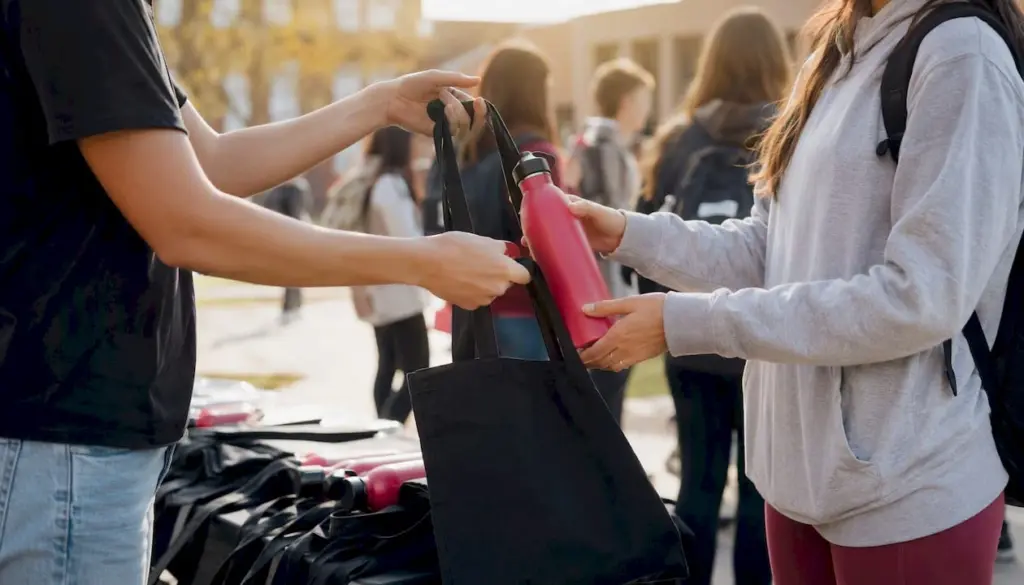
Clubs and societies benefit from smaller, cheaper items distributed frequently rather than one large annual order. A running club handing out branded socks at every second meeting builds more habitual engagement than a fsingle expensive jacket handed out once a year. Recruitment events and open days work on a different logic entirely. Prospective students and their families are making a comparison between institutions, and a well-designed branded item at an open day becomes a physical artefact of that comparison, something they take home and look at again before deciding.
Exam periods call for care-package style stationery and drinkware rather than apparel. Graduation is arguably the single most emotionally charged moment in the entire relationship, and a well-designed keepsake here has outsized influence on whether that graduate stays engaged as an alumnus. Alumni reunions and fundraising campaigns then reactivate that emotional connection years later, often using limited-edition anniversary items to create urgency around participation or giving.
A regional university club, for example, might run a simple activation: distribute branded scarves at a homecoming match, ask attendees to post a photo with a campaign hashtag, then follow up two weeks later with an alumni newsletter link to the same design in the online store. That loop, physical distribution, social amplification, digital follow-up, extends a single event into a multi-week engagement window. Pairing physical merchandise with a dedicated online merch store or app-based ordering system lets that reach continue well past the original event date.
Sustainability and procurement considerations for merch programs
Materials and certification claims increasingly influence whether students and alumni feel good about wearing an item, particularly among Gen Z audiences who scrutinise sourcing more than any prior cohort. Organic cotton, recycled PET fabric (commonly made from recycled bottles), Fair Trade certification, and clearly documented carbon-offset claims all give a marketing team something concrete to point to, rather than a vague sustainability statement nobody can verify.
- Check for recognised certifications (organic cotton standards, recycled content verification, Fair Trade) rather than accepting a supplier’s own marketing language at face value.
- Ask for documentation on carbon-offset claims specifically, not just a general “eco-friendly” label on the product page.
- Confirm minimum order quantities (MOQ) and lead times before locking in a launch date, since sustainable materials sometimes carry longer production windows.
- Request physical samples before committing to bulk production, and insist on a written sample-approval step in the contract.
Budget allocation across product tiers changes both cost and perceived value, and getting this balance wrong in either direction wastes money.
| Tier | Typical use case | Cost vs perceived value trade-off |
|---|---|---|
| Entry | Mass orientation packs, event giveaways | Low cost per unit, lower perceived value, best for volume distribution |
| Mid | Club merchandise, recruitment events | Balanced cost, solid perceived value, suits repeat campaigns |
| Premium | Graduation keepsakes, alumni anniversary drops | Higher cost per unit, high perceived value, reserved for emotionally significant moments |
Getting procurement right also means treating merchandise as more than a cost line. Research on merchandise as a branding strategy in higher education points out that a well-run program can double as a non-academic revenue stream and a genuine learning opportunity for students involved in the design and sales process, not just an expense a department absorbs each year. For teams weighing eco-friendly options specifically, a guide to eco-friendly corporate gifts outlines the material categories worth prioritising.
Practical checklist for running a merch program
Running a merchandise program well means treating procurement as a sequence, not a single purchase order. Start with a clear brief that specifies the audience, the occasion, the budget tier, and the specific action you want the item to encourage. Request physical samples before any bulk commitment, and build in time for a proper wash test and print-placement check, since a logo that cracks after three washes will do more damage to your brand than skipping the item altogether.
Vendor evaluation should cover concrete, answerable questions rather than vague reassurances:
- What are your realistic lead times from approved sample to delivered stock?
- What print or embroidery method do you use, and how does it perform under repeated washing?
- What is your quality control process before an order ships?
- What happens if a batch arrives with a defect, and what does your returns policy actually cover?
Guidance on supplier evaluation in university merchandise programs recommends requiring third-party material certificates alongside physical samples specifically to avoid expensive rework once an order has already gone to full production. A typical launch timeline runs eight to twelve weeks from initial brief to delivered stock, allowing for one design revision round and one sample approval cycle. The Prairie View A&M case referenced earlier in PPAI’s coverage shows what a properly sequenced capsule launch looks like when the brief, sample, and distribution stages are planned together rather than rushed at the end.
Author’s perspective: practical tips from campus campaigns
The biggest mistake university marketing teams make with merchandise is treating every campus population the same way. What lands at orientation, cheap, cheerful, distributed in bulk to a captive audience, falls flat at an alumni reunion, where the same generic tote bag reads as an afterthought rather than a gesture of genuine appreciation. Orientation merchandise should feel abundant and immediate. Alumni merchandise should feel considered and a little scarce.
Campus culture also resists anything that feels imposed from a marketing department rather than grown from the student body itself. The drops that get worn longest are usually the ones where a club, a faculty, or a student committee had a genuine hand in the design, not a token consultation after the concept was already locked. That single change, involving the actual wearer earlier in the process, does more for long-term wear rate than any amount of design polish applied afterwards.

The candid part is this: most universities are still bad at measuring merchandise beyond units distributed and dollars spent. Tracking wear rate, social mentions, and repeat store visits takes more effort than counting boxes shipped, and plenty of teams skip it because it’s inconvenient, not because it’s hard. If your program has run for more than a year and you cannot answer whether last year’s hoodie is still being worn, that gap in measurement is worth fixing before the next budget cycle, not after it.
How a specialist merch partner supports university engagement goals
Chilli Promotions is the practical alternative to running procurement entirely in-house, sourcing samples, chasing certifications, and managing print quality alone. Since 2001, Chilli Promotions has manufactured and supplied custom-branded promotional products across Australia and New Zealand, working as a genuine partner in strategy and design rather than simply filling a purchase order.
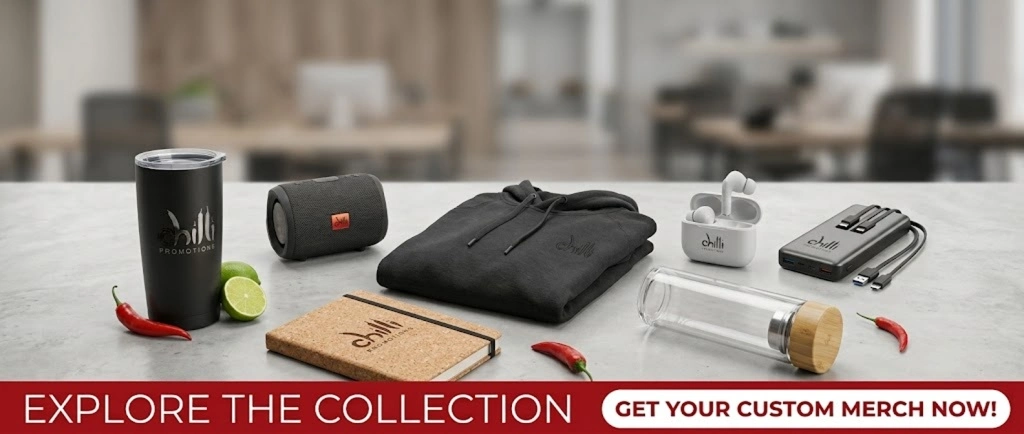
For universities specifically, that means support across the categories this article has covered: orientation packs designed for week-one impact, capsule collections built around calendar moments like homecoming or graduation, custom online merch stores that keep a campaign live long after the physical event ends, and sustainable product lines backed by real material documentation rather than a vague eco label. Chilli Promotions works from brief through sample approval to delivery, which removes the guesswork universities often face when scoping a supplier relationship for the first time.
If your team is planning its next orientation drop, capsule collection, or alumni campaign, start with Chilli Promotions’s promotional products for higher education page to see product categories mapped directly to campus use-cases, or request a quote to scope your next campaign.
Key takeaways for university merchandise programs
University merchandise drives engagement by combining psychological ownership, visible social identity signalling, and action-linked incentives into a single physical item.
| Point | Details |
|---|---|
| Ownership drives visibility | Items people own and display generate stronger belonging and more public advocacy than passive marketing. |
| Match category to moment | Apparel suits public visibility campaigns; drinkware and stationery suit daily-use, low-cost touchpoints. |
| Mix licensed and trend-led designs | Licensed basics build trust; non-licensed lifestyle drops capture trend-focused buyers. |
| Measure wear rate, not just units shipped | Track social mentions, event wear rate, and repeat store visits to prove real engagement lift. |
| Partner with a specialist supplier | Chilli Promotions supports universities from design brief through sample approval to sustainable, bulk-ready delivery. |
FAQ
Why is university merchandise important for engagement?
It converts belonging into something visible and portable. Students who identify with their university and own a branded item are measurably more likely to display it publicly, which research on university identification and purchase intent links directly to stronger loyalty and repeat buying.
What merchandise do Gen Z students actually want?
Gen Z students respond strongly to tech accessories, sustainable materials with verifiable certification, and limited-edition drops that feel scarce rather than mass-produced. A mixed portfolio of licensed basics and trend-led, non-licensed designs tends to perform best, based on research into apparel style and licensing preference.
What are the core categories in a university merchandise range?
Apparel, drinkware, bags, stationery, tech accessories, event giveaways, and sports merch each serve a different engagement goal, from long-term visibility (apparel) to daily habitual use (drinkware and stationery).
How do you measure whether university merchandise is actually working?
Track wear rate at events, social mentions tied to a campaign hashtag, repeat visits to a merch store, and attendance differences between cohorts that received an item and those that didn’t. A simple test group versus control group comparison over one term gives a clear read on real impact.
Should university merchandise always carry the official crest or logo?
Not always. Licensed crests perform best on staple basics like t-shirts and hoodies, where authenticity matters most, while non-licensed, lifestyle-first designs often perform better on trend-led or limited-edition items, according to studies on licensing status and apparel style.