For short runs and personalised pieces, digital printing is your go-to. For large paper runs, offset lithography wins on cost. For durable apparel at volume, screen printing or DTF (direct-to-film) are the practical standards. These are the types of printing methods that matter most for promotional and fabric work in Australia, and knowing which suits your material, run size and budget is the difference between a clean result and an expensive reprint.
Quick matches for common promo jobs:
- Business cards and brochures (500+): offset lithography for sharpest colour and lowest per-unit cost
- Custom T-shirts, bags, bulk apparel: screen printing for runs above 50 units; DTF or digital transfer for smaller or multi-colour runs
- Polyester drinkware and cushions: dye-sublimation for full-bleed, photo-quality results
- Branded pens, bottle caps, small irregular items: pad printing
- Signage, metal awards, rigid promos: UV/LED-UV printing
Chilli Promotions supplies custom-branded promotional products across Australia and New Zealand, working with clients to match the right print process to each product and run size.
Key takeaways
Matching your print method to substrate, run size and colour requirements upfront prevents the most common and costly errors in promotional and fabric production.
| Point | Details |
|---|---|
| Digital suits short runs | Under a few hundred units, digital printing offers lower setup cost and faster turnaround than plate-based methods. |
| Offset wins at volume | Offset lithography becomes more cost-effective as run sizes increase and delivers superior finish options for paper. |
| Screen printing needs volume | Screen printing is cost-competitive above 50 units and the clear choice for durable, high-volume apparel. |
| Sublimation requires polyester | Dye-sublimation bonds only with polyester or polymer-coated substrates; DTF is the alternative for cotton or dark fabrics. |
| Always request a strike-off | A physical sample on your chosen substrate is the single most effective way to avoid colour and compatibility errors. |
| Chilli Promotions | Supplies custom-branded promotional products across Australia and New Zealand, with sample strike-offs, eco-certified options and Pantone matching available. |
Table of Contents
- 1. How digital printing works and when it beats analogue
- 2. Why offset lithography still dominates high-volume paper print runs
- 3. Screen printing: the standard for durable apparel and promo items
- 4. Sublimation and dye-sublimation: full-colour photo effects on polyester
- 5. Flexographic and gravure printing: built for packaging and labels
- 6. UV and LED-UV printing: instant curing on rigid and speciality substrates
- 7. Pad printing and heat-transfer: marking small and awkward items
- 8. 3D printing: prototyping and bespoke components for promos
- 9. How to choose the right method for your promo or fabric project
- 10. What Australian buyers should check before ordering
- 11. A promotions specialist’s honest view on method selection
- Chilli Promotions: matched print methods, sustainable options, and real samples
- FAQ
1. How digital printing works and when it beats analogue
Digital printing sends artwork directly from a file to the print head, with no plates or screens involved. Inkjet printers deposit tiny droplets of liquid ink onto the substrate; laser (toner-based) printers fuse powdered toner with heat. Both eliminate the plate-making step that makes analogue methods expensive to set up.
Digital printing suits short runs, fast turnarounds and variable-data jobs — think personalised direct mail, event programmes, short-run posters and fabric strike-offs. Many Australian suppliers cite under a few hundred copies as the range where digital is clearly the more cost-effective choice. Above that threshold, setup-heavy methods start to compete on unit cost.
Colour on digital presses follows the CMYK subtractive colour model, which means what you see on screen (RGB) will not reproduce identically on press. Photo-grade inkjet on coated stock comes closest to photographic quality; toner-based digital works well on standard coated and uncoated papers. For fabric, digital inkjet printing allows small strike-offs before committing to a full run — a practical advantage for colour-critical branded apparel.
Typical lead times from Australian digital print suppliers range from a few business days for standard paper jobs, depending on complexity and finishing.
2. Why offset lithography still dominates high-volume paper print runs
Offset uses metal plates to transfer ink onto a rubber blanket, which then rolls the image onto the substrate. Each colour requires its own plate, so setup takes time and costs money. Once the press is running, though, unit costs drop steadily as volume climbs.
Offset becomes more cost-effective as run sizes increase and offers a wider range of specialty stocks and finishes than most digital presses can match. Typical applications include:
- Magazines, catalogues and annual reports
- High-volume business stationery and letterheads
- Premium brochures with spot UV, foiling or embossing
- Packaging for retail products
Colour fidelity is a genuine strength. Offset presses can print Pantone spot colours alongside CMYK, which matters when brand colour accuracy is non-negotiable. The trade-off is minimum run viability — short runs rarely justify the plate cost, and any artwork change requires new plates.
On the environmental side, modern offset presses use vegetable-based inks and waterless printing processes that reduce volatile organic compound (VOC) emissions, though coated stocks can complicate paper recyclability. Ask your supplier about their ink type and stock certification.
3. Screen printing: the standard for durable apparel and promo items
Screen printing pushes ink through a fine mesh stencil onto the substrate, one colour at a time. Each colour in the design requires a separate screen, so a four-colour logo means four screens, four setups and four passes through the press. That setup cost is why screen printing rewards volume.
For cotton garments, canvas bags and thick fabric banners, screen printing produces results that are hard to beat on durability and colour vibrancy. Plastisol inks sit on top of the fabric and cure under heat, creating a bold, opaque finish that holds up through repeated washing. Water-based inks penetrate the fibres for a softer hand feel and are a better choice for brands prioritising lower-impact production.
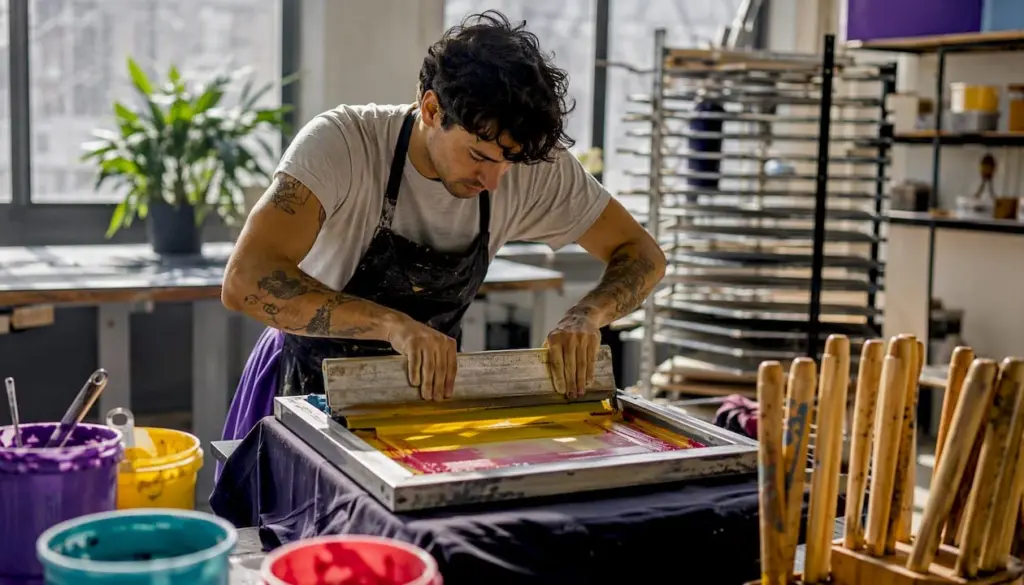
Run size guidance is straightforward: screen printing typically becomes cost-competitive above small to moderate quantities and is preferred for larger runs. Below that, setup costs per unit climb quickly, making digital transfer or DTF more practical.
Pro Tip: Always request a physical sample or strike-off before approving a full screen print run. Ink colour on a Pantone swatch and ink colour cured on a specific fabric can differ noticeably — especially on dark or textured substrates. Confirm your Pantone reference with the printer and ask for a wash test on apparel before production.
4. Sublimation and dye-sublimation: full-colour photo effects on polyester
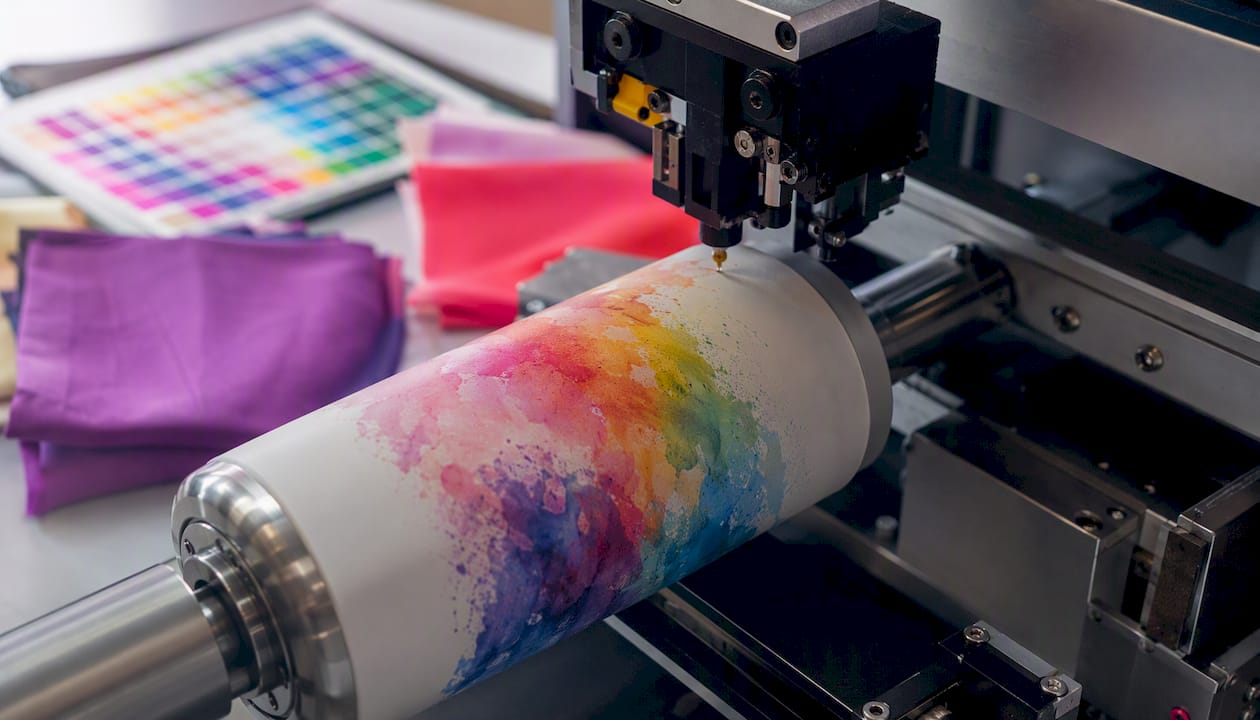
Dye-sublimation converts solid ink into a gas under heat and pressure, bonding the dye directly into polyester fibres or polymer-coated surfaces. The result is a print that is part of the material rather than sitting on top of it — no cracking, peeling or fading at the edges.
Best applications for sublimation in promotional work:
- Polyester apparel: jerseys, activewear, branded polo shirts
- Drinkware with polymer coating: mugs, travel cups, water bottles
- Soft furnishings: cushion covers, mouse pads, lanyards
- Full-bleed fabric panels and flags
The critical material constraint is that sublimation works on light-coloured polyester (or polymer-coated substrates) only. On cotton or dark fabrics, the dye has nothing to bond with and the colours appear washed out or do not transfer at all. This is the core distinction in any DTF vs sublimation comparison: DTF (direct-to-film) transfers a printed film layer onto the garment and works on cotton, dark fabrics and mixed fibres, while sublimation requires polyester and produces a softer, more integrated finish.
For branded drink bottles, confirm whether the substrate has a polymer coating before specifying sublimation — stainless steel without a coating will not accept the dye.
5. Flexographic and gravure printing: built for packaging and labels
Flexography uses flexible photopolymer plates wrapped around rotating cylinders to print at high speed onto rolls of substrate — corrugated cardboard, plastic film, paper bags and flexible packaging. The process suits any material that can be fed through a roll-to-roll press, which is why it dominates food and retail packaging.
Gravure takes a different approach: the image is engraved directly into a metal cylinder, which picks up ink and transfers it to the substrate. Setup costs are higher than flexo, but gravure delivers exceptional consistency over very long runs — millions of impressions with minimal quality variation. It is the method behind high-quality magazine covers, decorative laminates and premium flexible packaging.
For Australian businesses ordering custom packaging, a practical checklist to raise with your supplier:
- What ink system is used (water-based, UV-curable, solvent-based)?
- Is there a migration certificate for food-contact applications?
- What is the minimum order quantity and plate cost?
- Can the press handle your substrate weight and width?
Neither method suits short runs. Flexo becomes viable from a few thousand units; gravure typically requires tens of thousands. For smaller packaging runs, digital label printing is the practical alternative.
6. UV and LED-UV printing: instant curing on rigid and speciality substrates
UV printing cures ink instantly as it passes under an ultraviolet lamp (or LED array in LED-UV systems). Because the ink does not need to absorb into the substrate, UV printing works on materials that would reject conventional inks: glass, metal, acrylic, timber, ceramic tiles and rigid plastics.
Key use cases for promotional and point-of-sale work:
- Acrylic and glass awards with fine-detail logos
- Metal drinkware where sublimation is not an option
- Signage and display boards on rigid substrates
- Textured or embossed surfaces where ink adhesion is otherwise difficult
LED-UV systems run cooler than traditional UV lamps, which reduces heat distortion on thin or heat-sensitive substrates and lowers energy consumption. The trade-off is higher equipment and ink cost compared with standard digital printing, which flows through to per-unit pricing on smaller orders.
For Australian buyers, confirm with your supplier whether the UV inks used are rated for outdoor durability — some UV formulations are designed for indoor display only and will chalk or fade under direct sunlight. Lead times for UV flatbed printing typically run three to seven business days depending on substrate preparation and finishing.
7. Pad printing and heat-transfer: marking small and awkward items
Pad printing uses a silicone pad to pick up ink from an etched plate and press it onto the item’s surface. The pad’s flexibility lets it conform to curved, concave and irregular shapes — which is why it is the standard method for branded pens, lighters, golf balls, bottle caps and small plastic components. Colour registration is precise, but each colour requires a separate pass, so designs with more than two or three colours become expensive quickly.
Heat-transfer methods work differently. A design is printed onto a carrier (transfer paper or film), then applied to the product using heat and pressure. Vinyl heat-transfer cuts shapes from coloured film and welds them to fabric; digital heat-transfer prints full-colour artwork onto transfer paper for application to garments or hard goods. Both suit small runs where screen printing setup costs are not justified.
For giveaway items like branded phone cases, USB drives and small plastic components, pad printing remains the most cost-effective single-colour or two-colour option. For short-run apparel with photographic or gradient artwork, digital heat-transfer is a practical bridge between screen printing and full DTF production. Durability is lower than screen printing or sublimation — heat-transfer prints can crack or peel after repeated washing if the application temperature or pressure is not correctly calibrated.
8. 3D printing: prototyping and bespoke components for promos
Additive manufacturing builds objects layer by layer from digital files, using materials including PLA (polylactic acid, a plant-derived plastic), PETG, ABS and photopolymer resin. No tooling or moulds are required, which makes 3D printing uniquely suited to one-off and very small-batch production.
For promotional product work, the practical applications are narrow but genuinely useful:
- Prototype enclosures and product mockups before committing to injection moulding
- Custom display stands and point-of-sale fixtures in limited quantities
- Bespoke award components with complex geometry
- Mould masters for silicone or resin casting
Per-unit cost is high compared with any mass-production method, and throughput is slow — a single detailed object can take several hours to print. For mass giveaways, 3D printing is not viable. Where it earns its place is in the design validation stage: printing a prototype in PLA before ordering 5,000 injection-moulded units can prevent a costly tooling error.
Pro Tip: If you are developing a custom-shaped promotional product, budget for at least one 3D-printed prototype before finalising the mould brief. The cost of a prototype is trivial compared with the cost of correcting a mould.
9. How to choose the right method for your promo or fabric project
Work through these steps before briefing a supplier:
- Define your substrate. Is it cotton, polyester, coated paper, metal, plastic or something else? Substrate determines which methods are physically possible.
- Set your run size. Under 50 units: digital, heat-transfer or DTF. 50–500 units: screen printing, digital or sublimation depending on material. 500+ units: screen printing, offset or flexo depending on product type.
- Specify colour requirements. How many colours? Is Pantone matching required? Full-bleed photographic artwork? Each answer narrows the field.
- Confirm durability needs. Apparel that will be washed repeatedly needs screen printing, sublimation or DTF. Outdoor signage needs UV-rated inks. Food-contact packaging needs certified ink systems.
- Set your turnaround. Digital methods typically deliver in days; offset and screen printing need more lead time for setup and curing.
- Establish your budget shape. High setup, low unit cost (offset, screen, flexo) vs low setup, higher unit cost (digital, pad, heat-transfer). For promotional product planning, map this against your total order volume before committing.
Questions to ask every supplier before placing an order:
- What is your minimum order quantity for this method?
- Can you provide a physical strike-off or sample proof?
- Do you offer Pantone colour matching?
- For apparel: will you conduct a wash test before production?
- For food-contact packaging: do you hold ink migration certificates?
Red flags worth noting: a supplier who cannot provide a physical sample, cannot confirm substrate compatibility in writing, or cannot supply wash-test results for apparel is a risk. Artwork preparation also matters — merchandise design best practices consistently recommend supplying vector files (AI, EPS or PDF) with Pantone references rather than raster images, which lose resolution when scaled.
10. What Australian buyers should check before ordering
Lead times in Australia vary by method and location. Metropolitan suppliers (Sydney, Melbourne, Brisbane) typically offer faster turnaround on digital and screen printing than regional printers, though freight adds one to three business days for regional delivery. For time-sensitive campaigns, confirm production and freight lead times separately.
🌿 Sustainability considerations by method:
- Digital inkjet: water-based pigment inks are lower-impact than solvent-based; ask about ink certification
- Screen printing: water-based inks are preferable to plastisol for lower VOC output; confirm disposal practices
- Offset: vegetable-oil-based inks and FSC-certified stocks reduce environmental footprint
- Sublimation: no water waste in the transfer process, but polyester substrates have end-of-life considerations
- UV/LED-UV: LED systems use less energy than mercury-lamp UV; confirm whether inks are low-migration
For eco-friendly promotional products, the print method is only part of the sustainability picture. The substrate choice, ink system and end-of-life recyclability all contribute. Coated stocks, for example, can complicate paper recycling — ask your supplier whether the coating is aqueous (recyclable) or plastic-laminate (not recyclable in standard streams).
Regulatory practicalities for packaging: if your product will contact food or beverages, request a migration certificate from your supplier confirming the ink system complies with Australian food-contact standards. This applies to printed drinkware, food packaging and any item that may contact the mouth.
Action checklist before placing an order in Australia:
- ♻ Request a physical sample or strike-off on your chosen substrate
- 🔄 Confirm MOQ and whether carbon-offset options are available
- 🌿 Ask for ink type and any relevant safety or sustainability certifications
- Verify substrate compatibility in writing, not just verbally
Digital fabric printing suppliers commonly offer low minimums and no setup fees for online fabric orders, and recommend strike-offs for colour accuracy — particularly useful for first-time fabric runs or colour-critical branded textiles.
11. A promotions specialist’s honest view on method selection
Most print method decisions are simpler than they look, but the mistakes tend to cluster in the same places. Clients specify screen printing for a 30-unit run because it “sounds more professional,” then absorb setup costs that push the per-unit price well above what digital or DTF would have cost. Conversely, some buyers default to digital for a 2,000-unit apparel order and end up with slower throughput and higher total cost than screen printing would have delivered.
The heuristic worth keeping: match the method to the volume first, then check material compatibility, then confirm colour requirements. In that order. Colour matching is where the most expensive surprises happen — particularly when a brand colour sits outside the standard CMYK gamut and the brief does not specify a Pantone reference. A supplier who does not ask for a Pantone number on a colour-critical job is a supplier worth questioning.
Sustainability is increasingly a genuine procurement criterion, not just a marketing claim. Clients asking about sustainable promotional products are right to ask — and the answer involves the ink system, the substrate and the supplier’s own certifications, not just whether the product is made from recycled material.
The one piece of advice that saves the most money: order a strike-off. Every time. The cost is negligible; the cost of reprinting 500 garments because the colour was wrong is not.
Chilli Promotions: matched print methods, sustainable options, and real samples
Choosing the right print method is straightforward when you have a supplier who knows the substrate, the run size and the colour brief before production starts. Chilli Promotions has been manufacturing and supplying custom-branded promotional products across Australia and New Zealand since 2001, working with marketing teams, procurement managers and event organisers to match the right process to each product.
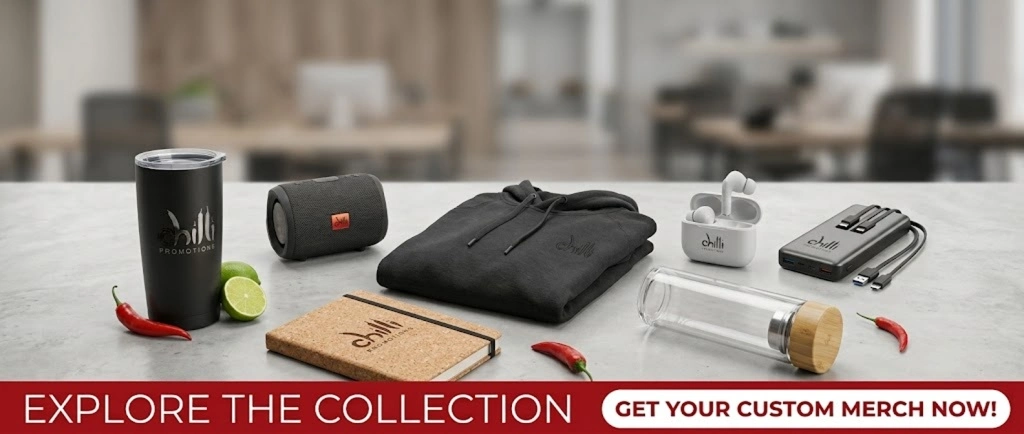
Whether you need screen-printed apparel for a large event, sublimation-branded drinkware, UV-printed awards or eco-certified merchandise with carbon-offset documentation, Chilli Promotions can provide physical samples and strike-offs before you commit to a full run. Sustainable ink and substrate options are available across the range, and the team can advise on Pantone matching, MOQ and lead times for your specific project.
Before you get in touch, prepare your artwork in vector format (AI, EPS or PDF), note your Pantone references, confirm your target run size and list your preferred substrates. Then browse the corporate giveaway range or go straight to the promotional products catalogue to request a quote.
FAQ
What are the main types of printing methods?
The most widely used commercial printing methods are digital (inkjet and laser), offset lithography, screen printing, dye-sublimation, flexographic, gravure, UV/LED-UV, pad printing, heat-transfer and 3D printing. Each suits different substrates, run sizes and colour requirements.
What are the three most common printing methods for promotional products?
Screen printing, digital printing and dye-sublimation cover the majority of promotional product applications in Australia. Screen printing suits high-volume apparel; digital suits short runs and variable artwork; sublimation suits polyester drinkware and fabric with full-colour photo effects.
What is the difference between DTF and sublimation?
DTF (direct-to-film) prints artwork onto a film that is heat-pressed onto the garment and works on cotton, dark fabrics and mixed fibres. Dye-sublimation bonds dye directly into the substrate and requires light-coloured polyester or a polymer coating to work correctly.
Which print method is best for small runs?
Digital printing (inkjet or laser) is generally the most cost-effective choice for runs under a few hundred units, as it has no plate or screen setup costs and can turn around jobs quickly. DTF and heat-transfer are also practical for small apparel runs.
When should I request a strike-off before production?
Request a strike-off for any colour-critical job, any first-time fabric or substrate run, and any apparel order where wash durability matters. A physical sample on your actual substrate is the most reliable way to confirm colour accuracy and adhesion before committing to full production.