A pre-production sample (PPS) is the production-intent, decorated unit you approve before releasing the production deposit. It’s made on the actual tooling, with the actual materials and the actual decoration method the factory will use for your full run. Approve it, and you’ve created a legally useful golden sample that becomes the benchmark for every unit that follows. Skip it, and you’re gambling thousands of dollars on items that may arrive the wrong colour, the wrong size, or decorated incorrectly.
For high-risk or custom promo items, PPS approval should always precede any production deposit. Here’s the quick distinction that matters:
- Digital proofs confirm artwork placement and colour intent on screen, nothing more.
- Blank samples confirm the base product’s fit, feel, and construction, without decoration.
- A PPS confirms the whole package — material, decoration, tolerances, and packaging, produced the way your bulk order will be produced.
TL;DR:
- A pre-production sample is produced with final tooling, materials, and decoration, serving as the legal benchmark for all future units.
- You should request a PPS mainly for custom colors, complex assemblies, new suppliers, or safety-related items, not for standard stock.
- Proper approval requires a detailed checklist, signed record, photographs, and referencing in the purchase order to protect against quality issues.
- PPS costs usually equal two to five units at production cost and take 10 to 20 days, including review and courier time.
- Managing sample approval processes through a specialist like Chilli Promotions can reduce administrative burden and enhance quality control.
Table of Contents
- What is a pre-production sample, and how does it differ from other sample types?
- When do you actually need a pre-production sample?
- What should be on your pre-production sample approval checklist?
- What do sample rounds cost and how long do they take?
- How do you manage suppliers and spot red flags during sampling?
- How does Chilli Promotions manage samples and quality on promo campaigns?
- What are the legal and IP considerations when you share samples?
- What goes wrong with pre-production samples, and how do you fix it?
- How do pre-production samples affect your launch timeline?
- Where does a documented PPS process actually save a launch?
- How should you communicate PPS feedback and revisions?
- Editorial take: the checklist matters more than the sample itself
- Get your samples managed properly, without chasing suppliers yourself
- Key Takeaways
- FAQ
What is a pre-production sample, and how does it differ from other sample types?
Marketing and procurement teams often use “sample” as a catch-all term, and that’s where trouble starts. Different sample types serve different jobs in the product development timeline, and asking a supplier for the wrong one wastes a review round you didn’t need to lose.
- Prototype — validates design intent early, often built with substitute materials or a 3D print rather than final tooling. Useful for concept sign-off, not for production accuracy.
- Blank sample (fit sample) — confirms the undecorated product’s dimensions, materials, and construction match spec, before any branding is applied.
- Decorated sample — shows how your logo or design looks once applied, useful for checking colour matching and placement, but not always made on final production tooling.
- Pre-production sample (PPS) — the production-intent unit, made with final tooling, final materials, and the confirmed decoration method. This is the sample that validates the entire production process, not just the design.
- TOP pull (Top of Production) — a random sample pulled once mass production has actually started, checked against the PPS to confirm consistency.
A PPS becomes a golden sample the moment it’s signed off. From that point, it’s kept by both parties as the legal and technical reference point for every unit produced afterwards.
When do you actually need a pre-production sample?
Not every promo order justifies the cost and time of a full PPS round. The decision comes down to risk, not habit.
Request a PPS when you’re dealing with custom Pantone colours, a new or unproven supplier, complex assembly (multi-part items, electronics, zippers, closures), safety-relevant products (drinkware, kids’ items, anything worn), or an order value large enough that a reprint would hurt. For many standard, repeat-stock items, a blank sample paired with a digital proof is a perfectly adequate, cheaper alternative.
| Promo category | Recommended sample approach |
|---|---|
| Repeat stock pens, notepads | Digital proof only |
| Standard tote bags, apparel (existing supplier) | Blank sample + digital proof |
| Custom-colour drink bottles | PPS |
| New supplier, any product | PPS |
| Electronics, tech accessories | PPS + functional test |
Pro Tip: Keep a simple risk register for every promo campaign — new supplier, new colour, or new construction each add one point. Two points or more means you request a PPS, no exceptions.
What should be on your pre-production sample approval checklist?

An approval checklist turns “looks good to me” into a defensible, recordable decision tied directly to your purchase order. Without one, disputes over quality later have nothing concrete to point back to.
Work through these categories on every PPS review:
- Dimensions — measure against tolerances (e.g. bottle height 250mm ±2mm, strap width 25mm ±1mm).
- Material spec — confirm grade, weight (GSM for fabric, gauge for plastics), and Pantone or CMYK colour code against the approved brief.
- Construction and decoration — check stitching, seam strength, print registration, embroidery density, and edge finishing.
- Functional testing — lids seal, zips run smoothly, USB ports connect, batteries charge.
- Packaging and labelling — barcode placement, care labels, compliance markings, individual poly bags if specified.
- Defect thresholds — agree in advance what’s acceptable (minor cosmetic marks) versus what triggers rejection (colour shift, structural failure).
Record the approval properly: assign a sample ID, photograph every angle including close-ups of decoration and labelling, name the approver, date the sign-off, and reference that sample ID directly in the purchase order. This documented approval isn’t paperwork for its own sake. A pre-production sample validates that the factory’s production system can actually execute the specification, and it becomes the binding quality benchmark the moment production starts. If a dispute arises later over colour or material substitution, this is the record you’ll be relying on, and it’s exactly the kind of documentation covered in our promotional product checklist for Australian businesses.
What do sample rounds cost and how long do they take?
Budgeting for samples is often the first thing procurement teams skip, and it’s the first thing that comes back to bite them when a launch date slips.
- Prototype samples typically run $50–$300 for soft goods, often free or low-cost for simple items.
- PPS usually costs the equivalent of 2 to 5 production units at cost, and many suppliers will credit this against a confirmed order — get that credit term in writing before you pay.
- Salesman samples (for internal pitching or client approval) can run 2 to 3 times unit cost, since they’re often produced outside the main production run.
On timing, proto rounds typically take 7 to 21 days, revision rounds 7 to 14 days each, and a PPS 10 to 20 days once materials are confirmed. Add 3 to 5 business days on top for courier transit and your own internal review. A supplier willing to absorb sample cost against a larger order is often more willing to negotiate on minimum order quantity too, so treat sample investment as a genuine negotiating chip, not just a cost centre.
How do you manage suppliers and spot red flags during sampling?
Getting the commercial terms right around sampling protects you long before any dispute over a finished order.
Negotiate sample credits upfront: ask that PPS cost be deducted from the first production invoice once you confirm the order, and get this in the purchase agreement, not a verbal promise. Require that the contract explicitly reference the approved PPS by serial number or batch date, so there’s no ambiguity later about which sample is the benchmark. Vague requests to “send a sample” are a common trap, because suppliers may provide an earlier-stage sample that was never intended as a production benchmark, leaving you with nothing solid to compare bulk production against.
Watch for these red flags:
- A supplier refuses to produce a PPS before you pay a deposit.
- Minimum order quantity changes without a stated reason after sampling.
- The supplier can’t or won’t provide batch material certificates.
Pro Tip: If a factory won’t produce a PPS before deposit, treat it as a signal about either their capability or their willingness to be held accountable. Walk before you pay.
How does Chilli Promotions manage samples and quality on promo campaigns?
Chilli Promotions documents every PPS approval against the purchase order, with photographs, sample IDs, and sign-off dates kept as part of the production record, not an afterthought. The golden sample becomes the working reference our quality control checks against right through to dispatch.
- Sample fees and courier costs are quoted upfront, not buried in a later invoice.
- Decoration checks follow the specifics covered in our guide to print methods and their limits.
- Colour consistency across a full order range is tracked using the principles in our colour in branded products guide.
What are the legal and IP considerations when you share samples?
Sharing a pre-production sample with a supplier, or receiving one back, isn’t a legally neutral act. Your artwork, logo, and any proprietary design elements are exposed to a third party the moment a sample is produced, and that exposure needs managing in writing, not assumed.
Before any sample round begins, your supplier agreement should state clearly who owns the artwork and tooling, and what the supplier can and can’t do with your design once the relationship ends. Tooling built specifically for your decoration (custom moulds, screens, or dies) is a common flashpoint: without a clause specifying ownership, a supplier may treat that tooling as theirs to reuse or sell on to a competitor. Manufacturing agreements should explicitly define sample expectations and ownership terms, because a verbal understanding gives you nothing to enforce if a dispute arises.
Non-disclosure agreements matter more at sampling stage than most procurement teams realise, particularly with a new supplier or when the product includes anything not yet publicly launched. If your PPS reveals an unreleased campaign, a limited-edition colourway, or a sponsorship tie-in, put an NDA in place before the first sample ships, not after you’ve noticed the design has leaked.
Retain your golden sample as evidence. If a dispute over quality or IP ever escalates, the physically approved PPS, with its sign-off record, photographs, and date, is far stronger evidence than an email thread or a verbal agreement. Keep it in a controlled location, not in a staff member’s desk drawer, and note its storage location in your supplier contract.
What goes wrong with pre-production samples, and how do you fix it?
Most PPS problems fall into a handful of predictable categories, and most have a straightforward fix if you catch them at sample stage rather than after 5,000 units have shipped.
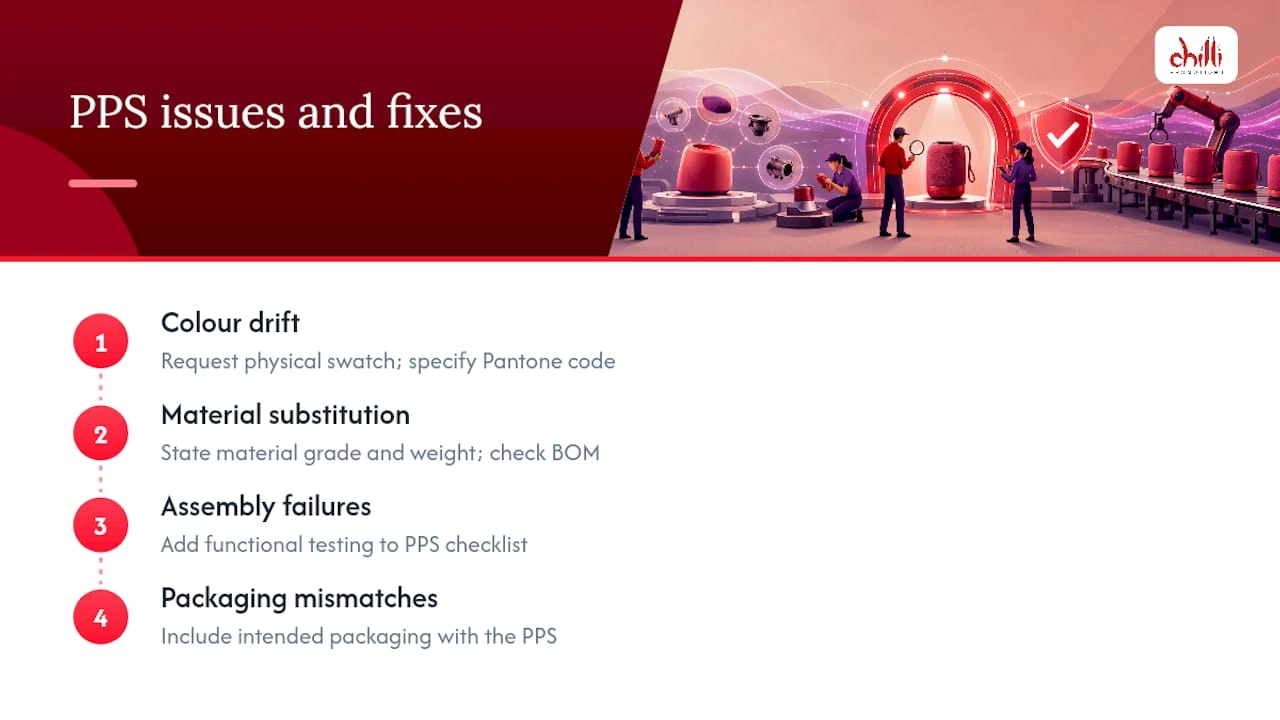
Colour drift is the most common issue. A Pantone match that looked right on a digital proof often shifts once applied to a different substrate, particularly on fabric versus hard plastic. Fix: request a physical colour swatch alongside the PPS, not just a screen proof, and specify the Pantone code in the contract rather than a verbal “make it look like this”.
Material substitution happens when a factory swaps a specified material for a cheaper equivalent, often without flagging it. Fix: state material grade and weight explicitly in your spec sheet and cross-check the PPS against a bill of materials, a step independent inspection processes are specifically designed to catch.
Assembly or functional failures (zips that jam, lids that leak) tend to surface only under real use, not visual inspection. Fix: build functional testing into your checklist rather than treating the PPS review as a purely visual exercise.
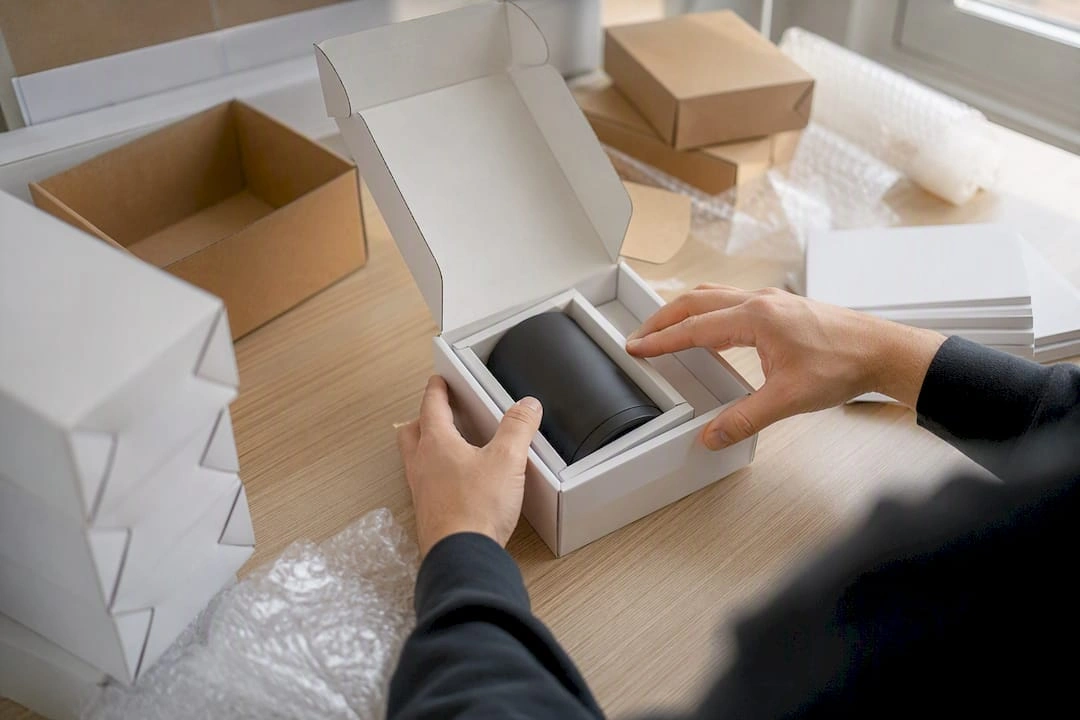
Packaging mismatches are easy to overlook because attention naturally goes to the product itself. Fix: request the PPS with its intended retail or bulk packaging included, not shipped loose.
When a defect does surface, document it against your approval checklist immediately, photograph the specific issue, and request a revised sample rather than a verbal assurance that “it’ll be fixed in production.” A second review round costs days, not weeks, and it’s far cheaper than a container of stock you can’t use.
How do pre-production samples affect your launch timeline?
A PPS round adds time upfront, and that’s precisely the point. Building 10 to 20 days for PPS production, plus review time, into your campaign schedule feels like a delay until you compare it against the alternative: discovering a fault after a bulk order has already left the factory.
Campaigns that skip PPS approval to save two or three weeks often lose far more time later, dealing with returns, re-decoration, or an emergency reorder against a launch date that’s already public. A conference giveaway, a sponsorship activation, or a new product launch tied to a fixed date has no slack for that kind of failure. Building the PPS review window into your critical path, rather than treating it as an optional extra, is what actually protects your launch date.
The knock-on effect works the other way too. A clean, fast PPS approval, where the first sample nails the brief, can compress your overall timeline because it removes the need for a second or third revision round. Suppliers who consistently deliver an accurate PPS on the first attempt are worth prioritising for time-sensitive campaigns specifically because they remove that risk from your schedule.
Where does a documented PPS process actually save a launch?
Consider a national retail chain ordering 3,000 branded drink bottles for an in-store loyalty campaign timed to a fixed launch date. The digital proof looked correct, and the blank sample confirmed capacity and lid function. The PPS, however, revealed the screen-printed logo was applying with visible registration drift on the bottle’s curved surface, something no flat digital proof could have shown.
Because the fault was caught at PPS stage, the supplier adjusted the print jig and resubmitted a corrected sample within the review window, well ahead of the production deadline. Had the fault surfaced in the bulk run instead, the retailer would have been looking at reprinting or scrapping a meaningful portion of a 3,000-unit order, days before a launch date already locked into store marketing.
A second, smaller example: a university ordering custom tote bags for an orientation event required a specific cotton weight for durability. The PPS showed a lighter fabric than specified, caught through a simple weight check against the material spec, well before 2,000 bags were cut and sewn. Both cases share the same lesson: the value of a PPS isn’t in the sample itself, it’s in what it prevents downstream, and that value compounds with order size.
How should you communicate PPS feedback and revisions?
Vague feedback produces vague revisions, and that’s where second and third sample rounds start piling up unnecessarily. The fix is specificity, tied directly to your approval checklist rather than general impressions.
Structure every round of feedback the same way: reference the specific checklist item (“logo placement, front panel, per approval checklist item 4”), state the measured deviation (“logo sits 8mm left of the approved 40mm centre mark”), and specify the exact correction required (“reposition to centre, ±2mm tolerance”). Avoid subjective language like “looks off” or “doesn’t feel right,” since it leaves the supplier guessing and increases the odds of a wasted revision round.
Put feedback in writing, always, even when a phone call or video walkthrough happens first. Attach photos with annotations showing exactly where the issue sits, and set a clear deadline for the revised sample. Where a revision genuinely can’t meet the original spec (a colour that simply won’t hold on a particular fabric, for instance), get that limitation documented in writing too, so it doesn’t resurface as a dispute after bulk production.
Editorial take: the checklist matters more than the sample itself
The conventional advice on pre-production samples treats the sample as the goal, approve it and move on. That’s backwards. The sample is only as useful as the checklist behind it, and most procurement failures trace back to an approval process that was too loose, not a sample that was too flawed.
What’s overrated: treating PPS approval as a single yes/no gate. What actually works is treating it as a documentation exercise, tolerances recorded, sample ID logged, photos taken, approver named, all tied to the purchase order. That record is what protects you if bulk production drifts from what you approved.
What’s underrated: the discipline of matching sample type to risk. Not every order needs the time and cost of a full PPS, and teams that request one reflexively for low-risk repeat items waste budget better spent scrutinising the genuinely risky orders, new suppliers, custom colours, complex assembly. Prioritise the checklist rigour on the orders where a fault would actually hurt, and let simpler items move through faster, cheaper verification instead.
— Allissar Tawadros
Get your samples managed properly, without chasing suppliers yourself
Chasing sample approvals across multiple suppliers, tracking sign-offs, and cross-checking tolerances against a purchase order is exactly the kind of administrative load that pulls marketing and procurement teams away from the campaign itself. Chilli Promotions runs that whole process for you, sample requests, documented PPS approval records, and quality control checks tied directly to the golden sample, so you’re reviewing a finished decision, not managing a supplier back and forth.
When Chilli Promotions manages your samples, you get a recorded approval trail (sample ID, photos, sign-off date) integrated into our own QC process before your order ever reaches bulk production, along with clear sample fees and courier costs quoted upfront. If you’re planning a campaign that needs custom colours, a new product line, or simply a supplier you can trust to get the PPS right the first time, browse our promotional products range and request a quote to get your sample process started.
Key Takeaways
A signed-off pre-production sample, made with final tooling and materials, is the legal and technical benchmark every bulk order must be measured against.
| Point | Details |
|---|---|
| PPS precedes deposit | Never release a production deposit for custom or high-risk items before PPS sign-off. |
| Match sample type to risk | Use blank samples and digital proofs for low-risk stock items; reserve PPS for custom colours or new suppliers. |
| Budget realistically | Expect PPS to cost 2 to 5 production units and take 10 to 20 days once materials are confirmed. |
| Document every approval | Record sample ID, photos, approver, and date, and reference it in the purchase order. |
| Chilli Promotions manages the process | Chilli Promotions documents PPS approvals and ties them into its own QC checks before bulk production begins. |
FAQ
What is a pre-production sample?
A pre-production sample (PPS) is a production-intent unit made using the final tooling, materials, and decoration method that will be used for the full order, serving as the approved benchmark for mass production.
What are some examples of pre-production samples?
Examples include a screen-printed drink bottle made with the actual production mould and ink, a custom tote bag sewn from the exact fabric weight specified in the brief, or a branded USB drive assembled on final tooling with functional ports tested.
What documents matter most in the pre-production approval process?
The core documents are the signed approval checklist, dated photographs of the sample, the purchase order referencing the sample ID, the material specification sheet, and any written sample-credit agreement with the supplier.
What does “PP sample” mean?
“PP sample” is shorthand for pre-production sample, the same production-intent unit referred to as a PPS, used to confirm the factory can meet spec before bulk manufacturing begins.
Does Chilli Promotions manage sample approval for promotional orders?
Yes, Chilli Promotions documents PPS approvals with sample IDs, photographs, and sign-off records, and integrates the golden sample into its own quality control checks ahead of bulk production.