Most staff gifts under $300 (GST inclusive) per person are exempt from Fringe Benefits Tax under the minor benefits exemption, provided the gift is infrequent and irregular. That test decides whether a Christmas hamper or gift voucher triggers Fringe Benefits Tax or not.
Before you approve any staff gift or event this year, take these three steps:
- Confirm the cost per person — get the GST-inclusive total for each individual gift, not the whole order.
- Classify the benefit — decide whether it’s a non-entertainment gift (hamper, merchandise, voucher) or entertainment (event tickets, off-site parties).
- Record the context — note the date, occasion, and whether this is a one-off or part of a recurring pattern.
The Australian Taxation Office is the final word on how these rules apply to your business, and if you’re ever audited, you’ll need records to back up your position.
Pro Tip: Keep a simple spreadsheet logging every staff gift’s cost, date, and occasion. It takes five minutes per entry and saves hours if the ATO ever asks you to substantiate an exemption claim.
Key Takeaways
Most staff gifts under $300 (GST inclusive) per person qualify for the FBT minor benefits exemption, provided they’re infrequent, non-entertainment, and properly documented.
| Point | Details |
|---|---|
| Know the $300 test | Applies per benefit, per person, GST inclusive, not as an annual allowance. |
| Classify before you buy | Non-entertainment gifts (hampers, merchandise, vouchers) get better tax treatment than entertainment. |
| Watch the pattern | Regular, predictable gifting can void the exemption even if each gift is under $300. |
| Separate salary packaging | Benefits provided through salary sacrifice generally don’t qualify for the minor benefits exemption. |
| Document everything | Keep cost, recipient, date, occasion, and invoices for five years in case of audit. |
| Choose compliant suppliers | Chilli Promotions supplies branded merchandise and hampers designed to sit clearly within non-entertainment gift categories. |
This article is general information, not a substitute for advice from a qualified financial advisor. Consult a qualified financial professional about your own circumstances before acting on anything here.
Table of Contents
- What counts as a gift for FBT staff gifts purposes?
- How does the minor benefits exemption actually work?
- Are staff Christmas parties and meals FBT exempt?
- What tax and GST outcomes follow an FBT decision?
- A step-by-step checklist before you approve any gift
- Why branded promotional gifts are the safer tax choice
- How do you value a gift that goes over $300?
- Do gift vouchers count differently for FBT?
- Do FBT rules change under salary packaging arrangements?
- What records do you need if the ATO audits your gifts?
- Where the conventional advice on FBT staff gifts falls short
- Where to find gifts that keep you on the right side of FBT
- FAQ
What counts as a gift for FBT staff gifts purposes?
The ATO splits staff benefits into two buckets, and which one your gift lands in changes the tax outcome completely. Non-entertainment gifts include branded merchandise, hampers, wine, flowers, and gift vouchers redeemable for goods. Entertainment includes tickets to concerts or sporting events, holidays, and meals classified under the meal entertainment rules.
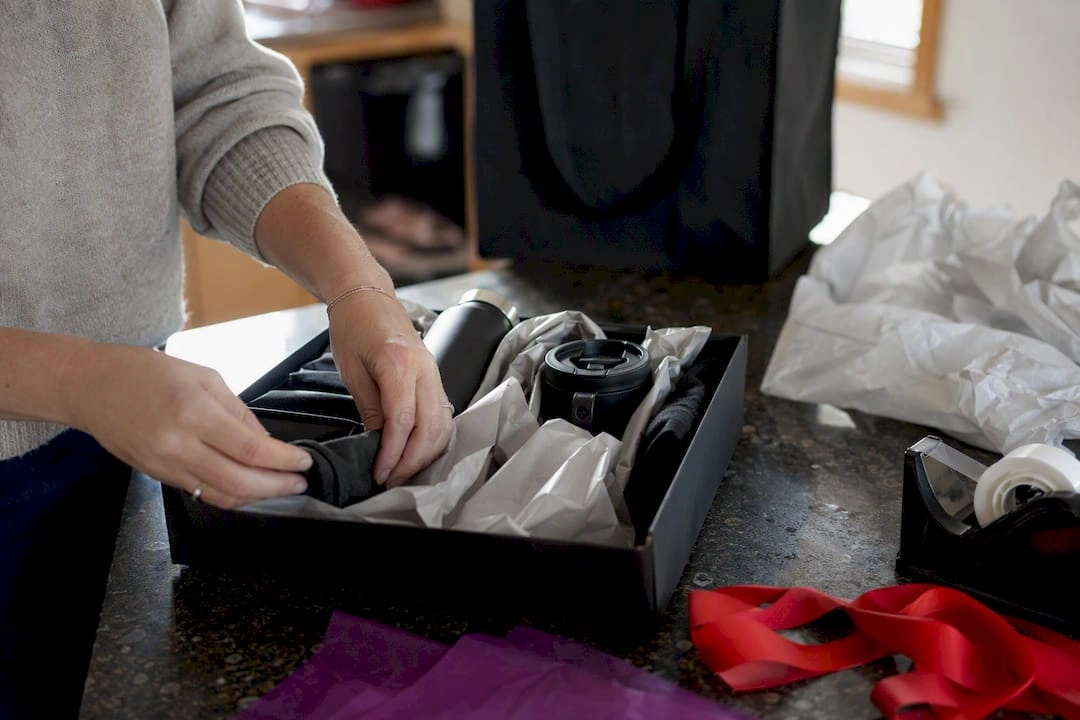
This distinction matters because non-entertainment gifts under $300 are typically deductible and carry GST credits, while entertainment benefits exempted as minor benefits usually forfeit both. Get the classification wrong and you could lose a deduction you were entitled to, or worse, understate an FBT liability.
| Benefit type | Example | Typical tax outcome (under $300) |
|---|---|---|
| Non-entertainment gift | Hamper, branded merchandise, gift voucher | FBT exempt, tax deductible, GST credit available |
| Entertainment | Concert tickets, holiday, off-site meal | May be FBT exempt as minor benefit, but generally no deduction or GST credit |
| Mixed event | Christmas party with gifts | Assessed separately, each component tested individually |
- Non-entertainment gifts are the more tax-effective option for HR teams wanting a deduction alongside the FBT exemption.
- Entertainment benefits can still dodge FBT under the minor benefits rule, but you’ll usually pay for that exemption in lost GST credits and deductions.
How does the minor benefits exemption actually work?
Section 58P of the Fringe Benefits Tax Assessment Act sets the legal test, and it comes down to notional taxable value: less than $300 (GST inclusive), assessed per benefit, per employee. That’s not an annual allowance you can spend down. It’s a threshold applied fresh to each individual gift.
Beyond the dollar figure, the Commissioner weighs whether it would be “unreasonable” to treat the benefit as a fringe benefit. TR 2007/12 sets out the criteria: how often similar benefits are provided, the total value of associated benefits, whether the gift arose from a salary sacrifice arrangement, and how difficult it would be to value and record the benefit precisely.
A $250 Christmas hamper given once a year to each staff member sits comfortably inside the exemption: it’s under $300, infrequent, and unconnected to salary packaging. Give that same $250 hamper monthly, though, and the ATO can aggregate the pattern and disqualify the exemption entirely, because regular, predictable gifting undermines the “infrequent and irregular” test.
Pro Tip: Note the reason for each gift (“end-of-year appreciation”, “farewell gift”, “birthday”) rather than just the amount. A documented, varied rationale is stronger evidence of irregularity than a bare dollar figure on its own.
Are staff Christmas parties and meals FBT exempt?
Food and drink provided to employees on business premises during a working day is generally exempt from Fringe Benefits Tax, subject to specific restrictions. It covers current employees only and doesn’t automatically extend to partners, clients, or off-site venues.
- On-premises lunch for staff on a Tuesday: exempt, no dollar cap.
- Off-site Christmas party for staff and partners: assessed as a minor benefit, meaning the $300 per-person test applies to each attendee.
- Taxi travel home from an off-site party: treated as a separate benefit, tested against the same $300 threshold.
An office lunch on business premises costs nothing in FBT no matter the spend. Move that same celebration to a restaurant and invite partners along, and the ATO’s own worked scenarios show each person’s share needs to stay under $300, or FBT applies to the whole benefit, not just the excess.
What tax and GST outcomes follow an FBT decision?
Getting the classification right pays off twice: once through the FBT exemption, and again through deductions and GST credits. Non-entertainment gifts under $300 are generally deductible and eligible for GST credits. Entertainment benefits exempted under the minor benefits rule usually miss out on both, because the same exemption that removes the FBT liability also removes the deduction.
When a gift exceeds $300 and no exemption applies, FBT is calculated at 47% on the grossed-up value of the benefit, using a gross-up factor of 2.0802 for benefits where GST credits are claimable. A $400 gift can end up costing considerably more once grossed up, which is exactly why most businesses stay under the threshold deliberately rather than by accident.
Keep these records for every gift or event:
- Cost per item or per person, GST inclusive.
- Recipient name and role.
- Date and stated occasion.
- Evidence the gift was a one-off, not a recurring arrangement.
- Supplier invoices and any associated event costs (venue, transport, catering).
- Store these records alongside your annual FBT return working papers.
- Review your gifting calendar each quarter to catch any pattern building up before it becomes a compliance problem.
A step-by-step checklist before you approve any gift
Run every proposed gift or event through this sequence before signing off:
- Classify it. Decide if it’s a non-entertainment gift or entertainment, and estimate the GST-inclusive notional value.
- Check the pattern. Is this infrequent and irregular, or does it match something given last month or last quarter?
- Confirm the attendee list. Employees only, or does it include associates and clients? Separate any party costs from the gift itself.
- Determine the tax treatment. Exempt or FBT payable, and what that means for your deduction and GST credit position.
Watch for these red flags during procurement:
- The same gift repeated on a schedule (birthdays, monthly milestones) without variation.
- Gifts delivered through salary packaging or salary sacrifice arrangements, which fall outside the minor benefits exemption regardless of value.
- Combined costs for a gift plus an associated event creeping toward or past $300 per person.
Why branded promotional gifts are the safer tax choice
Tangible branded items, whether that’s drinkware, apparel, or a hamper, sit clearly on the non-entertainment side of the line, which makes classification straightforward and defensible if the ATO ever asks — making promotional merchandise trends and planning a valuable reference for HR teams. Event tickets and travel vouchers invite a harder conversation about whether they count as entertainment, so if a tax-effective outcome matters to you, keep the gift physical and practical.
Pro Tip: If you’re deciding between a $280 gift voucher for a retailer and a $280 experience voucher, pick the retail voucher. It’s clearly non-entertainment and keeps your deduction and GST credit intact.
- Branded merchandise and hampers are easy to value and document for the $300 test.
- Physical gifts avoid the meal entertainment and event valuation calculations that complicate tickets and travel.
- Consistent, well-documented categories make your approach to merchandise in reward programs easier to defend at audit time.
Chilli Promotions supplies branded promotional products and corporate hampers built with these compliance checks in mind, giving HR teams a straightforward, non-entertainment option for staff gifting.
How do you value a gift that goes over $300?
Once a gift’s notional taxable value hits $300 or more, the minor benefits exemption is off the table and you need a defensible valuation method. The starting point is market value: what would this item cost if bought at arm’s length from a retailer on the date it was provided? For a branded hamper, that’s the retail price of its contents plus any assembly or delivery cost, not your negotiated bulk-order rate.
The ATO’s guidance on assessing entertainment-related benefits sets out actual value and meal entertainment calculation methods for benefits involving food, drink, or recreation. For straightforward physical gifts, the simpler approach is generally the supplier invoice, provided it reflects a genuine market price rather than an internal cost estimate.
Two traps catch employers out here. First, using your wholesale or bulk-discount cost instead of retail market value understates the benefit and can leave you short if audited. Second, splitting a single gift into smaller components to dodge the threshold, such as billing a $350 hamper as a $290 hamper plus a $60 card, doesn’t work. The ATO looks at the substance of what was actually provided as one benefit, not how the invoice is itemised.
If you’re unsure whether a gift will land above or below $300 once GST and delivery are factored in, get a written quote before ordering. That figure becomes part of your audit trail regardless of which side of the threshold you land on, and it removes any guesswork about which valuation method applies when tax time comes around.
Do gift vouchers count differently for FBT?
Gift vouchers are treated as property fringe benefits, and the same $300 minor benefits test applies to them in exactly the same way it applies to a physical hamper or bottle of wine. A $250 department store voucher given once a year, per employee, sits inside the exemption on the same terms as any other non-entertainment gift.
Where vouchers get complicated is redemption flexibility. A voucher redeemable for goods and services generally stays classified as non-entertainment. But a voucher specifically for a restaurant meal, a show, or an experience-based redemption can tip into entertainment, which changes both the FBT test applied and, if exempt, whether you keep the deduction and GST credit.
Frequency also bites vouchers harder than most gifts, because vouchers are easy to issue repeatedly without much administrative friction. A $50 voucher handed out every month to recognise good performance might look harmless individually, but twelve of them in a year builds a pattern the ATO can treat as one aggregated, non-exempt benefit rather than twelve separate minor ones. If your recognition program relies on vouchers, space them out and vary the occasion, rather than running them on a fixed monthly cycle.
Keep the voucher’s face value, GST-inclusive, as your notional taxable value for testing purposes, and retain the purchase receipt or statement showing the denomination and date issued.
Do FBT rules change under salary packaging arrangements?
Salary packaging changes the FBT analysis in one crucial way: the minor benefits exemption generally does not apply to benefits provided under a salary sacrifice arrangement, regardless of how small the cost is. If an employee agrees to forgo salary in exchange for a gift or benefit, that arrangement typically removes the “infrequent and irregular, low-value” reasoning the exemption relies on, because the benefit was negotiated and expected rather than a genuine one-off gesture from the employer.
This distinction trips up businesses that run flexible benefits programs alongside standard staff gifting. A $250 hamper given at the employer’s discretion at Christmas is a strong candidate for exemption. The same $250 hamper offered as one menu option within a salary packaging platform is a different beast entirely, and it’s far more likely to attract FBT because the exemption’s underlying logic, that this is a small, spontaneous, employer-initiated gesture, no longer holds.
If your business offers salary packaging, keep genuine discretionary staff gifts entirely separate from anything an employee can select or negotiate through that platform. Document which category each benefit falls into at the point it’s provided, not retrospectively at FBT return time. Where you’re unsure whether a benefit sits inside a packaging arrangement, treat it as though FBT applies and get advice before assuming an exemption, because getting this wrong on a program-wide basis compounds the liability across every participating employee.
What records do you need if the ATO audits your gifts?
An ATO audit tests whether your paperwork actually supports the exemption you claimed, not just whether the gift itself was reasonable. The burden sits with the employer to demonstrate that a benefit met the minor benefits criteria, so incomplete records can turn a legitimately exempt gift into a disputed liability simply because you can’t prove the facts.

At minimum, maintain a record for every gift or event that shows the GST-inclusive cost, the recipient, the date provided, and the stated occasion or reason. Keep the supplier invoice or receipt showing actual market value, not an internal estimate. For anything assessed against the “unreasonable to treat as a fringe benefit” test, note why the gift was infrequent, such as a comparison against your gifting history for that employee over the previous twelve months.
For events, keep a separate breakdown of attendees, distinguishing employees from associates and clients, since each attendee’s per-person cost is tested individually. Retain venue invoices, catering costs, and transport arrangements as distinct line items rather than one lump sum, because an auditor will want to see how you arrived at the per-person figure used to justify the exemption.
Hold these records for the standard five-year period the ATO expects for tax records generally. A simple annual gifting register, updated as each gift is approved rather than reconstructed later, is the single most effective piece of evidence you can produce if a return is queried.
Where the conventional advice on FBT staff gifts falls short
Most guides treat the $300 threshold as the whole story, and that’s where a lot of businesses get into trouble. The dollar figure is the easy part. What actually catches employers out is the frequency test, because it’s judged on pattern, not on any single transaction, and plenty of well-meaning recognition programs fail it without anyone noticing until an audit forces the question.
The gap I keep seeing is between businesses that document as they go and businesses that reconstruct their reasoning after the fact. A $280 hamper given once a year needs almost no justification if it’s logged at the time. The same hamper given quarterly needs a genuine argument for why it’s still irregular, and that argument is far weaker when it’s written six months later than when it’s written on the day.
If you take one thing from the rules covered here, prioritise separating your gift categories before you plan your gifting calendar for the year. Decide now which gifts are discretionary one-offs, which sit inside recognition programs, and which touch salary packaging. That single act of categorisation does more to protect your FBT position than any amount of after-the-fact record tidying, because it stops the aggregation problem before it starts rather than trying to argue your way out of it later.
Where to find gifts that keep you on the right side of FBT
Getting the classification right matters more than the gift itself, and physical branded merchandise consistently gives HR teams the cleanest outcome: easy to value, clearly non-entertainment, and straightforward to document against the $300 test. Chilli Promotions manufactures and supplies custom branded promotional products and corporate hampers across Australia and New Zealand, built for exactly this kind of compliant, tangible gifting.
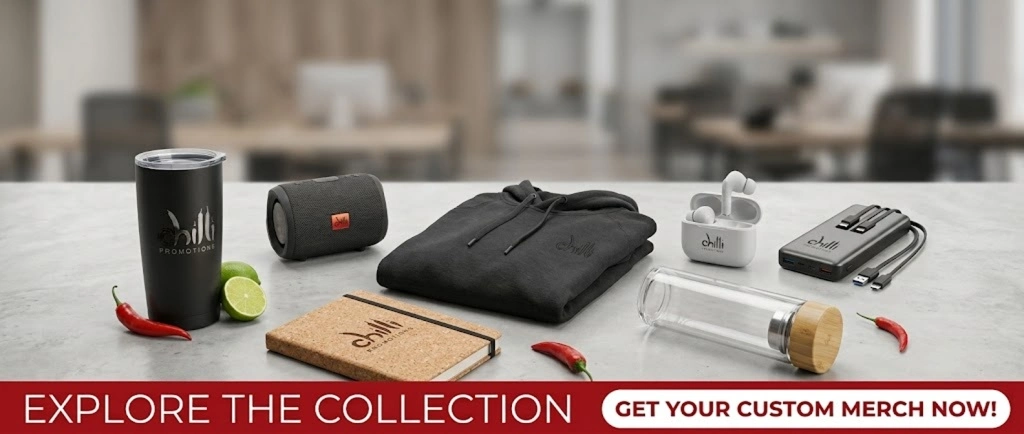
Whether you’re planning end-of-year hampers, recognition gifts, or a broader promotional products range for your team, Chilli Promotions works with you to choose items that fit both your budget and your compliance checklist, including sustainable and carbon-offset options if that matters to your business. Browse corporate giveaway ideas suited to the minor benefits exemption, or get a quote for your next round of staff gifts before your next event lands on the calendar.
Sources
- Minor benefits exemption | Australian Taxation Office
FAQ
Are staff gifts tax deductible in Australia?
Non-entertainment gifts under $300 GST inclusive are generally tax deductible and eligible for GST credits, while entertainment-related gifts exempted under the minor benefits rule usually miss out on both.
Can you give gifts to staff without triggering FBT?
Yes, as long as the gift’s notional taxable value is under $300 GST inclusive and the gift is infrequent and irregular, it typically qualifies for the minor benefits exemption under Section 58P.
Is a $10 gift card okay to give your employees for Christmas?
Yes, a gift card well within the $300 threshold and, given once a year, easily satisfies the minor benefits exemption, though repeating small vouchers monthly can still create a frequency problem.
What are the tax rules for gifts in Australia?
Gifts to employees are assessed against the $300 per-benefit minor benefits exemption; gifts under that threshold and given infrequently are generally FBT exempt, deductible, and eligible for GST credits, while larger or entertainment-based gifts may attract FBT at 47% on the grossed-up value.
Does Chilli Promotions supply gifts suited to the FBT exemption?
Yes, Chilli Promotions supplies branded promotional merchandise and corporate hampers that fall clearly into the non-entertainment gift category, making them straightforward to document against the $300 minor benefits test.