The fastest way to deliver consistent, on-brand merchandise at scale is a managed, HR-controlled employee swag store with single sign-on and regional fulfilment built in. Skip the DIY e-commerce plugin and skip the storage cupboard. Request a demo or pilot from a provider like Chilli Promotions, or run your own 10 to 20 person internal pilot first if you’d rather test the model before committing.
- Time saved: Automated allowances and HRIS wiring remove manual order processing from HR’s plate.
- Brand control: Locked artwork, approved colourways and permissioned access stop rogue reorders.
- Measurable spend: Centralised reporting shows redemption rates and budget burn in real time.
Key Takeaways
A managed employee swag store with SSO, regional fulfilment and centralised reporting cuts HR admin time while keeping spend and brand control measurable.
| Point | Details |
|---|---|
| Start with a pilot | Test with 10 to 20 employees across regions before a full rollout to catch sizing and fulfilment issues. |
| Curate, don’t overload | Keep the core catalogue to 10 to 15 items to lower waste and simplify decisions. |
| Use hybrid fulfilment | Pre-stock fast-moving essentials and use on-demand production for low-volume or seasonal items. |
| Track three metrics monthly | Monitor spend against budget, redemption rate, and sizing distribution to catch problems early. |
| Choose a managed provider | Chilli Promotions curates catalogues, locks brand controls and manages regional fulfilment for Australian and New Zealand teams. |
Table of Contents
- Why a company swag store benefits HR, ops and employer brand
- Which fulfilment model suits your company: stocked, on-demand or hybrid?
- What features and questions matter when choosing a swag-store partner?
- How do you launch a swag store from pilot to company-wide rollout?
- What shipping and returns policies should you require?
- What policies and allowance models keep engagement high?
- How does Chilli Promotions run a managed swag store for clients?
- How do you track swag store data, usage and budgets?
- What legal and compliance issues should HR check before launch?
- How much does a swag store cost to set up and run?
- What the swag store conversation keeps getting wrong
- Get your employee swag store running the right way
- FAQ
Why a company swag store benefits HR, ops and employer brand
A dedicated company swag store solves three problems at once: distribution, brand consistency, and employee choice. Instead of HR fielding one-off requests for hoodies and drink bottles, a store lets people select what they want from a controlled catalogue, while decoration files, colourways and logo placement stay locked down centrally.
Statistic callout: Once People Ops fields more than ten swag requests a month, or headcount passes roughly 200, a dedicated store becomes the more efficient option than ad hoc ordering.
- Streamlined distribution replaces email chains and spreadsheet tracking.
- Consistent branding protects how your logo and colours appear across every item.
- Employee choice within a curated range lifts perceived value without blowing the budget.
- Centralised reporting on redemption and sizing data informs smarter future purchasing.
Pro Tip: *Track redemption rate and hours saved per month in the first 60 days.
Which fulfilment model suits your company: stocked, on-demand or hybrid?
Three models cover most corporate merch store setups. Held stock means bulk-ordering items in advance and warehousing them, which suits high-frequency essentials but ties up capital. On-demand (made-to-order) production means nothing gets printed until an order lands, which suits low-volume or experimental items but adds a few days to lead time. Hybrid blends both: pre-stock your fastest-moving core items and use on-demand production for everything else, which keeps delivery quick without the waste of over-ordering seasonal or niche SKUs.
- Held stock fits large headcounts (500+) with predictable, repeat demand like onboarding kits.
- On-demand fits smaller teams, new-hire welcome packs, or items with frequent design changes.
- Hybrid fits most mid-size organisations running events plus year-round recognition orders.
Pro Tip: Pre-stock for confirmed events with fixed dates. Use on-demand for anything where quantity is a guess. It avoids the “swag closet” full of unclaimed size-large tees.
What features and questions matter when choosing a swag-store partner?
A corporate merchandise shop is only as good as its operational wiring. Before signing with any provider, confirm these capabilities are actually built in, not promised as a future roadmap item:
- Single sign-on (SSO) and HRIS integration for automated allowances and entitlements
- Regional production and fulfilment nodes to cut customs delays and per-unit cost
- On-demand production with no minimum order quantities
- Brand controls: locked artwork, approved colourways, permissioned catalogue access
- Real-time reporting on spend, redemption and sizing data
Ten questions worth asking any prospective partner:
- Does your platform support SSO and HRIS webhook integration out of the box?
- What are your standard lead times for bulk orders versus single made-to-order items?
- Can you route production and shipping regionally to reduce customs handling?
- Is there a minimum order quantity, or is on-demand production genuinely available?
- How do allowance and milestone credit rules get configured and audited?
- What reporting dashboards do we get access to, and how often do they refresh?
- What’s your quality control process before an order ships?
- How are returns and sizing exchanges handled, and who bears the cost?
- Can you show a comparable case study or pilot outcome?
- What’s the total cost breakdown, including setup fees versus per-unit pricing?
Red flags include vague answers on lead times, no visible reporting layer, and any promise of “free reworks” without an explained QC process behind it.
How do you launch a swag store from pilot to company-wide rollout?
A structured rollout beats a big-bang launch every time. Follow this sequence:
- Define the program’s purpose and budget model (employer-funded, allowance, or hybrid).
- Curate a core catalogue of 10 to 15 SKUs, no more, to keep decisions simple and waste low.
- Configure SSO and wire HRIS webhooks so allowances and milestone triggers run automatically.
- Pilot with 10 to 20 employees across multiple regions to catch sizing and fulfilment edge cases.
- Fix issues surfaced during the pilot, then open the store to the full workforce.
Timeline template: Day 0 (pilot launch), Day 30 (review redemption and fulfilment data), Day 60 (full rollout decision).
Cost callout: Typical annual allowances run $150–$300 per employee, with recognition-moment credits around $40–$120. Setup fees and pre-stock unit costs vary by supplier and catalogue size.
What shipping and returns policies should you require?
Specify lead times and routing clearly in any procurement brief, because vague SLAs are where swag programs quietly fail.
| Fulfilment type | Typical lead time | Best suited for |
|---|---|---|
| Stocked bulk orders | 5 to 10 business days | Events, onboarding batches, company-wide campaigns |
| On-demand single orders | 7 business days | Individual employee orders, recognition moments |
| International shipments | 10 business days | Distributed or multi-country teams |
- Require address verification before dispatch to cut failed deliveries.
- Ask providers how they handle customs documentation for cross-border shipments.
- Confirm regional production nodes are used rather than shipping everything from one warehouse.
Pro Tip: Publish a clear sizing chart with real garment measurements, not just S/M/L labels. It’s the single biggest lever for cutting exchange requests.
What policies and allowance models keep engagement high?
Running a predictable program comes down to a handful of rules, applied consistently.
- Lock decoration files so no local team can alter logo placement or colourways.
- Keep region-aware visibility so employees only see items shippable to their location.
- Offer a genuine size range, not just unisex mid-sizing, to avoid alienating staff.
- Review the catalogue quarterly and retire underperforming SKUs.
Three allowance structures work well in practice: an annual stipend ($150 to $300 per employee), milestone credits tied to tenure or achievements, and manager recognition budgets for spot-bonuses (roughly $40 to $120 per moment).
Pro Tip: A tight catalogue of premium items beats a sprawling one of average items. Employees notice quality faster than they notice choice.

How does Chilli Promotions run a managed swag store for clients?
Chilli Promotions builds and manages the store end to end: curated catalogues, locked decoration files, regional fulfilment across Australia and New Zealand, and reporting that shows spend and redemption without HR chasing numbers manually.
- Catalogue curation focused on 10 to 15 quality core items, not an overwhelming list
- Decoration and brand controls locked centrally, with sustainable and carbon-offset options available
- HRIS-aware allowance and milestone structures configured to match your existing policies
- A pilot typically runs across a small cross-section of teams before full rollout, giving you real fulfilment and sizing data before scaling
Request a pilot brief to see what a store built around your brand actually looks like before committing to full rollout.
How do you track swag store data, usage and budgets?
A mature program treats the store as a data source, not just a shopfront. Centralised reporting on spend, redemption rates and sizing data lets HR spot problems before they become expensive, and this is one area where most companies leave value on the table by never looking past order confirmations.

At minimum, track three things monthly: total spend against allowance budget, redemption rate by department or region, and sizing distribution against what’s held in stock or ordered on-demand. A store where redemption sits well below allowance suggests the catalogue doesn’t match what employees actually want. A spike in exchange requests on one item usually means the size chart is wrong, not that the item is unpopular.
Inventory analytics matter differently depending on your fulfilment model. If you’re holding stock, track sell-through rate per SKU so you’re not sitting on unsold hoodies six months later. If you’re running on-demand, track production turnaround against your promised lead time, because that’s the metric that erodes trust fastest when it slips.
Budget dashboards should separate one-off setup costs from ongoing per-order spend, since blending the two makes it hard to forecast next year’s allocation. Most platforms worth using will surface this as a standard report rather than something you build yourself in a spreadsheet. If a provider can’t show you a live dashboard during evaluation, treat that as a genuine gap, not a minor inconvenience.
What legal and compliance issues should HR check before launch?
Trademark and brand usage sit at the centre of compliance for any branded employee gifts program. Your logo, tagline and colour palette are protected intellectual property, and any third-party store you set up needs a locked, approved artwork file that decoration teams can’t alter without sign-off. This matters more than most HR teams initially assume, particularly if regional offices have historically sourced their own local merch with slightly different logo treatments.
Tax treatment of gifted merchandise varies by value and context, and it’s worth checking with your finance or tax adviser how fringe benefits rules apply to items distributed through an allowance model versus items given as genuine gifts. Recognition-moment items and milestone gifts can sit in different categories to standard onboarding kits, so don’t assume one blanket rule covers the whole catalogue.
Data privacy also deserves a line item. An employee promotional items store that integrates with HRIS is handling employee addresses, sizing data and sometimes photos for personalisation. Confirm your provider’s data handling practices match your organisation’s privacy obligations before wiring the integration live, and get that confirmation in writing as part of the procurement process rather than assuming it by default.
How much does a swag store cost to set up and run?
Total cost of ownership breaks into three buckets: setup, per-unit product cost, and ongoing management. Setup typically covers platform configuration, SSO/HRIS integration and initial catalogue build, and this is usually a fixed or quoted cost rather than a recurring one.
Per-unit costs depend heavily on your fulfilment model. Held stock generally lowers per-unit price through bulk manufacturing but requires upfront capital tied up in inventory. On-demand production carries a modest per-unit premium but removes that capital risk entirely, which is why the hybrid approach appeals to most mid-size organisations balancing cash flow against speed.
Ongoing management costs are the part most budgets underestimate. Someone needs to review the catalogue quarterly, monitor allowance spend, and handle exceptions like address changes or sizing exchanges. A managed provider absorbs most of this operational load into their service fee, while a self-built store shifts it onto internal HR or ops time, which is real cost even when it doesn’t appear on an invoice.
When budgeting, use the allowance ranges already discussed as your baseline ($150 to $300 annual stipends, $40 to $120 per recognition moment) and add setup and management fees on top. A realistic total cost of ownership model accounts for all three buckets across a 12-month cycle, not just the sticker price of the merchandise itself.
What the swag store conversation keeps getting wrong
Most advice on this topic treats a swag store like a website project: pick a template, upload a logo, done. That’s the gap. A store without SSO, HRIS webhooks and regional fulfilment isn’t a system, it’s a shopfront with the same manual bottlenecks as the spreadsheet it replaced.
The conventional wisdom also overvalues catalogue size. Bigger isn’t better here. A tight range of 10 to 15 genuinely good items outperforms a sprawling 60-item list every time, because employees spend less time deciding and providers spend less time managing exceptions.
If there’s one thing HR teams should prioritise first, it’s the pilot. Not the branding, not the full catalogue, the pilot. Ten to 20 people across a couple of regions will surface every sizing, shipping and integration problem your rollout would otherwise hit at scale, and fixing those issues early is far cheaper than fixing them after 500 employees have already logged in.
Get your employee swag store running the right way
The DIY route, cobbling together a generic online shop or fielding requests through email, works for a while, until the size exchanges and reorder emails start eating a real chunk of someone’s week. Chilli Promotions runs the managed alternative: a curated catalogue, locked brand controls, and fulfilment handled across Australia and New Zealand, including carbon-offset and sustainable product options if that matters to your policy.
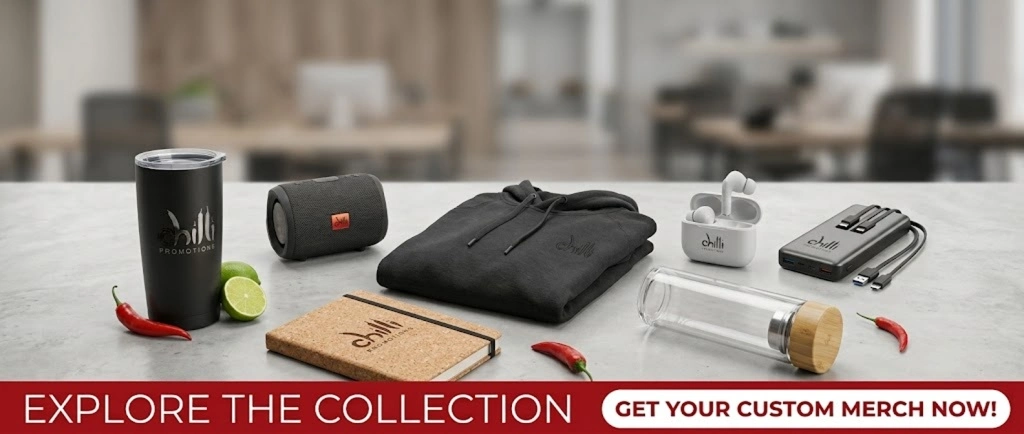
Whether you’re building a new-hire kit, a milestone recognition range, or a full company-wide store, Chilli Promotions works from your brand guidelines to keep every item consistent, from work from home gift packs to seasonal drops. Browse the promotional products range or request a pilot quote to see what a managed store built around your catalogue actually looks like before you commit to full rollout.
FAQ
What is the best company swag for employees?
Quality basics that people actually use daily, drink bottles, apparel and tech accessories, tend to outperform novelty items. A curated 10 to 15 item catalogue covering these categories usually beats a large, uncurated list.
Where can I buy corporate swag?
Corporate swag is best sourced through a managed provider that handles catalogue curation, decoration and regional fulfilment, such as Chilli Promotions, rather than assembling items from multiple ad hoc suppliers.
What is the point of a swag store?
A swag store centralises distribution, protects brand consistency through locked artwork and colourways, and gives employees choice within an approved range, all while generating reporting data on spend and redemption.
How do I know if my company needs a dedicated swag store?
If HR is fielding more than ten swag requests a month, or headcount has passed roughly 200, a dedicated store is usually more efficient than handling requests individually.
Should I hold stock or use on-demand production?
Most mid-size organisations do best with a hybrid model: pre-stocking fast-moving essentials and using on-demand production for seasonal or low-volume items, which balances speed against waste.