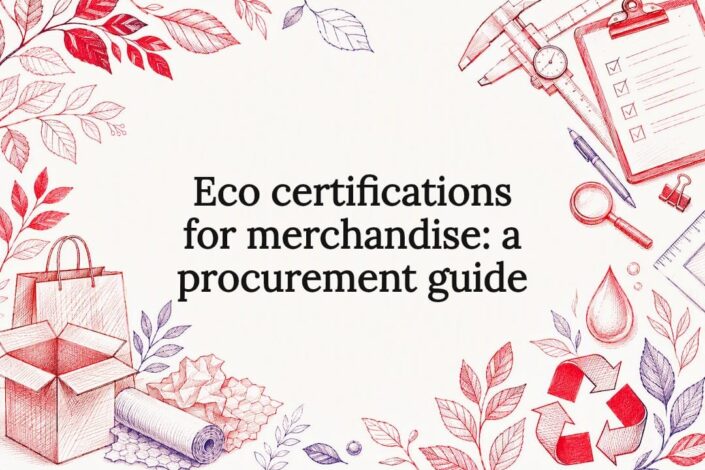
When you’re assessing eco certifications for merchandise, prioritise proof over promises: material and product certifications (GOTS, OEKO‑TEX, GRS), lifecycle and circularity marks (Cradle to Cradle, EU Ecolabel), forestry and packaging credentials (FSC), and labour standards (Fairtrade, Fair Wear Foundation, Ethical Clothing Australia). Company‑level ratings such as EcoVadis sit alongside these, not instead of them.
The strongest single proofs procurement teams should ask for:
- A valid chain‑of‑custody or licence number you can check against the certifier’s own registry
- A recent, dated third‑party audit report, not a marketing summary
- A company‑level rating (EcoVadis, B Corp) used to support, not replace, product‑level labels
Product labels prove what a material or process is. Company ratings prove how a business operates. You need both, because a factory can score well on paper while an individual product still lacks organic or recycled content certification.
Key Takeaways
Verified licence numbers and recent audit reports matter more for merchandise procurement than any certification logo standing alone.
| Point | Details |
|---|---|
| Match scope to claim | Use material‑level labels (GOTS, GRS) for fibre claims and product‑level marks (OEKO‑TEX) for chemical safety claims. |
| Layer labels where needed | Combine GOTS with OEKO‑TEX, or GRS with chain‑of‑custody documentation, to cover claim gaps neither label handles alone. |
| Verify before you order | Check licence numbers against the certifier’s own registry and request the latest audit report. |
| Use ECA and GECA locally | Ethical Clothing Australia and GECA give Australian buyers domestic labour and lifecycle evidence for tenders. |
| Source through Chilli Promotions | Chilli Promotions supplies certified product ranges with chain‑of‑custody documentation for tender‑ready procurement. |
Table of Contents
- Why eco certifications for merchandise actually matter
- What do material and environmental certifications cover?
- Which labour and ethical trade certifications matter for sourcing?
- How do you choose the right certification for your merchandise?
- How do you verify a supplier’s certification claims?
- What should Australian procurement teams check first?
- A practitioner’s view on certification versus marketing claims
- How Chilli Promotions supports certified merchandise sourcing
- Where to verify certificates and licence numbers
- FAQ
Why eco certifications for merchandise actually matter
Certifications do real work in procurement, not just marketing. They give tender evaluators something concrete to score against, they support modern slavery statement disclosures, and they reduce the risk of a supply chain surprise turning into a reputational one.
For brand and marketing teams, a verified label substantiates a sustainability claim instead of just asserting it. That distinction is becoming commercially unavoidable: 65% of consumers now expect certified packaging, and a similar share expect companies to actively avoid deforestation in their supply chains.
Scope matters as much as the badge itself. A certification can apply at material level (this fibre is organic), product level (this finished item meets a chemical safety standard), or company level (this business meets a governance and ethics benchmark). Mixing these up in a claim, saying a “certified organic” T‑shirt when only the cotton batch was certified, is one of the fastest ways to attract a greenwashing complaint.
- Procurement teams use certifications as tender evidence and audit‑ready documentation
- Marketing teams use them to make specific, defensible sustainability claims
- Risk and compliance teams use them to support supplier due diligence and disclosure obligations
What do material and environmental certifications cover?
Most confusion in this space comes from assuming one label covers everything. It doesn’t. Each certification has a defined scope, and knowing that scope is the difference between a claim that holds up and one that gets challenged.
GOTS (Global Organic Textile Standard) certifies organic fibre content plus social criteria across the processing chain, from harvesting through to labelling. It’s a strong choice when a product needs to be marketed as genuinely organic and ethically processed, not just “cotton based.” GOTS does not, on its own, verify chemical safety of the finished dyed or printed product, which is where OEKO‑TEX comes in.

OEKO‑TEX (specifically the Standard 100 certification) tests the finished product for harmful substances. It doesn’t tell you anything about whether the fibre was organically grown or whether workers were fairly paid. It’s a chemical safety mark, full stop, and it’s often layered on top of GOTS rather than used as a replacement for it.
Bluesign takes a process‑level approach, certifying that a manufacturer’s chemical use, water consumption, and energy practices meet defined environmental criteria. It’s common in technical apparel and textile supply chains where the manufacturing process itself carries the environmental risk.
Global Recycled Standard (GRS) verifies recycled content and tracks it through the supply chain via chain‑of‑custody documentation. If a product claims “made from recycled plastic bottles,” GRS certification is what lets that claim survive scrutiny.
Better Cotton Initiative (BCI) licenses cotton grown under improved farming practices, though it operates on a mass‑balance system rather than strict batch traceability, so a BCI claim on a finished good is different in nature to a GOTS claim.
Cradle to Cradle Certified evaluates a product across multiple achievement levels for material health, circularity, and social fairness rather than a simple pass or fail, making it useful for buyers who want a lifecycle view rather than a single‑issue tick.
EU Ecolabel applies a whole‑of‑lifecycle environmental standard recognised across the European market, useful when merchandise is destined for EU‑based clients or events.
FSC (Forest Stewardship Council) governs paper, wood, and packaging sourcing, and this is where chain‑of‑custody certification and promotional licensing genuinely matter. Notebooks, packaging inserts, and wooden merchandise items should carry a checkable FSC licence code, not just a printed logo.

Pro Tip: Stack labels to close claim gaps. A cotton tote bag claiming “organic and non‑toxic” should carry both GOTS (for the organic fibre and social criteria) and OEKO‑TEX (for the finished‑product chemical safety), because neither certification covers the other’s ground.
Cert profiles to check before you specify a product
- GOTS: material and process level; audits fibre sourcing plus social criteria; licence number verifiable through the GOTS public database.
- OEKO‑TEX: product level; tests finished goods for restricted substances; certificate number checkable via the OEKO‑TEX portal.
- Bluesign: process/company level; audits chemical, water, and energy management at manufacturing sites.
- Global Recycled Standard: material and chain‑of‑custody level; verifies recycled input percentage through documented transaction records.
- Better Cotton Initiative: material level, mass‑balance system; licensed farmers and supply chain members tracked centrally.
- Cradle to Cradle Certified: product level, multi‑tier; assesses material health, circularity, and social fairness together.
- EU Ecolabel: product/lifecycle level; assesses environmental impact across a product’s full life cycle for the European market.
- FSC: material and chain‑of‑custody level; licence and certificate finder lets buyers verify a code before ordering packaging or paper goods.
Which labour and ethical trade certifications matter for sourcing?
Material certifications tell you what a product is made of. Labour certifications tell you who made it and under what conditions, and for merchandise buyers exposed to modern slavery reporting obligations, this is often the harder gap to close.
Fairtrade certifies specific products or ingredients (cotton, coffee, cocoa used in gift items) against minimum price and community development standards, verified at the producer level.
Fair Wear Foundation focuses on factory‑level labour standards including wages, hours, and workplace safety, with ongoing monitoring rather than a one‑off pass.
GoodWeave targets child labour and forced labour risk specifically in carpet, textile, and home goods production, with unannounced factory inspections.
Ethical Clothing Australia (ECA) accredits local supply chains against Australian workplace law, verified through on‑the‑ground third‑party compliance checks covering every stage from design to dispatch.
SA8000 is a broader international social accountability standard covering child labour, forced labour, and freedom of association at the factory level, often used alongside product‑specific labels.
WRAP and SEDEX aren’t certifications in the strict sense so much as auditing and disclosure frameworks that buyer guides commonly recommend combining with product‑level labels, forming what one buyer’s guide describes as a complete compliance package of product certs, social audits, and company assurances.
- Request the specific factory or facility covered by the certificate, not just the brand name
- Ask when the accreditation was last renewed, since most labour certifications operate on annual or biennial cycles
- Treat a company‑level badge as supporting evidence, never as proof for a specific product line
Labour and ethical cert profiles at a glance
Fair Wear Foundation and GoodWeave both rely on unannounced or scheduled factory audits assessing wages, working hours, and health and safety, with corrective action plans issued where gaps are found. ECA’s accreditation is broader in scope, covering the full local supply chain rather than a single factory. EcoVadis and B Corp sit apart from all of these: they rate a whole business against environmental, labour, ethics, and procurement criteria, but as ECA itself notes, a strong company rating doesn’t automatically validate an individual product’s eco claim. You still need the product‑level certificate for that.
How do you choose the right certification for your merchandise?
Start with what the product actually is and where it’s going. A framework that works for most procurement teams:
- Identify the material category (cotton apparel, timber or paper goods, plastic or metal drinkware) to narrow the relevant certification family.
- Confirm the end market (EU tenders often expect EU Ecolabel or equivalent; Australian public sector tenders increasingly ask for ECA or GECA).
- Define the exact claim you need to make (organic, recycled content, low‑toxicity, ethically made) and match it to a label that specifically covers that claim.
- Assess your buyer’s risk profile, government and large corporate tenders generally demand stronger documentary evidence than a small internal order.
- Combine product‑level labels with company‑level ratings like EcoVadis when a supplier can offer both.
Pro Tip: Treat a certification logo with no visible licence number as a red flag. Genuine third‑party certifiers always issue a checkable number or code; self‑declared “eco‑friendly” claims without one are the single most common form of greenwashing in merchandise sourcing.
Watch too for expired licences quietly left on old product sheets, and vague claims like “sustainably sourced” that don’t name a standard at all.
How do you verify a supplier’s certification claims?
- Map each product line against the certifications relevant to its material and market.
- Request the licence, certificate, or chain‑of‑custody number directly from the supplier, never take a printed logo at face value.
- Confirm the audit date on the certificate, most credible schemes require annual renewal.
- Cross‑check the number against the certifier’s own public registry before placing a large order.
- Order independent testing for chemical safety claims if no valid OEKO‑TEX or equivalent certificate exists.
- File the certificate, audit report, and verification screenshot in your procurement record for tender purposes.
Full certification of a new product line can take anywhere from a few months to close to a year depending on the scheme’s complexity, GOTS and Fair Wear audits tend to run longer than a straightforward FSC chain‑of‑custody check. Verifying an existing supplier’s claims is far faster: a licence lookup and an audit report request can be turned around within days.
What should Australian procurement teams check first?
For local supply chains, Ethical Clothing Australia (ECA) accreditation is the clearest domestic signal, verifying compliance with Australian workplace law from design through to dispatch and widely used to support tender responses and modern slavery reporting.
Alongside ECA, GECA (Good Environmental Choice Australia) assesses textiles across the full lifecycle, sourcing, manufacture, packaging, and use, while requiring compliance with ILO labour conventions. Government and corporate buyers increasingly want a whole‑of‑business rating like EcoVadis or B Corp presented alongside these product‑level marks, plus FSC documentation for any paper or timber packaging.
Government and enterprise tenders don’t just want a logo on a spec sheet. They want a licence number they can independently check, and a recent audit report they can attach to their own compliance file.
Pro Tip: Keep a single procurement folder per supplier containing the current certificate, the licence number, and the last audit report date. When a tender deadline lands, you’ll need to produce these in hours, not weeks.
A practitioner’s view on certification versus marketing claims
Certifications only earn their keep when you ask for the audit report, not just the logo. A licence number you can verify in a public registry is worth more than any amount of confident marketing copy. The real trade‑off in sourcing certified sustainable promotional products is balancing lead time and cost against the strength of the proof, and that balance should always favour verifiable evidence.
How Chilli Promotions supports certified merchandise sourcing
Chilli Promotions gives procurement teams a shortcut past the guesswork this guide has just walked through: certified product ranges and the paperwork to back them, in one place, without chasing multiple suppliers for licence numbers.

Chilli Promotions has operated as Australia’s first 100% carbon‑offset promotional products company since 2001, and that history shows in how sourcing requests get handled. The team can supply:
- Certified product lines across drinkware, apparel, bags, and stationery, matched to the specific claim you need to make
- Chain‑of‑custody documentation for FSC‑certified paper and timber items, ready for your procurement file
- Packaging options that carry verifiable FSC credentials rather than unlicensed “eco” labels
- Project support for tender responses, including sourcing evidence and certificate collation
If your team is comparing eco‑friendly corporate gifts or building a certified merchandise range from scratch, start by browsing the promotional products range and requesting a quote with your certification requirements listed upfront. It’s the fastest way to get a supplier response that already matches your evidence needs, rather than a generic catalogue.
Where to verify certificates and licence numbers
- GOTS public registry, for checking organic textile certificate numbers
- FSC’s certificate finder, for chain‑of‑custody and promotional licences
- OEKO‑TEX certificate search, for finished‑product chemical safety checks
- ECA’s accreditation page, for Australian supply chain compliance
- A downloadable list of labels and certifications compiled for procurement teams
When in doubt, request the audit report directly rather than relying on the certificate alone.
FAQ
What are eco certifications, exactly?
They’re third‑party verified marks confirming a material, product, or company meets defined environmental or social standards, distinct from self‑declared claims that carry no independent audit behind them.
Which certification is best for sustainability overall?
There’s no single best certification; GOTS and OEKO‑TEX suit organic textiles with chemical safety needs, FSC suits paper and packaging, and Cradle to Cradle suits buyers prioritising circularity across a product’s full life.
What are the main categories of sustainable merchandise credentials?
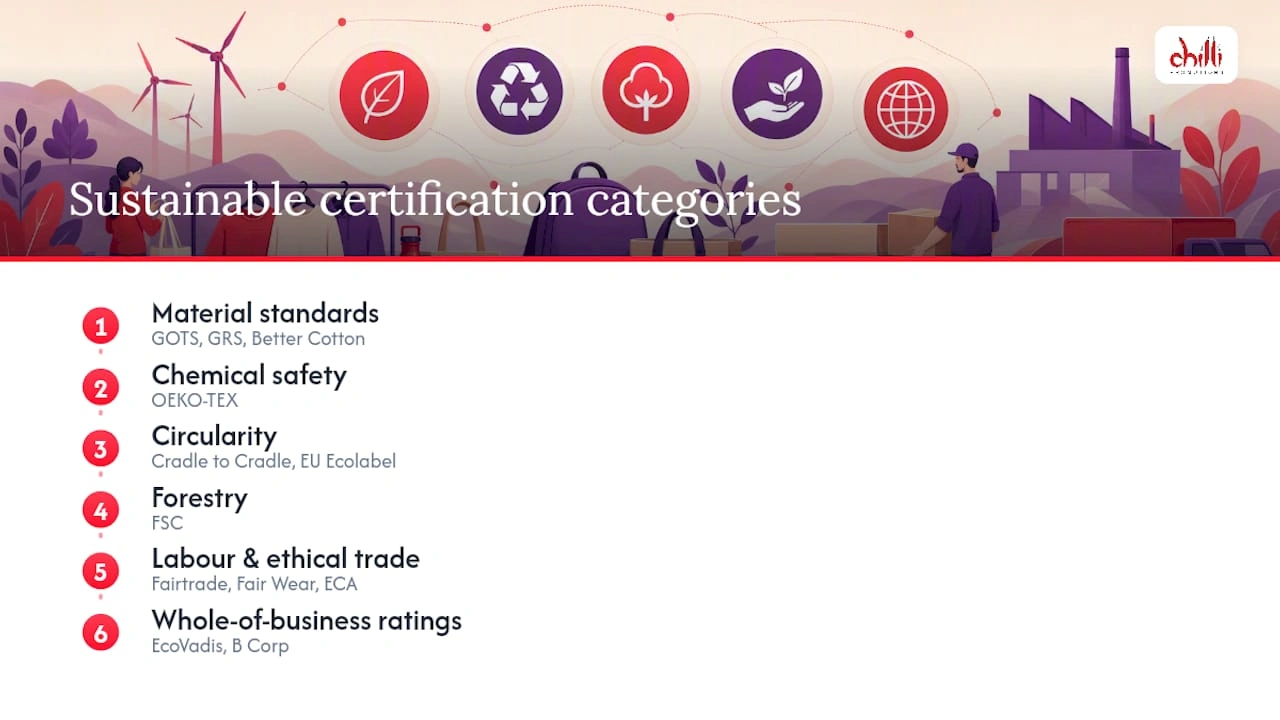
They generally fall into material standards (GOTS, GRS, Better Cotton), chemical safety (OEKO‑TEX), circularity (Cradle to Cradle, EU Ecolabel), forestry (FSC), labour and ethical trade (Fairtrade, Fair Wear, ECA), and whole‑of‑business ratings (EcoVadis, B Corp).
Does GOTS cover the same things as OEKO‑TEX?
No. GOTS certifies organic fibre content plus social criteria across processing, while OEKO‑TEX tests the finished product for harmful substances, and buyers often need both to make a complete organic‑and‑safe claim.
Can Chilli Promotions supply certified merchandise with documentation?
Yes. Chilli Promotions sources certified product lines and provides supporting chain‑of‑custody documentation, particularly for FSC‑certified paper, timber, and packaging items used in tender submissions.