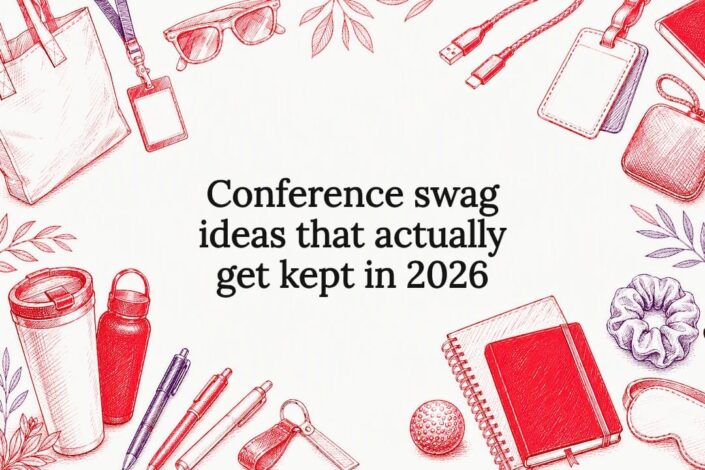
Pick conference swag using three rules: usefulness, brand fit, and sustainability. Skip anything that fails all three, no matter how cheap it looks on a supplier’s catalogue page. The strongest categories for 2026 events fall into a short list, and organisers who commit to fewer, better items consistently outperform those handing out bulk novelty stock.
The highest-performing categories right now are:
- Drinkware — insulated bottles and tumblers with genuine daily use
- Tech and travel accessories — power banks, wireless chargers, cable organisers
- Apparel — retail-quality crewnecks, polos and caps, not thin tees
- Notebooks and desk items — refillable pens, dot-grid notebooks
- Eco-friendly swag — recycled PET, bamboo and certified materials
- Wellness and consumables — coffee samples, sleep masks, hand sanitiser
- VIP kits — curated, themed bundles for your highest-value contacts
Match the category to your event goal. Brand awareness calls for visible, portable items; recruitment calls for wellness and desk goods that outlast the booth conversation; VIP hospitality calls for kitted experiences, not single objects.
Key Takeaways
Effective conference swag combines genuine utility, brand fit, and sustainability, distributed through a tiered model that rewards qualified engagement rather than blanket handouts.
| Point | Details |
|---|---|
| Apply the three-rule filter | Choose items for usefulness, brand fit, and sustainability before considering unit cost. |
| Use tiered gifting | Reserve premium items for attendees who complete a qualifying action like booking a demo. |
| Weight sustainability heavily | 55.8% of buyers now treat sustainability as a central procurement criterion, per APPA. |
| Pair giveaways with qualification | Freebies boost booth contacts but don’t reliably convert to serious inquiries without follow-up mechanics. |
| Source through one supplier | Chilli Promotions supplies drinkware, apparel, tech accessories and eco-friendly kits as a single-order solution for Australian and New Zealand organisers. |
Table of Contents
- Conference swag ideas: what makes good swag in the first place
- Welcome packs, totes and kitted experiences
- Tech and travel accessories that solve attendee problems
- Drinkware and tumblers attendees actually keep
- Apparel and wearable items that become daily wear
- Notebooks, pens and desk items that stay on desks
- Wellness, consumables and experiential swag
- Eco-friendly swag: materials, certifications and procurement tips
- Budget-friendly giveaways that still get kept
- Premium and VIP gifts: how to structure tiers and trigger distribution
- How to distribute swag: on-site handout, earned swag, or digital redemption
- How Chilli Promotions designs high-impact conference swag
- Author perspective: swag as part of the attendee experience
- Chilli Promotions: a single-step route to quotes, kitting and fulfilment
- FAQ
Conference swag ideas: what makes good swag in the first place
Good swag solves a problem the attendee already has. A phone stand, a reusable coffee cup, or a portable charger earns a place in someone’s bag because it gets used on Tuesday, not because it looked good on a booth table on Monday.
Three factors decide whether an item survives past the conference car park:
- Utility and habit — items tied to a daily routine (coffee, commuting, screen time) get carried home and used for months.
- Portability and visibility — anything bulky or fragile gets binned before the attendee reaches the airport; anything worn or carried in public multiplies your brand’s impressions.
- Brand fit and perceived value — retail-forward items that look like something the attendee would buy themselves outperform obviously cheap giveaways, a shift Event Marketer has tracked as leading brands move from mass giveaways to curated, retail-style merchandise.
Sustainability now sits alongside those three as a procurement standard rather than a nice-to-have. APPA’s research found 55.8% of end users treat sustainability as a central purchasing criterion, and 52.2% are willing to pay up to 10% more for genuinely sustainable products.
Sustainability now decides purchase intent for over half of end users — a figure that changes the maths on cheap, disposable swag entirely.
A tiered gifting model protects your budget while doing more with it: general foot traffic gets a low-cost, high-utility item; qualified leads who book a demo or meeting get a mid-tier product; VIPs and key accounts get a fully kitted experience.
Pro Tip: Budget backwards from your VIP tier first. Decide what a top-tier prospect deserves, then work down. Most organisers do the opposite and run out of quality stock before the people who matter most walk past.
Welcome packs, totes and kitted experiences
A welcome pack sets the tone for the entire event before a single session starts. Attendees judge your brand’s polish the moment they open the bag, which makes packaging as important as the products inside it.
Standard welcome packs typically include:
- A branded tote or backpack
- A notebook and pen
- A drink bottle or reusable cup
- A small snack or coffee sachet
- A lanyard and badge holder
VIP kits go further, built around a theme rather than a grab bag of items:
- Travel kit — packing cubes, a portable charger, an eye mask, noise-cancelling earbuds
- Productivity kit — a premium notebook, a stylus, a desk organiser, a wireless charging pad
- Wellbeing kit — a reusable water bottle, herbal tea, a sleep mask, hand cream
Pre-shipping VIP kits to hotel rooms avoids the queue at registration and creates a stronger first impression, though it adds lead time and courier cost. On-site distribution is cheaper and more flexible but competes with a crowded check-in desk for attention.
Pro Tip: Ship VIP kits ahead of arrival whenever the budget allows. A branded box waiting in a hotel room reads as hospitality; the same box handed over at a trestle table reads as inventory.
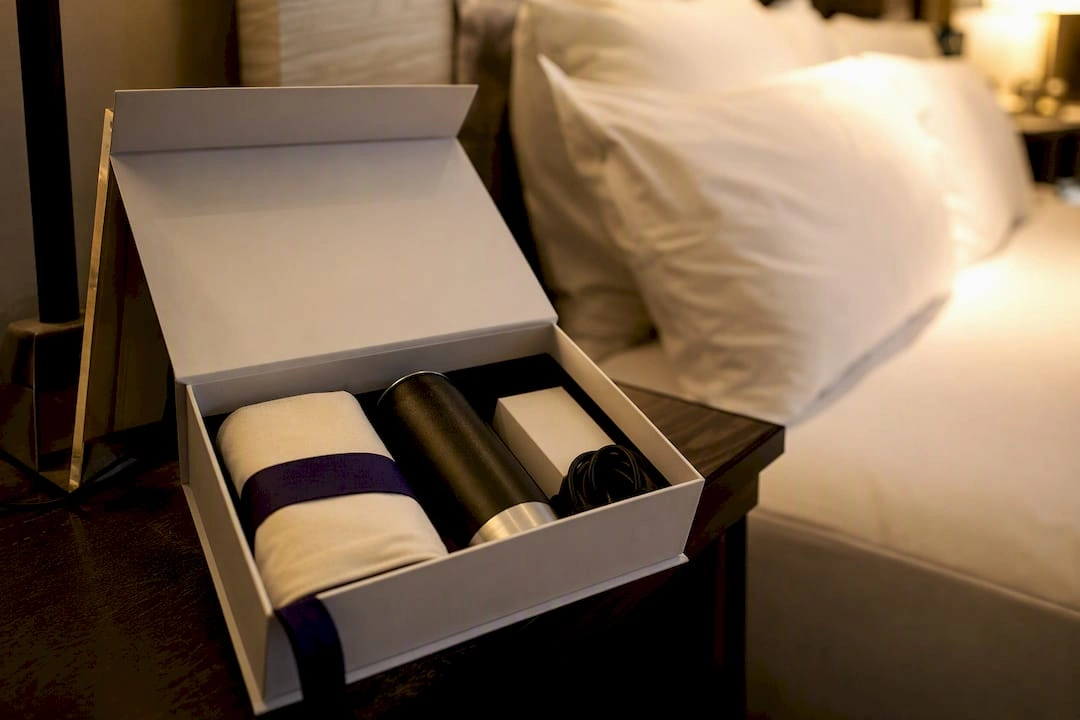
Packaging matters more than most organisers budget for. Event Marketer points to retail-style drops and limited-edition packaging as a genuine driver of social sharing, turning an unboxing into free content rather than a cost centre.
Tech and travel accessories that solve attendee problems
Conference days drain phone batteries and fill lanyards with dead weight. Tech and travel accessories rank among the best conference giveaways precisely because they fix a problem the attendee is having right now, not a hypothetical one.
Strong options include:
- Power banks (10,000mAh or higher, with a USB-C port)
- Wireless charging pads
- Universal travel adapters
- Cable organisers and pouches
- Phone wallets with card storage
- Padded earbud cases
Lower-cost items in this category still carry high perceived value. A phone wallet or a cable tidy costs a fraction of a power bank but reads as thoughtful rather than cheap, which is exactly the retail-forward positioning organisers should be chasing.
NFC and QR-enabled items add a second job to the giveaway: lead capture. A tag embedded in a lanyard or a sticker on a power bank can trigger a landing page, a contact form, or a digital business card exchange. Industry research on high-ROI merchandise shows tech gadgets with these interactive triggers consistently outperform static giveaways for lead capture.
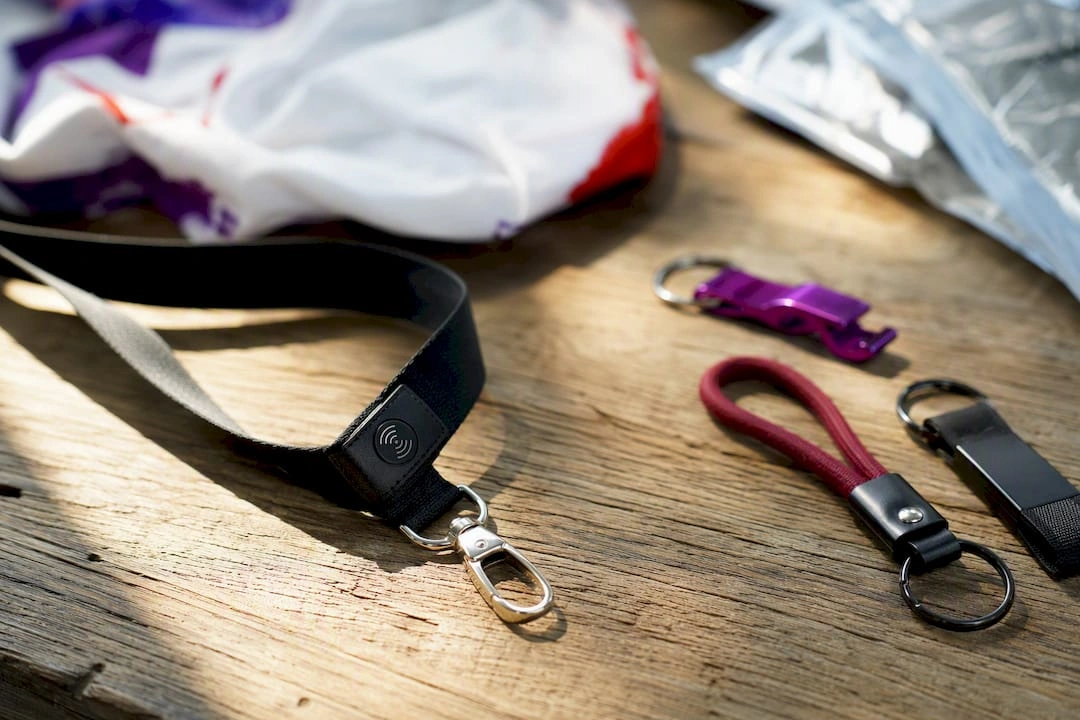
Check battery safety documentation before shipping power banks internationally. Airlines and couriers apply watt-hour limits, and undocumented lithium batteries can be held at customs. Choose devices under 100Wh and keep supplier compliance paperwork on file.
Drinkware and tumblers attendees actually keep
Insulated stainless steel bottles and tumblers remain one of the best trade show giveaways because they solve a problem attendees face every single day, not just at the conference. A bottle that keeps water cold through four sessions earns a permanent spot on someone’s desk.
Material choice affects both keep rate and sustainability positioning:
- Stainless steel — durable, recyclable, holds temperature well, higher unit cost
- Recycled PET plastic — lighter and cheaper, lower perceived value, still recyclable
- Bamboo-lidded tumblers — strong sustainability signal, needs care around dishwasher use
Branding placement matters as much as the material. A laser-etched logo on the base or a debossed mark on the lid survives years of use; a printed wrap peels within months and turns a premium item into rubbish.
Pro Tip: Choose a debossed or laser-etched finish over screen printing for anything that goes in a dishwasher. It costs marginally more per unit and outlasts the printed alternative by years.
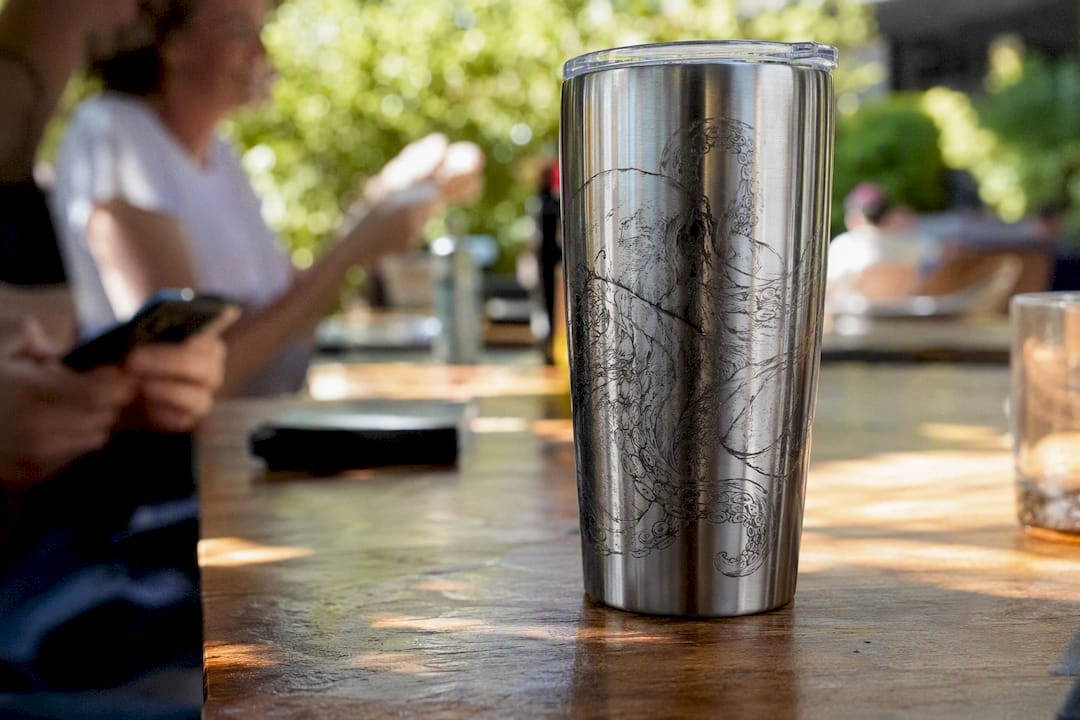
Drinkware typically carries longer lead times than apparel or stationery, particularly for custom colourways or engraved finishes. Factor in drayage (the cost and time of moving stock from the freight dock to your event floor) when ordering for a venue with strict delivery windows, and confirm your supplier’s minimum order quantities early if you’re mixing multiple colours across tiers.
Apparel and wearable items that become daily wear
A retail-quality crewneck or polo gets worn on a Saturday morning coffee run. A thin, boxy tee gets used as a car rag within a month. That difference in fabric weight and cut is the entire argument for spending more on fewer apparel pieces.
Strong apparel and wearable options include:
- Heavyweight crewnecks and quarter-zips
- Performance polos for corporate or golf-adjacent audiences
- Structured caps and beanies
- Tote bags in canvas or recycled cotton
- Socks (an underrated category with a surprisingly high keep rate)
Choose unisex or gender-neutral cuts where possible, and stock a genuine size range rather than defaulting to men’s sizing with a handful of smalls added as an afterthought. Certified organic cotton or recycled polyester fabrics carry sustainability signals that matter to the growing share of buyers who now weigh environmental impact in procurement decisions.
Distribution strategy affects both cost and satisfaction. Pre-order sizing before the event cuts waste and guarantees fit; on-site sizing tables work for smaller events but risk running out of popular sizes by lunch; VIP attendees should get a size request built into their registration form so their item is ready and correctly sized when they arrive.
Notebooks, pens and desk items that stay on desks
Desk items win by being genuinely nicer than what the attendee already owns. A refillable pen with real weight in the hand, or a dot-grid notebook with a proper elastic closure, competes with retail stationery rather than looking like a giveaway.
Reliable choices include:
- Hardcover notebooks with dot-grid or ruled pages
- Refillable metal pens (not disposable plastic)
- Desk organisers or cable trays
- Sticky note sets in a branded slipcase
Small feature upgrades change how an item is perceived. A QR code printed inside the back cover linking to templates or a resource hub gives the notebook a second use beyond note-taking. A refill system (ink cartridges, replaceable notebook inserts) signals longevity and quietly reinforces the sustainability argument, since the attendee replaces a $3 refill instead of discarding a $15 pen.
Bundling stationery into a themed kit, paired with a tote and a drink bottle, extends visibility well past the conference floor. A notebook alone sits in a drawer; a notebook that arrived as part of a “productivity kit” gets used because it was framed as a set, not a spare.
Wellness, consumables and experiential swag
Consumables solve a distribution problem most organisers overlook: they never become clutter. A coffee sachet, a protein bar, or a small bottle of hand sanitiser gets used within days and never sits in a landfill-bound drawer.
High-performing consumable and wellness options include:
- Specialty coffee or tea sachets
- Protein bars or snack packs
- Travel-size hand sanitiser
- Sleep masks
- Small handheld massagers or heat packs
- Electrolyte sachets
Check dietary labelling requirements before ordering any food item, and confirm the venue’s own catering and allergen rules, since some conference centres restrict outside food distribution on the floor entirely.
Consumables carry a genuine sustainability advantage over cheap, non-usable merchandise. Analysis of promotional product lifecycles shows that switching from bulk novelty giveaways to higher-quality, purpose-built items (including consumables that get used up rather than discarded) measurably cuts promotional waste. A branded stress ball that sits in a drawer for three years does more environmental harm over its life than a coffee sachet consumed within a week.
Eco-friendly swag: materials, certifications and procurement tips
Sustainable conference giveaways are no longer a side category. They are becoming the default expectation among the buyers approving your merchandise budget, and the APPA sustainability research puts a number on it: 55.8% of end users now treat sustainability as a central procurement criterion, and 52.2% will pay up to 10% more for genuinely sustainable stock.
Over half of buyers say sustainability now decides which promotional products get approved, not just which ones get admired.
Common material choices, each with real trade-offs:
- Recycled PET (rPET) — made from post-consumer plastic bottles, widely available, good for bags and apparel
- Bamboo — fast-growing, biodegradable, less durable for items requiring flex or moisture resistance
- Sugarcane-based plastics — compostable in the right facility, but often need industrial composting rather than home composting
Verify supplier claims rather than accepting a green label at face value. Ask for certification documentation (recycled content percentages, ISO standards, carbon-offset paperwork) before committing budget, and treat vague terms like “eco-friendly” without backing evidence as a red flag. Chilli Promotions’ eco-friendly promotional products range documents these credentials for exactly this reason.
The lifecycle approach beats bulk buying every time: fewer, better items in genuinely recyclable or biodegradable materials outperform a warehouse of cheap plastic pens that end up in landfill within a year. Chilli Promotions’ guide to sustainable promotional products walks through this procurement logic in more detail.
Budget-friendly giveaways that still get kept
Low-cost swag doesn’t have to mean low perceived value. The trick is choosing items with a naturally high value-to-cost ratio and presenting them well, rather than bulk-buying whatever is cheapest per unit.
Items that punch above their price point:
- Enamel pins (collectible, low unit cost, high keep rate)
- Branded stickers (near-zero cost, laptop-worthy for the right design)
- Mini hand sanitisers or lip balm
- Seed packets or small succulents
- Branded phone grips
Pair budget items with an earned mechanic rather than handing them out freely at the door. A pin earned by visiting a demo station, or a sticker pack unlocked by scanning a QR code, creates a small moment of engagement that a passive giveaway never does.
The real risk with cheap swag isn’t the cost. It’s what Event Marketer calls the shift away from mass giveaways altogether: attendees now associate a table piled with identical plastic items with brands that haven’t thought about their merchandise strategy. Smarter distribution, not a bigger budget, is what separates a booth giveaway idea attendees keep from one they bin at the nearest bin on the way out.
Premium and VIP gifts: how to structure tiers and trigger distribution
VIP gifts earn their cost by being reserved for people who have already shown intent, not handed to anyone who walks past a table. A tiered structure protects your budget while making the top tier feel genuinely exclusive.
Worthwhile premium items include:
- Leather or vegan-leather portfolios
- Premium wireless headphones
- Curated wellness or travel kits (see the kitting section above)
- High-end drinkware with engraved personalisation
- Branded technology bundles (charger, cable, stand, case)
Trigger mechanics decide who gets the top tier. Common approaches include:
- Booking a live demo or product walkthrough
- Attending a scheduled meeting with a sales representative
- Contributing to a case study or customer reference call
- Reaching a spend or seniority threshold identified pre-event
Trade show research shows tiered distribution consistently improves qualified-lead rates compared with blanket giveaways, because the gift becomes a reward for a qualifying action rather than a cost of attendance. That distinction also protects your budget: instead of spreading spend evenly across every attendee, you concentrate it on the smaller group already showing buying intent.
How to distribute swag: on-site handout, earned swag, or digital redemption
The best distribution model depends on your event goal, not your budget alone. On-site handouts maximise reach and brand visibility at the point of contact but create luggage friction, since attendees flying home resist carrying bulky items through security. Digital redemption solves that friction entirely: the attendee scans a code, selects an item from a curated menu, and it ships directly to their home or office after the event.
| Model | Best for | Main trade-off |
|---|---|---|
| On-site handout | Brand awareness, high foot traffic | Luggage objections reduce keep rate for bulky items |
| Earned/tiered swag | Qualified lead generation | Requires staff to manage triggers and track eligibility |
| Digital redemption | International attendees, VIP kits | Adds fulfilment lead time and shipping cost |
Hybrid approaches combine all three: light, portable items go out on-site; anything bulky or premium moves to digital redemption; and the earned tier sits on top, unlocked by a demo booking or meeting. NFC and QR triggers embedded in badges or booth signage make this manageable at scale, letting you track who redeemed what and follow up accordingly. A partner tool like QRlytics also cuts printed collateral waste, since a single QR code can replace a stack of printed brochures or redemption vouchers.
Pro Tip: Build your digital redemption menu around three or four items maximum. Too much choice slows the scan-to-claim process at a busy booth and increases abandoned redemptions.
Logistics checklist for whichever model you choose:
- Confirm drayage costs and delivery windows with the venue at least six weeks out
- Order apparel and drinkware eight to twelve weeks ahead to allow for custom colourways
- Set a clear fulfilment deadline for digital redemption orders (two to three weeks post-event is standard)
- Track redemption data against attendee tier to measure which gifts actually convert into meetings
Academic research offers a useful caution here: giveaways increase verbal contacts with recruiters at a booth but don’t reliably increase serious follow-up inquiries on their own. Swag draws people in. Qualification mechanics, like the tiered triggers above, are what turn that attention into something measurable.
How Chilli Promotions designs high-impact conference swag
Chilli Promotions has manufactured and supplied branded promotional products and corporate gifts across Australia and New Zealand since 2001, working with clients on tailored programs rather than one-off orders. That approach shapes how organisers should plan their own swag orders.
An ordering checklist worth following regardless of supplier:
- Confirm your event date and work backwards to a lead time of at least eight weeks for apparel or drinkware
- Check minimum order quantities per colourway before finalising a tiered structure
- Request certification documentation for any item marketed as eco-friendly or carbon-offset
- Ask about kitting and packaging services if you’re assembling welcome packs or VIP boxes in-house versus outsourcing the build
Three sample kits map neatly to common event goals:
- Brand awareness — tote bag, drink bottle, sticker pack, low-cost tech accessory
- Recruitment — notebook, pen, wellness item, QR-linked digital resource (see Chilli Promotions’ HR conference product ideas for more examples)
- VIP hospitality — premium drinkware, curated wellness kit, engraved tech bundle, pre-shipped packaging
Author perspective: swag as part of the attendee experience
The mistake most organisers make isn’t picking the wrong products. It’s treating swag as an afterthought bolted onto registration instead of designing it as part of the attendee’s experience from the moment they book their ticket.
Picture a mid-sized industry conference where the organiser reserved a genuinely premium tech bundle for anyone who booked a fifteen-minute meeting slot in advance. Foot traffic barely changed. Meeting bookings tripled. The gift wasn’t the drawcard; the qualifying action was, and the gift simply rewarded people for doing it.
Plan swag alongside your lead capture strategy from day one, not after the product order is already placed. The item matters less than the moment it’s tied to.
— Allissar Tawadros
Chilli Promotions: a single-step route to quotes, kitting and fulfilment
Sourcing bulk drinkware, apparel, tech accessories and eco-friendly kits from separate suppliers means chasing separate lead times, separate minimums, and separate freight bookings. Chilli Promotions consolidates that into one order, one point of contact, and one delivery schedule across your entire tiered gifting program, from general-traffic giveaways through to VIP kits.
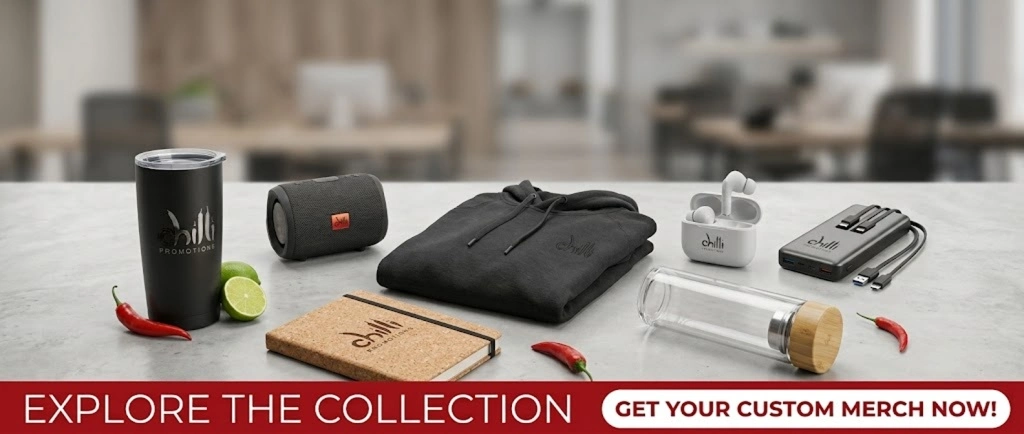
Chilli Promotions has supplied custom-branded promotional products and corporate gifts across Australia and New Zealand since 2001, with carbon-offset and sustainable ranges built into standard catalogue options rather than offered as a costly add-on. Whether you need bulk drinkware for a general-attendee giveaway or a fully kitted VIP experience, the team works as a partner on the brief rather than just processing an order.
Browse 20 promotional products for corporate giveaways to shortlist categories for your next event, or head to the promotional products range to request a quote and sample kit ahead of your booking deadline.
FAQ
What is good conference swag?
Good conference swag is useful, portable, and aligned with your brand’s perceived value, items like insulated drink bottles, quality apparel, and tech accessories that attendees genuinely use after the event rather than discard.
What are some cool swag ideas?
Enamel pins, wireless charging pads, dot-grid notebooks with QR-linked resources, and curated wellness kits all rank among the most kept booth giveaway ideas, largely because they solve a real problem rather than sitting idle.
What are some good conference swag ideas for 2026?
The strongest 2026 categories are drinkware, tech and travel accessories, retail-quality apparel, eco-friendly materials, and tiered VIP kits, distributed through a mix of on-site handouts and digital redemption to avoid luggage friction. Chilli Promotions supplies most of these categories with sustainable options built in.
What are some cool conference merch options?
Retail-forward merch like structured caps, heavyweight crewnecks, and engraved stainless steel tumblers consistently outperform cheap novelty items, especially when packaged as part of a themed kit rather than handed out individually.