The most effective bank customer retention gift ideas share four traits: they’re modest in value, obviously professional, matched to the client segment and occasion, and tracked through a simple compliance-first policy. Get those four right and gifting becomes a retention lever rather than a compliance headache.
Here’s the shortlist that works across most banking relationships:
- Premium stationery (leather folios, quality pens) — client onboarding and account opening
- Insulated drinkware (branded flasks, coffee cups) — everyday retail thank-yous and branch events
- Curated hampers — mortgage settlement, renewal milestones
- Experience vouchers (dining, wine tasting) — high-value renewals and referrals, within threshold
- CSR-linked donations — deal closes where a personal gift risks looking transactional
- Tiered personalised keepsakes (engraved items) — long-tenure anniversaries
- Branded tech accessories — SME and corporate client onboarding kits
- Seasonal gift boxes — end-of-year relationship maintenance across the client book
Pro Tip: Keep the gift modest, keep it useful, and log it the same day it leaves the building. A five-minute entry in a gift register saves hours of compliance review later.
Key Takeaways
Effective bank customer retention gifting pairs a modest, segment-matched item with a documented approval threshold and a gift register entry made the same week.
| Point | Details |
|---|---|
| Match gift to segment | Use low spend for retail, medium to high for HNW, and functional branded kit for SME clients. |
| Time gifts to genuine milestones | Onboarding, renewal, and referral moments outperform generic seasonal sends for retention impact. |
| Set clear value thresholds | Entry gifts under $50 need no approval; anything above $150 needs documented senior sign-off. |
| Log everything within five days | A centralised gift register with approval workflow keeps the program compliant and auditable. |
| Use a specialist for scale | Chilli Promotions handles sourcing, subtle branding, kitting, and compliance paperwork for bank gifting programs of any size. |
Table of Contents
- Why bank customer retention gift ideas actually work
- Gift ideas by occasion: onboarding, renewal, referral, and season
- How do you match gifts to different customer segments?
- What are the best gift categories for banking clients?
- How much should a bank spend on client gifts?
- What should a bank’s client gifting policy cover?
- How should you handle packaging, timing, and privacy?
- How do you measure the retention impact of gifting?
- When should a bank use a specialist gift-fulfilment partner?
- What I’d actually do if I ran a bank’s gifting program
- How Chilli Promotions supports a compliant bank gifting program
- FAQ
Why bank customer retention gift ideas actually work
Gifting works because it changes how a client feels about a relationship they mostly experience through statements, fees, and phone queues. A well-timed, well-chosen gift is one of the few moments a bank shows up as a human relationship rather than a transaction ledger. That shift in perception is what drives the retention effect, not the dollar value of the item itself.
The signal, not the spend: Best-practice etiquette guidance is clear that a business gift should never imply an obligation. The gift’s job is to say “we value this relationship,” not “you owe us something.” Get that balance wrong and even an expensive gift can damage trust rather than build it.
Quality matters more than volume in financial services specifically, because clients judge a bank’s gifts against a backdrop of professionalism and discretion. Industry commentary on financial services gifting confirms that quality premium items outperform mass-market giveaways for recall and client sentiment. A single well-made hamper beats five branded pens handed out indiscriminately.
Three reasons this matters for retention specifically:
- Clients remember experiences and quality items far longer than fee waivers or rate discounts
- A tasteful gift reinforces the sense that a relationship manager knows the client, not just the account number
- Consistent, policy-backed gifting signals operational maturity to corporate and SME clients evaluating a banking relationship
None of this works without measurement, which we cover in detail further down, but the short version is: track sentiment and referral rate changes against a control group before scaling any gifting program.
Gift ideas by occasion: onboarding, renewal, referral, and season
For most banks, three gift types cover the bulk of occasions: a welcome item at onboarding, a milestone item at renewal or anniversary, and a thank-you item for referrals. Seasonal sends round out the calendar without needing a special trigger.
Onboarding and new signings. A new mortgage or account relationship is the highest-leverage moment to make an impression, because the client is actively forming their opinion of the bank. Strong options include a branded leather document wallet, a quality insulated mug for the first coffee meeting, a small welcome hamper delivered to the home, or a locally sourced gift box that signals genuine effort rather than a mail-merge. Chilli Promotions’ guide to mortgage client appreciation gifts covers this moment in more depth.

Anniversaries and renewals. These moments reward acknowledgement more than extravagance. A personalised keepsake marking five or ten years with the bank, a curated hamper timed to the renewal conversation, or a premium notebook and pen set all land well without appearing transactional.

Referrals and thank-yous. Referral gifts need to feel like genuine gratitude, not payment for a lead. A quality branded item, a donation made in the client’s name, or a handwritten note paired with a modest gift usually outperforms anything that looks like a reward scheme.
Seasonal and holiday sends. End-of-year hampers, branded diaries for the new year, or a small charitable donation in the client’s name work across the whole client book without needing individual justification.
Pro Tip: Never send a gift during an active tender, procurement review, or loan approval decision. Even a modest item sent at the wrong moment can look like it’s trying to influence an outcome, and that’s the fastest way to trigger a compliance review.
Gift cards, cash, and expensive experiences are the three categories that most reliably raise compliance questions, because they read as cash equivalents. If in doubt, choose a physical, branded, clearly professional item instead.
How do you match gifts to different customer segments?
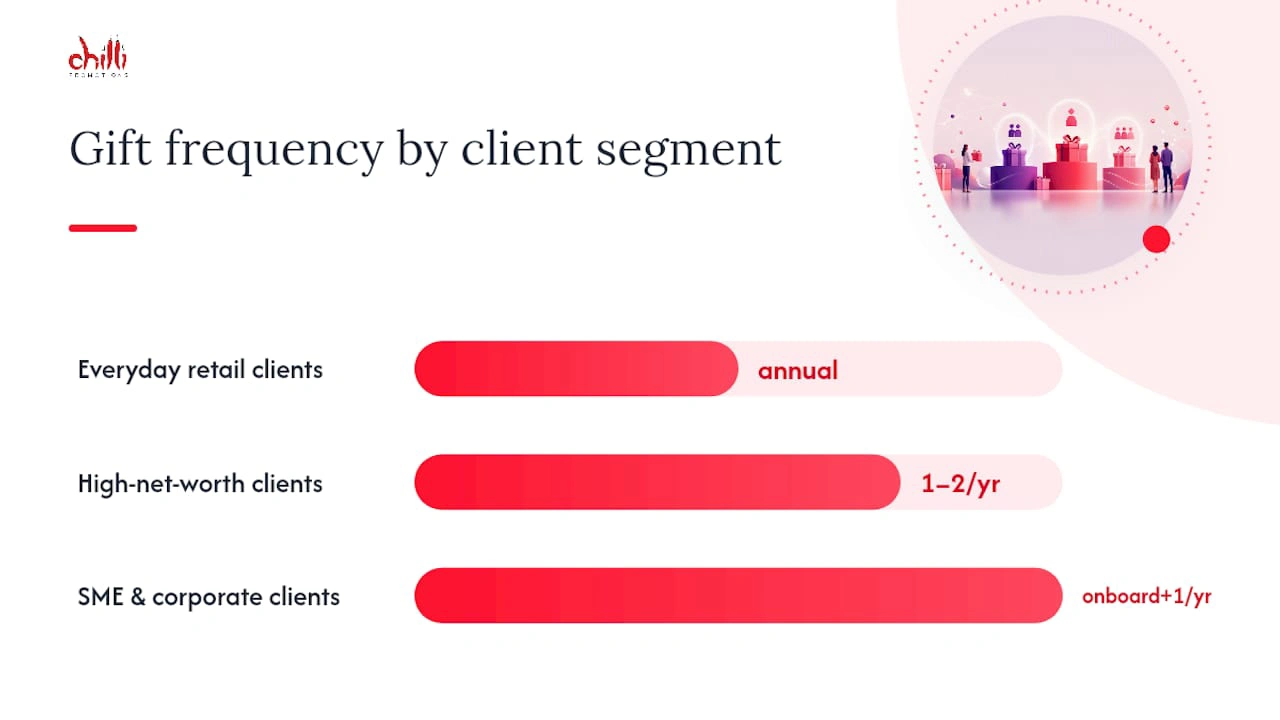
The right gift depends on who’s receiving it. Everyday retail clients respond to useful, modest items; high-net-worth and private banking clients expect quality and discretion; business and SME clients want something functional they’ll actually use in the office.
Here’s a working segment map:
- Everyday retail clients: insulated drinkware, branded stationery, seasonal hampers. Spend band: low, with modest value appropriate for annual or milestone-triggered frequency.
- High-net-worth / private banking clients: curated hampers, premium leather goods, experience vouchers. Spend band: medium to high, subject to internal thresholds. Frequency: one to two touchpoints per year, tied to genuine milestones.
- SME and corporate clients: branded tech accessories, professional kit (folios, quality bags), team-oriented gift boxes for the client’s whole office. Spend band: medium per recipient. Frequency: onboarding plus one annual relationship-maintenance send.
Chilli Promotions’ work on community banking merchandise shows how regional branches apply a similar tiered logic at branch level, scaling gift value to relationship depth rather than treating every client identically.
The principle underneath all three tiers is the same: retail clients want utility with a touch of discretion, HNW clients want quality and exclusivity without ostentation, and business clients want something branded and functional that reflects well on their own office. Get the tier wrong in either direction, either underspending on a valuable relationship or overspending on a modest one, and the gift stops doing its job.
What are the best gift categories for banking clients?
Seven categories consistently perform well for banks: premium stationery, insulated drinkware, curated edible hampers, branded tech accessories, experience vouchers, charitable donations, and branded professional kit. Each has a clear rationale for financial services specifically.
- Premium stationery — leather folios and quality pens signal professionalism and get used in client meetings, keeping the bank’s brand visible without being loud about it.
- Insulated drinkware — a well-made flask or coffee cup gets daily use, which is exactly the kind of quiet, repeated brand exposure that builds familiarity over time. Chilli Promotions’ overview of why branded merchandise builds bank trust explains this repetition effect in more detail.
- Curated edible hampers — locally sourced hampers feel personal and are easy to scale across a client book without individual customisation.
- Branded tech accessories — wireless chargers, quality cable organisers, or laptop sleeves work particularly well for SME and corporate clients who’ll use them at their own desks.
- Experience vouchers — dining or tasting experiences work for higher-value relationships, provided the value sits comfortably under approval thresholds.
- Charitable donations — a donation made in the client’s name avoids any appearance of a personal favour while still marking the occasion meaningfully.
- Eco-friendly and sustainable ranges — increasingly expected by corporate clients auditing their own supply chains; Chilli Promotions covers this shift in its guide to sustainable banking merchandise.
The items that cause the most trouble are the ones that look like cash. Gift cards, vouchers redeemable for cash, and anything resembling a personal favour (jewellery, alcohol as a stand-alone gift in some jurisdictions, or anything gender or age-specific) create discomfort or compliance flags. Keep branding subtle and packaging high-quality. A discreet debossed logo on a leather folio reads as far more professional than a large printed logo on a cheap item, and it’s the packaging and finish, not the size of the logo, that tells the client the gift was chosen with care.
How much should a bank spend on client gifts?
The rule of thumb: entry-level gifts sit under a modest threshold and need no special approval, mid-tier gifts in a moderate range need a manager sign-off, and anything above a higher threshold needs documented senior approval plus a note in the gift register.
A simple three-band structure keeps this manageable:
- Entry band (under $50): standard onboarding items, seasonal hampers, everyday retail thank-yous. No approval required beyond standard budget allocation.
- Mid band ($50–$150): renewal gifts, referral thank-yous, SME onboarding kits. Requires line-manager approval and a register entry.
- Premium band (above $150): HNW relationship gifts, major anniversary sends. Requires senior or compliance sign-off before dispatch, in line with the tiered spending patterns seen across financial services firms of different sizes.
Frequency matters as much as value. Most policies cap gifting to one or two touchpoints per client per year outside genuine milestones, because repeated gifting to the same client can accumulate into a reportable pattern even when each individual item sits under threshold.
Pro Tip: Check with your finance or tax team on fringe benefits tax treatment before scaling any gifting program. FBT rules can apply differently depending on whether the recipient is a client versus an associate of an employee, and getting this wrong creates a tax exposure that’s far more costly than the gifts themselves.
What should a bank’s client gifting policy cover?
Treat client gifting as a controls process, not a marketing free-for-all. Every professional gifting guide converges on the same structure: value thresholds, an approval workflow, and a central register.
A workable compliance checklist covers:
- Value thresholds clearly defined per band, matching the entry/mid/premium structure above
- Approval workflow naming who signs off at each threshold, with escalation for anything above the premium band
- Gift register fields: recipient, date, item, value, occasion, approver
- Restricted recipient lists, particularly government officials or clients involved in active tenders
- Time-sensitive rules barring gifts during procurement or loan decision windows
Sample policy lines worth adopting directly:
- No cash or cash-equivalent gifts (gift cards) above a low threshold, echoing the approach large corporate anti-bribery policies take with cash and near-cash items
- Prior written approval required for anything above the mid-tier threshold
- Register entries logged within five business days of dispatch
- Where a gift can’t be accepted or declined gracefully, donate it or share it across the team rather than returning it awkwardly
The Reserve Bank of Australia’s own code of conduct applies value caps and mandatory recording for gifts above threshold, which is a useful benchmark for any regulated institution drafting its own policy. Practical company gift policy templates built for the Australian market follow the same shape and are a solid starting point for drafting.
Pro Tip: A centralised, automated gift log that flags anything approaching threshold before it’s dispatched removes most of the manual review burden. Firms that treat gifting as a controls process rather than an ad hoc courtesy report far fewer compliance incidents.
How should you handle packaging, timing, and privacy?
Personalise the note and the packaging, keep the personal data collected to the bare minimum, and build in enough lead time for anything customised.
Fulfilment options fall into three categories, and the right choice depends on volume:
- In-house packing works for small client books or one-off sends where a personal touch matters more than speed
- Partner kitting suits mid-size programs where consistency across dozens or hundreds of recipients matters
- Direct-ship via vendor is the practical choice once a program scales past a few hundred recipients per year
A short privacy and personalisation checklist:
- Keep printed labels to name and delivery address only; avoid printing account details or relationship values anywhere on packaging
- Offer an opt-out for clients who’d rather not receive gifts, and record that preference
- Get explicit consent before including any dietary-specific items (a hamper with alcohol or particular allergens)
- Keep records only as long as needed for the gift register and tax purposes, not indefinitely
Build in lead time. Engraving, debossing, and any custom embossing typically need one to two weeks minimum, and seasonal windows (end of financial year, EOFY gifting, Christmas) compress supplier capacity fast. Order early rather than reacting to the calendar.
How do you measure the retention impact of gifting?
Measure gifting impact with a simple cohort test: give a defined group of clients a gift, leave a matched control group ungifted, and compare retention and referral behaviour over the following two to three renewal cycles.
Track a small, consistent set of KPIs rather than trying to measure everything:
- Retention rate change between gifted and control cohorts
- Referral rate from gifted clients versus baseline
- Net Promoter Score movement following the gift
- Average revenue or product uptake per client over the following twelve months
- Simple engagement signals: email open rates, event attendance, or branch visit frequency
Run the test with a large enough cohort that a genuine shift is visible rather than noise. Even a modest test, one branch’s client book split into gifted and ungifted groups over a single renewal cycle, gives a usable early signal before committing budget bank-wide. Treat the first cycle’s results as directional. A single quarter rarely proves causation on its own, but a consistent pattern across two or three renewal cycles is a strong basis for scaling the program.
When should a bank use a specialist gift-fulfilment partner?
Bring in a specialist partner once volume, compliance documentation, or personalisation turnaround start straining internal resources. Trying to manage engraving, kitting, and compliance paperwork manually past a few hundred recipients a year usually costs more in staff time than it saves.
When scoping a partner, banks should require:
- Subtle, professional branding options (blind debossing rather than loud logo printing)
- Compliance paperwork on request, including GST and FBT guidance where relevant
- Sample approval before any bulk production run
- Secure, trackable fulfilment with delivery confirmation
A practical example: a mortgage onboarding kit for a regional lender might include a leather document wallet, an insulated flask, and a welcome card, all kitted and shipped directly to new clients within 48 hours of loan settlement, with a compliance export ready for the quarterly audit. That kind of turnaround is difficult to replicate with an internal team juggling other priorities.
Pro Tip: Contract for lead times, quality thresholds, and replacement guarantees explicitly. A supplier who can’t commit to a defined turnaround in writing will cost you the goodwill the gift was meant to build.
What I’d actually do if I ran a bank’s gifting program
Start narrow. I’d pick one client segment, choose a single flagship gift for it, set a hard spend threshold, and pilot it for one quarter before touching any other segment.
My checklist would run: select the segment with the clearest retention risk, pick one gift that fits that segment’s expectations, set the approval threshold in writing before ordering a single item, run the pilot against a control group, and only then decide whether to scale.
The gift register belongs with compliance or operations, not with individual relationship managers, and sign-off should sit one level above whoever’s sending the gift.
How Chilli Promotions supports a compliant bank gifting program
Chilli Promotions supplies compliant, personalised branded gifts and handles fulfilment end to end, so your relationship managers spend their time on clients, not on sourcing and packing.
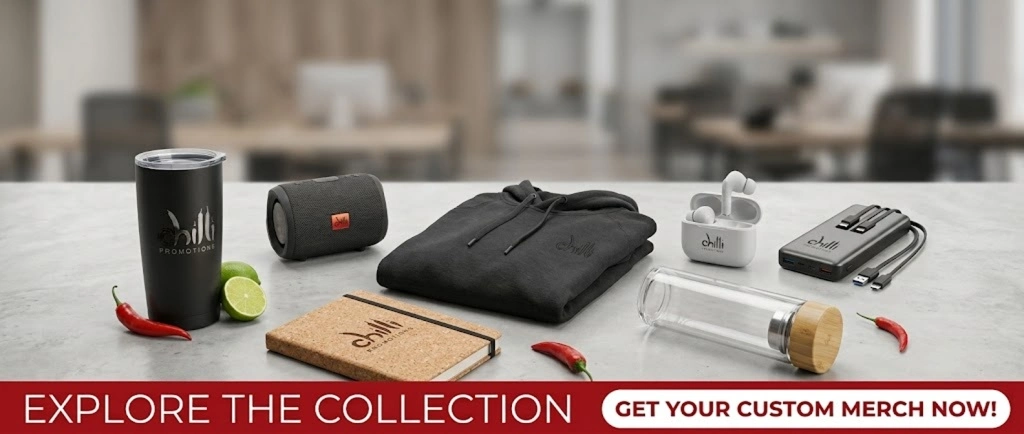
Since 2001, Chilli Promotions has manufactured and supplied custom-branded promotional products across Australia and New Zealand, including subtle debossing and embossing options that suit the discretion financial services clients expect. The service covers product sourcing, kitting and direct-ship logistics, and compliance paperwork you can hand straight to your gift register, alongside eco-friendly ranges for banks with sustainability commitments to meet. Chilli Promotions has also built out sector-specific guidance, including examples of bank staff wellness gifts, reflecting genuine experience with how financial institutions think about gifting internally and externally.
If you’re drafting a pilot program, browse the banking and finance promotional products range for ideas that fit the segment thresholds outlined above, or request a sample and quote through the promotional products catalogue to see finish and packaging quality before committing budget.
FAQ
What are some good gift ideas for bank customers?
Premium stationery, insulated drinkware, curated hampers, and branded tech accessories work well because they’re modest, professional, and get repeated use, which keeps the bank’s brand visible without looking like a promotional freebie.
What are some creative customer appreciation ideas for banks?
Beyond one-off gifts, banks can send milestone hampers timed to loan settlement or account anniversaries, make a charitable donation in a client’s name for referrals, or offer an experience voucher for long-tenure relationships, provided the value sits within approval thresholds.
What are some unique client gift ideas for financial services?
Personalised keepsakes marking a specific tenure milestone, locally sourced hamper boxes, and subtly branded professional kit like leather folios tend to stand out precisely because they avoid looking mass-produced.
How much should a bank spend on a client gift?
Most banks work off a three-band structure: under $50 needs no special approval, $50 to $150 needs manager sign-off, and anything above $150 needs documented senior or compliance approval before dispatch.
Can banks give clients gift cards or cash?
Cash and cash-equivalent gifts like gift cards are the items most likely to trigger compliance concerns, and most bank anti-bribery policies either restrict or prohibit them outright above a low threshold.