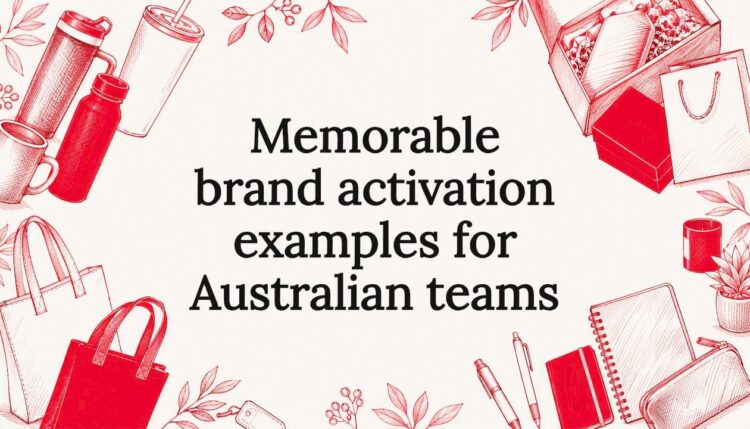
Eight promotional-product activation formats worth briefing today:
- Conference swag packs — branded drinkware or tote bags distributed at industry events; hero product: insulated drink bottle; KPI: estimated impressions per week of use.
- New employee welcome kits — curated branded packs sent on day one; hero products: notebook, pen set, apparel; outcome: faster cultural onboarding.
- Student engagement packs — branded merchandise for recruitment events distributed at open days or O-Week; hero products: tote bags, stationery; outcome: brand recall among prospective students.
- Employee WFH kits — work-from-home gift packs for distributed teams; hero products: desk accessories, tech accessories; outcome: team cohesion and retention signals.
- Sustainability activations — eco-friendly corporate gifts replacing single-use items; hero products: recycled-content bags, plant-based pens; outcome: brand alignment with environmental values. ♻
- Loyalty and milestone gifts — tiered gifts for long-term clients or staff anniversaries; hero products: premium drinkware, quality apparel; outcome: deepened relationships.
- Retail sampling bundles — branded product samples paired with a gift; hero products: branded pouches, reusable bags; outcome: trial conversion uplift.
- Targeted direct-mail kits — personalised packs sent to prospects or donors; hero products: notebooks, branded confectionery; outcome: response rate uplift.
Australian Consumer Law (ACL) governs transparency in all promotional gifting. Chilli Promotions has supplied custom-branded merchandise across Australia and New Zealand since 2001, with carbon-offset and eco-friendly options available across all eight formats above.
Key takeaways
Promotional-product activations work when utility, compliance, and fulfilment reliability are built into the brief from the start.
Table of Contents
- Why do promotional-product activations create memorable brand presence?
- Ten procurement-ready examples of memorable brand activations
- How do you choose products and design them so recipients keep them?
- What budget bands and lead times should procurement plan for?
- What are the Australian legal and compliance requirements for promotional activations?
- How do you measure the impact of a promotional-product activation?
- Supplier and procurement checklist: what to ask before you commit
- What actually makes a brand activation memorable, in practice?
- Chilli Promotions: custom merchandise, eco options, and procurement support
- Sources
- FAQ
Why do promotional-product activations create memorable brand presence?
Physical products earn their place in daily routines in a way digital ads simply cannot. A quality drink bottle on a desk, a notebook in a bag, or a branded tote on a commute each generate repeated, low-cost impressions that feel like service rather than advertising. Utility-first items like notebooks, drink bottles and pens create exactly this kind of subconscious, repeated brand exposure.
The mechanics behind this are straightforward:
- Physical presence in daily routines builds habitual brand recall without requiring the recipient to opt in each time.
- Emotional association forms when a useful gift solves a real problem; the brand that gave it earns goodwill.
- Cost-per-impression advantages over digital advertising are significant when a single item is used repeatedly over months or years.
- Peer visibility extends reach beyond the original recipient whenever the item is used in public.
The lesson from practitioners across thousands of campaigns is consistent: the most successful promotional products are the ones people genuinely use, not the most expensive or the most novel. Feastables, MrBeast’s chocolate brand, illustrated this principle at scale by choosing a commonplace, everyday product that fit audience habits and generated significant sales during 2024. The underlying logic translates directly to branded merchandise that boosts awareness for Australian organisations: fit the product to the recipient’s life, and the brand follows.
Ten procurement-ready examples of memorable brand activations
- Conference swag pack — Insulated drink bottles and branded tote bags distributed at a national industry conference. Audience: delegates and speakers. Expected outcome: ongoing brand visibility post-event. KPI: estimated weekly impressions (uses per week × recipients). Procurement note: allow 4–6 weeks for custom print runs; budget typically sits in the mid range.
- New employee welcome kit — A curated branded pack including a quality notebook, pen set, and a branded hoodie or polo, delivered on day one. Audience: new hires. Expected outcome: faster cultural alignment and reduced early attrition. KPI: estimated retention rate after approximately 90 days. Procurement note: stage deliveries to HR onboarding calendar; confirm apparel sizing data in advance.
- Student engagement pack — Branded tote bags, stationery sets, and a reusable cup distributed at university open days or O-Week activations. Audience: prospective students. Expected outcome: brand recall and enrolment enquiry uplift. KPI: enquiry conversion rate pre- and post-activation. Procurement note: minimum order quantities often apply; confirm 6–8 weeks ahead of semester dates.
- Employee WFH kit — Desk accessories, a branded notebook, and a tech accessory (cable organiser or wireless charger) sent to remote staff. Audience: distributed employees. Expected outcome: team cohesion and visible brand presence in home offices. KPI: employee engagement survey scores. Procurement note: fulfilment to multiple addresses adds lead time; confirm addresses 3 weeks prior.
- Sustainability activation swap — Replacing single-use plastic giveaways with recycled-content tote bags or plant-based pens at a corporate event. Audience: clients and staff. Expected outcome: brand alignment with sustainability values and reduced waste. KPI: volume of single-use items displaced. Procurement note: eco-certified products may carry a slight premium; request NoCO2 documentation from your supplier.
- Loyalty milestone gift — Premium branded drinkware or quality apparel gifted to clients at 5- or 10-year relationship milestones. Audience: long-term clients. Expected outcome: deepened relationships and referral intent. KPI: net promoter score change among gift recipients. Procurement note: higher-value gifts require management sign-off per ACL best practice; budget in the premium band.
- Retail sampling bundle — A branded reusable pouch containing product samples, distributed in-store or at a pop-up. Audience: retail shoppers. Expected outcome: trial conversion and repeat purchase uplift. KPI: redemption rate on an enclosed offer code. Procurement note: coordinate with retail partners on distribution windows; allow 3–4 weeks for pouch production.
- Targeted direct-mail kit — A personalised pack containing a branded notebook and a handwritten note, mailed to high-value prospects or major donors. Audience: prospects or donors. Expected outcome: response rate uplift and meeting conversion. KPI: response rate versus control group. Procurement note: personalisation adds fulfilment time; budget for variable data printing.
- Graduate recruitment pack — Branded apparel, a quality pen, and a campus-specific tote distributed at graduate fairs. Audience: final-year students. Expected outcome: employer brand recall and application rate uplift. KPI: applications from targeted campuses. Procurement note: apparel sizing and colour matching to brand guidelines requires an approved proof before production.
- Post-event follow-up kit — A small branded gift (quality pen or desk item) mailed within 48 hours of a sales event or conference meeting. Audience: warm leads. Expected outcome: conversion rate uplift and shortened sales cycle. KPI: meeting-to-proposal conversion rate. Procurement note: keep a standing stock of follow-up items to enable fast despatch; review seasonal promotional merchandise ideas to keep the range fresh.
How do you choose products and design them so recipients keep them?
The single most reliable predictor of whether a branded item stays in use is daily utility. Quality and subtle branding come next. Maximum logo coverage is rarely the answer.
- Daily utility first — choose items recipients reach for every day: drink bottles, notebooks, quality pens, tote bags, and tech accessories.
- Durability — a product that fails within weeks damages brand perception; request samples and test before committing to a production run.
- Design aesthetics — restrained, well-placed branding outperforms oversized logos; recipients are more likely to use an item that looks good.
- Apparel sizing and fit — confirm size runs match your audience demographic; poorly fitting apparel goes unworn.
- Tech compatibility — for tech accessories, confirm compatibility with current device standards before ordering.
- Eco credentials — recycled-content materials, plant-based inks, and carbon-offset production reduce waste and increase long-term brand impressions when recipients keep and use the item. 🌿
Pro Tip: Ask your supplier for a physical sample before approving artwork. Colour on screen rarely matches colour on product, and tactile finishes (soft-touch coating, debossing) can only be assessed in hand. A sample approval step protects your budget and your brand.
For drinkware specifically, branding placement and print method directly affect how long the decoration lasts; laser engraving outlasts pad printing on metal bottles.
What budget bands and lead times should procurement plan for?
Budget and timeline planning is where many activations stall. The three indicative bands below are a starting framework; every campaign requires a formal quote based on quantity, product specification, and decoration method.
- Low band — items such as branded pens, stickers, or simple tote bags; suitable for high-volume, wide-distribution activations where per-unit cost is the primary constraint.
- Mid band — items such as notebooks, ceramic mugs, or basic apparel; the most common range for conference packs, welcome kits, and student engagement programmes.
- Premium band — items such as insulated stainless-steel drink bottles, quality apparel, or tech accessories; appropriate for loyalty gifts, executive packs, and milestone recognition.
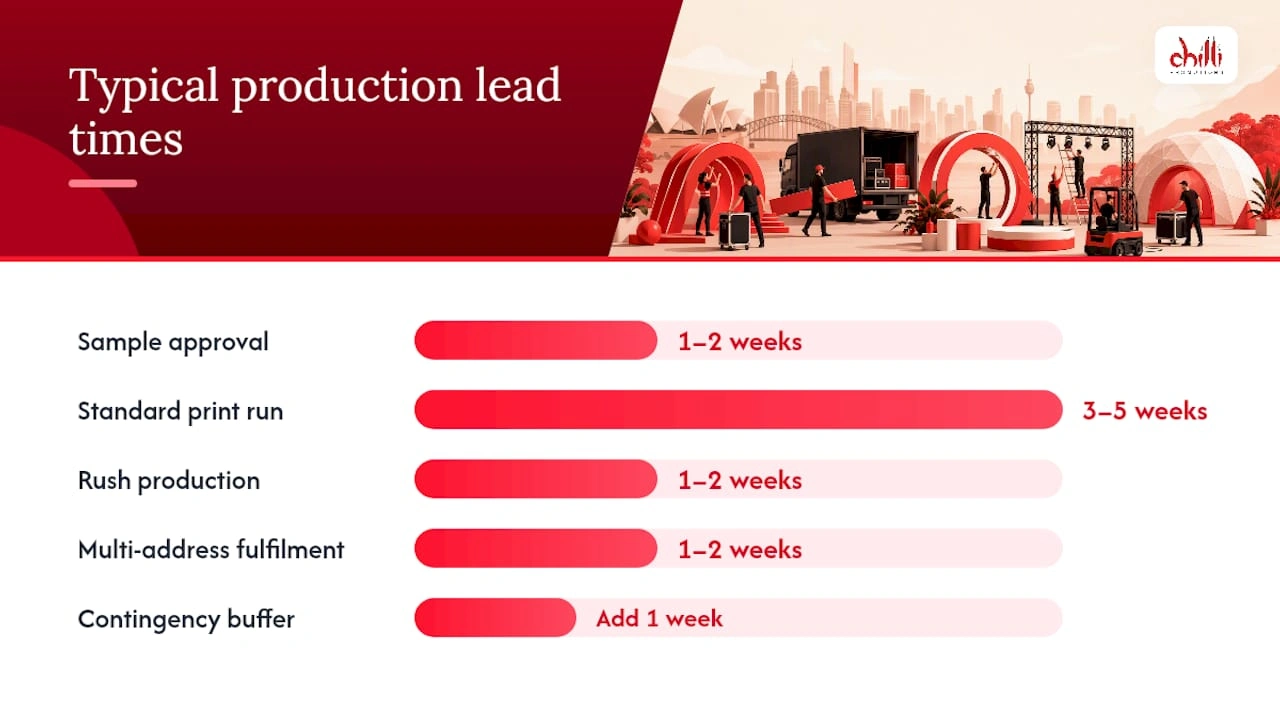
| Planning stage | Typical lead time |
|---|---|
| Sample approval | 1–2 weeks from artwork sign-off |
| Standard custom print run | 3–5 weeks from approved sample |
| Rush production (where available) | 1–2 weeks, with a rush fee applied |
| Fulfilment to multiple addresses | Add 1–2 weeks to production lead time |
| Contingency buffer (recommended) | Add 1 week minimum for all campaigns |
Procurement tips worth building into every brief: request samples before approving production; confirm minimum order quantities (MOQs) upfront; stage deliveries to match event or onboarding calendars; and always hold a contingency buffer of at least one week for supply chain delays.
What are the Australian legal and compliance requirements for promotional activations?
Transparency in promotion terms and thorough record-keeping are the two non-negotiable foundations of ACL compliance for any gifting or promotional programme.
- Publish clear terms — any promotion linked to a purchase, competition, or giveaway must have terms that are accurate, accessible, and not misleading under the ACL.
- Check trade-promotion permit requirements — some Australian states require permits for trade promotions involving prizes; requirements vary by state and prize value. Confirm your obligations before launching.
- Keep gift records — maintain a register of gifts given, including recipient, value, and date, to support both tax and ACL compliance.
- Require management sign-off for gifts over $150 — this internal control reduces legal and reputational risk and aligns with best-practice gift policy guidance.
- Audit privacy and data handling — if your activation involves a competition or fulfilment that collects personal data, review your privacy disclosures and ensure they comply with the Privacy Act 1988.
- Seek legal or tax advice for complex programmes involving high-value gifts, FBT implications, or multi-state promotions.
This section provides general information only and is not a substitute for legal or tax advice. Confirm current requirements with a qualified professional or the relevant state authority.
How do you measure the impact of a promotional-product activation?
Link every activation to a business goal before you order a single item. Awareness, retention, and conversion each require different metrics.
- Distribution reach — total number of items distributed; the baseline denominator for all other metrics.
- Estimated impressions — uses per week multiplied by recipients multiplied by campaign duration in weeks; a practical proxy for ongoing brand exposure.
- Retention/keep rate — surveyed or observed proportion of recipients still using the item at 30 or 90 days post-distribution.
- Redemption rate — for activations with an enclosed offer code or QR scan, the proportion of recipients who redeem; a direct conversion signal.
- Cost-per-impression (CPI) — total campaign cost divided by estimated total impressions; allows comparison with digital channel benchmarks.
- Event follow-up conversion — meeting-to-proposal or enquiry-to-application rate for activations tied to specific events.
A simple CPI calculation: if a mid-band activation costs $3,000 for 200 items and each item generates an estimated 5 impressions per week over 20 weeks, total estimated impressions are 20,000, giving a CPI of $0.15. For a deeper framework, the promotional products ROI guide for Australian marketers covers tracking methods including unique codes, QR scans, and follow-up surveys.
Supplier and procurement checklist: what to ask before you commit
Get these answers before approving any quote.
- Request a physical sample — confirm colour, finish, and decoration quality before production begins.
- Confirm MOQ and pricing tiers — understand the minimum order quantity and whether pricing changes at higher volumes.
- Clarify the proofing process — ask how many proof rounds are included and what the approval timeline looks like.
- Verify manufacturing origin and lead times — confirm where the product is made and the realistic production and shipping window.
- Check sustainability claims — ask for NoCO2 documentation, recycled-content certification, or ISO 14001 credentials if eco options are specified.
- Confirm insurance and liability — ensure the supplier carries appropriate product liability insurance.
- Ask for references — request at least two references from comparable campaigns in your sector.
- Agree on QA and returns — confirm the defect threshold, QA inspection process, and returns policy before signing off.
- Plan for contingencies — agree on an escalation contact and a contingency plan if supply chain disruption affects delivery.
- Lock approval gates — document who approves samples, proofs, and final despatch; this prevents delays and miscommunication.
Pro Tip: Build a promotional product checklist into your standard supplier brief template. It saves time on every subsequent campaign and gives new procurement team members a reliable starting point.
What actually makes a brand activation memorable, in practice?
After more than two decades working with Australian organisations on promotional programmes, the pattern is clear: utility and fulfilment reliability matter more than novelty or budget size.
Teams often arrive with a brief built around what looks impressive in a presentation. The activations that generate the strongest long-term results are almost always the ones built around what the recipient actually needs. A quality insulated drink bottle used every day for two years delivers far more brand impressions than a novelty item discarded after a week. The role of merchandise in marketing is not decoration; it is a functional touchpoint that either earns its place in someone’s life or ends up in landfill.
The second thing practitioners underestimate is fulfilment. A beautifully designed pack that arrives damaged, late, or with the wrong branding destroys the goodwill the activation was meant to create. Supplier qualification, sample approvals, and contingency planning are not administrative overhead; they are the difference between a campaign that lands and one that becomes a procurement post-mortem.
Chilli Promotions: custom merchandise, eco options, and procurement support
Chilli Promotions gives Australian marketing and procurement teams a single, accountable partner from concept through to fulfilment with Aesthetic Collective’s expert medical aesthetics marketing services. Where other routes require you to coordinate separate suppliers for design, production, and delivery, Chilli Promotions handles sampling, production, branded online stores, and bulk fulfilment under one roof, with carbon-offset and eco-certified product lines available across the range. 🌿
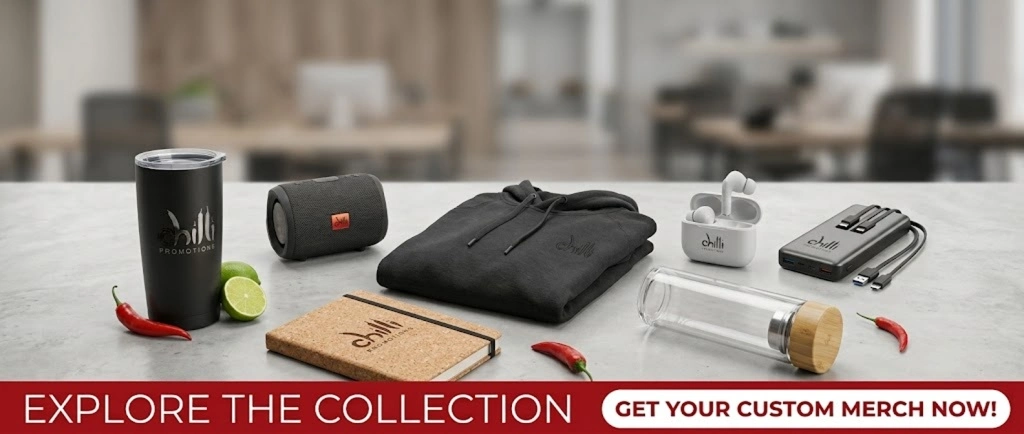
Whether you are briefing a conference swag pack, a sustainability activation, or a loyalty milestone gift, the corporate giveaway product range covers hero items across every budget band, and the team can advise on ACL-compliant terms and eco credentials. Chilli Promotions has supplied custom-branded merchandise across Australia and New Zealand since 2001. Request a quote or sample today to get your next activation moving.
FAQ
What makes a promotional product activation memorable?
Recipients keep and use items that solve a real daily need. Utility-first products like drink bottles, notebooks, and quality tote bags generate repeated brand impressions long after the activation ends.
Do Australian businesses need a permit to run a promotional giveaway?
Some states require trade-promotion permits, particularly when prizes are involved. Check your state’s requirements and publish clear terms to stay compliant with the ACL; Sprintlaw’s guidance covers the key obligations.
What is a realistic lead time for a custom promotional product run?
Standard custom print runs typically take 3–5 weeks from an approved sample, plus 1–2 weeks for sample approval and additional time for fulfilment to multiple addresses. Always build in a contingency buffer of at least one week.
How do you calculate cost-per-impression for a promo-product campaign?
Divide the total campaign cost by estimated total impressions (uses per week multiplied by recipients multiplied by campaign weeks). A mid-band activation generating 20,000 estimated impressions at a $3,000 total cost produces a CPI of $0.15.
Can Chilli Promotions supply eco-certified products for sustainability activations?
Yes. Chilli Promotions offers carbon-offset and eco-friendly product lines, including recycled-content and plant-based options, with NoCO2 documentation available across the range.