TL;DR:
- Seasonal promotional merchandise is most effective when carefully planned as part of a broader digital campaign and ordered well in advance.
- Durable, useful items aligned with the Australian seasonal calendar generate higher impressions and brand engagement over time.
The most effective approach to seasonal promotional merchandise is a planned shortlist of durable, useful items integrated with digital channels — not a last-minute grab from a catalogue. APPA research confirms that 66% of promotional product recipients visit a brand’s website or social channels after receiving a physical item, which means your merchandise is only doing half the job if it stops at the handover. The planning rule that holds across every category: standard orders need 10–15 business days, while complex or large-volume campaigns require 8–10 weeks, so your first action is to lock in a supplier brief and reserve stock before the season hits.
Here is what the most effective seasonal campaigns have in common:
- They match the item to the season and the audience’s actual behaviour, not just the calendar
- They treat merchandise as a physical anchor for email, social and SMS, not a standalone giveaway
- They prioritise quality and useful life over novelty, because a durable item earns more impressions per dollar
- They plan procurement 3–6 months ahead for premium decoration and secure stock during peak periods
- They measure success by whether the item is still in use six months after distribution, not by units handed out
Table of Contents
- What seasonal promotional merchandise ideas work best by season?
- How do you match seasonal items to specific use cases?
- How do you choose sustainable materials without greenwashing?
- How do you pick the right merchandise for your campaign?
- What are typical lead times and costs in Australia?
- How do you turn merchandise into a full campaign asset?
- 30 seasonal promotional merchandise ideas for Australian campaigns
- Does promotional merchandise actually drive results in Australia?
- Key takeaways
- What most planners get wrong about seasonal merchandise
- Chilli Promotions: your seasonal merchandise partner across Australia
- Useful sources
- FAQ
What seasonal promotional merchandise ideas work best by season?
Australia’s seasons run opposite to the Northern Hemisphere, and your merchandise calendar should reflect that. The Australian purchasing cycle has four distinct peaks: late January to February (back to school and new year), March to May (events season), May to June (EOFY), and October to November (pre-Christmas). Plan your product selections around those windows, not a generic global template.
Summer (December–February)
Summer in Australia means outdoor events, beach culture, and long days. Items that travel well and get used in public are your best investment for brand exposure during this period.
- Insulated drink bottles and tumblers: Used daily in the heat, they carry your logo into offices, gyms, and beaches. High perceived value, long useful life.
- Branded beach towels: Ideal for consumer-facing campaigns and staff gifts. Large print area, strong visual impact at outdoor events.
- Cooler bags: Practical for picnics, markets, and sporting events. Reusable, which aligns with sustainability goals and keeps the brand visible across multiple occasions.
- Sunscreen and lip balm sets: Low-cost, high-utility items suited to outdoor event giveaways and health-sector campaigns.
- Branded caps and bucket hats: Wearable advertising with strong summer relevance; embroidery or screen print both work well.
Autumn (March–May)
Autumn is Australia’s peak conference and events season. Items that are portable, desk-friendly, and useful during a full day of sessions perform best.
- Notebooks and journals: A conference staple with a premium feel when paired with a quality pen. FSC-certified paper options are widely available.
- Power banks: High perceived value, used repeatedly, and suited to tech-sector and professional audiences.
- Lanyards and badge holders: Functional at events and low-cost to produce in volume; pair with a QR code for digital integration.
- Tote bags: Carry everything from conference materials to groceries. rPET or organic cotton options align with ESG commitments
- Branded pens and stylus sets: Low-cost, high-volume items that work across every audience.
Winter (June–August)
Winter is EOFY gifting season and the ideal window for premium, desk-side items that recipients keep for months. This is when perceived value matters most.
- Insulated mugs and travel cups: Used every morning, which means daily brand impressions. Laser engraving gives a premium finish that outlasts printed alternatives.
- Knitwear and fleece jackets: High-value staff gifts and client appreciation items. Embroidery holds up wash after wash.
- Premium planners and desk sets: Suited to corporate gifting and onboarding kits. A well-designed planner stays on a desk for the full year.
- Branded blankets: Practical, high-perceived-value items for premium client gifts or staff recognition.
- Candles and wellness kits: Growing in popularity for corporate gifting; pair with branded packaging for an unboxing moment.
Spring (September–November)
Spring brings Earth Day (April in the Northern Hemisphere, but Australian sustainability campaigns often align with September’s Clean Up Australia events), outdoor events, and the pre-Christmas push. Eco and outdoor items lead here.
- Seed packets and plantable cards: Low-cost, memorable, and genuinely sustainable. Compostable packaging available.
- Recyclable tees and organic cotton apparel: Suited to outdoor events, community campaigns, and staff gifting.
- Picnic blankets and outdoor sets: Strong for consumer-facing events and spring activations.
- Reusable coffee cups: Consistent performers year-round, but spring campaigns tie naturally to sustainability messaging.
- Branded sunglasses: Affordable, fun, and highly visible at outdoor events and festivals.
How do you match seasonal items to specific use cases?
Choosing the right item is as much about the marketing job as the season. Matching item choice to attendee behaviour — portable items for long outdoor events, desk items for conferences — is what separates a campaign that gets results from one that fills a bin.
| Use case | Recommended item types | Best for | Budget tier | Procurement note |
|---|---|---|---|---|
| Events & conferences | Notebooks, power banks, tote bags, lanyards | Professional audiences, B2B | Mid to premium | MOQ typically 50–250 units; allow 3–4 weeks |
| Client & corporate gifts | Insulated drinkware, premium planners, knitwear | Retention, relationship-building | Mid to premium | Packaging and personalisation add lead time |
| Staff & onboarding | Apparel, desk sets, wellness kits, branded bags | Internal culture, new starters | Low to mid | Coordinate with HR for sizing and delivery |
| Campaign giveaways | Pens, sunscreen, seed packets, caps | Acquisition, awareness | Low | High MOQ; plan 6–8 weeks for volume |
| Everyday brand visibility | Drink bottles, reusable cups, tote bags | Retention, daily impressions | Low to mid | Durable items justify higher unit cost |
Events and conferences work best with items recipients can use on the day: a tote bag to carry materials, a notebook for sessions, a power bank for a full day away from a desk. Keep MOQs in mind — most quality suppliers require a minimum of 50 units for decorated items, and 250 or more for lower-cost categories.
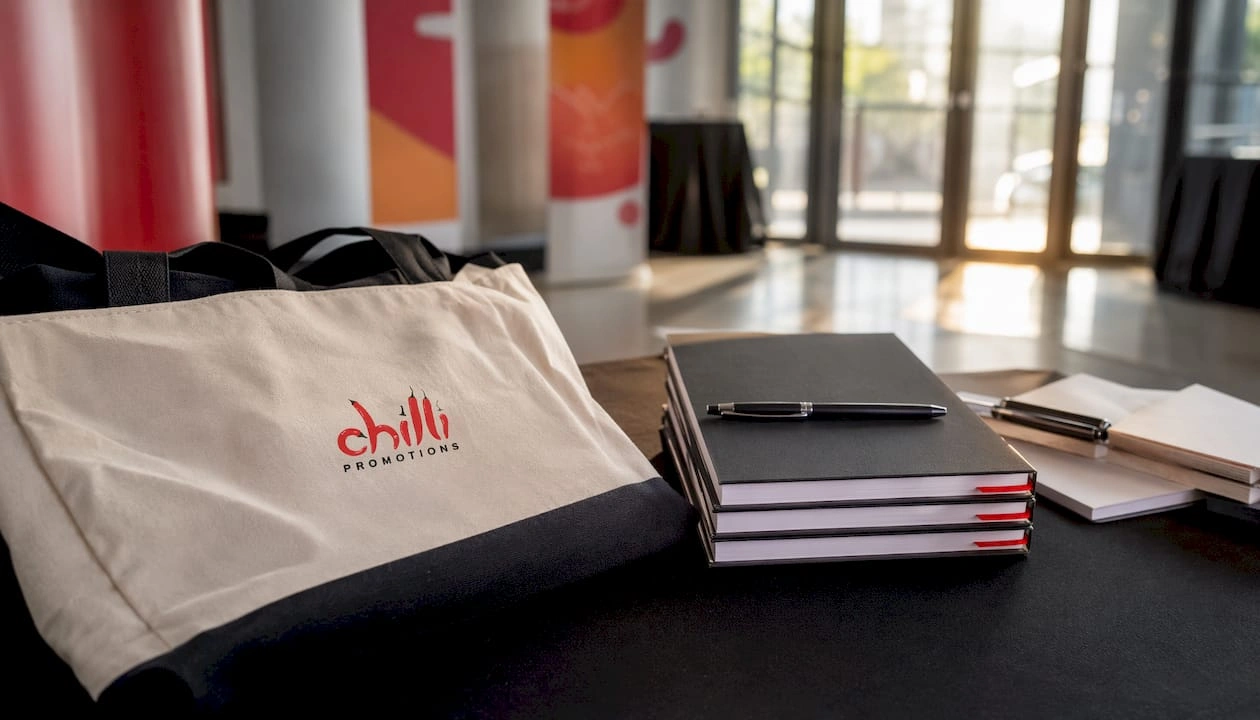
Client gifts are where personalisation pays off. Adding a recipient’s name alongside your logo can raise perceived value by over 50% and significantly reduce discard rates. Budget for premium packaging; the unboxing experience is part of the gift.
Staff and onboarding kits benefit from a cohesive set rather than a single item. A branded notebook, pen, and drink bottle in a quality bag signals investment in the employee from day one. Coordinate sizing for apparel well in advance.
Campaign giveaways at high-volume outdoor events call for low-cost, high-utility items. Sunscreen sachets, seed packets, and branded pens are practical choices that recipients actually use rather than discard. Volume orders need 6–8 weeks minimum.
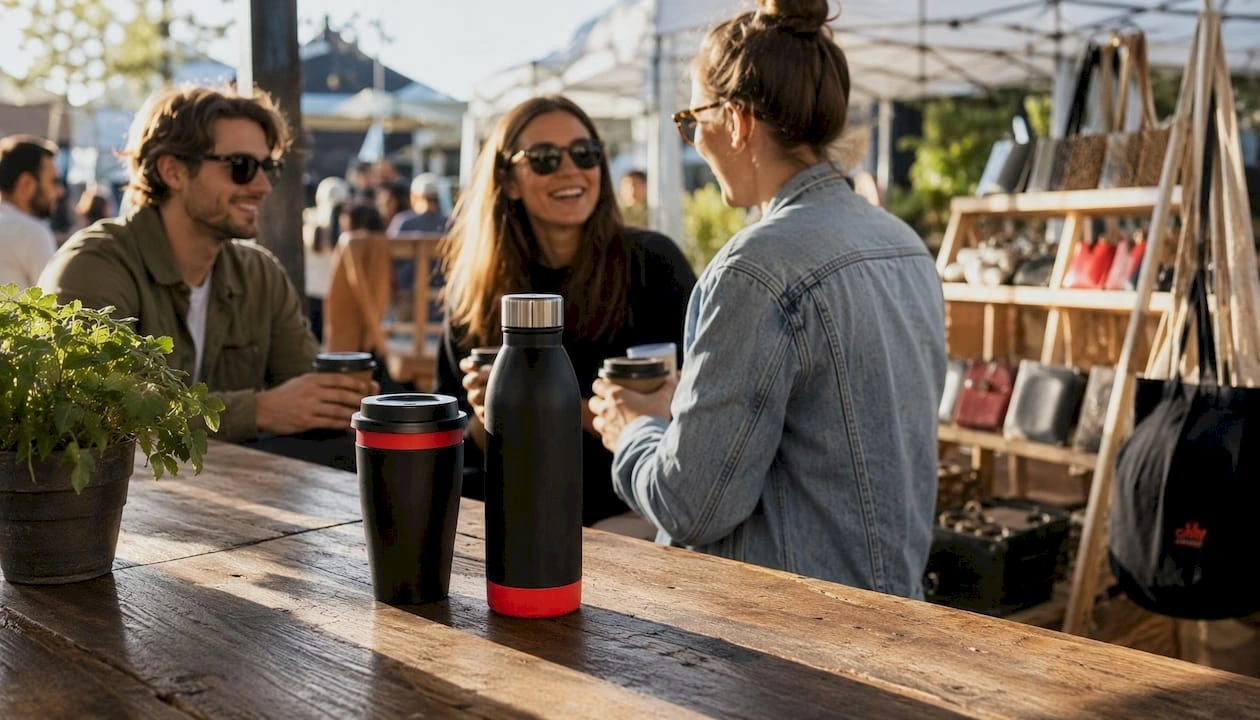
Everyday branded items like reusable coffee cups and drink bottles earn the most impressions per dollar because they travel into workplaces, gyms, and cafés. A quality item used daily for a year delivers far more brand exposure than a novelty giveaway used once.
How do you choose sustainable materials without greenwashing?
Sustainability is no longer a differentiator in Australian promotional merchandise — it is an expectation. The challenge is choosing options that genuinely reduce environmental impact rather than just using the word “eco” on the label. Sustainable merchandise decisions require verifying supplier claims, not just accepting them.
The practical eco categories to understand:
- rPET (recycled polyethylene terephthalate): Bottles and bags made from recycled plastic. Ask for the recycled content percentage — 100% rPET is meaningfully different from 20%.
- Organic cotton: Grown without synthetic pesticides. Look for GOTS (Global Organic Textile Standard) certification rather than a supplier’s own “organic” claim.
- FSC-certified paper: For notebooks, cards, and packaging. The Forest Stewardship Council certification is independently verified.
- Biodegradable and compostable packaging: Useful for reducing waste at events, but check whether the item requires industrial composting conditions — home compostable is a higher standard.
- Bamboo: A fast-growing, low-input material suited to pens, drinkware, and desk accessories. Verify that the bamboo is not blended with plastics in the product body.
Supplier claims checklist:
- ♻ Ask for the recycled content percentage in writing
- Request third-party certification documents (GOTS, FSC, GRS)
- Confirm end-of-life guidance: is the item recyclable, compostable, or landfill-bound?
- Verify carbon-offset documentation if the supplier claims carbon neutrality
- Check whether eco options carry a price premium and factor that into your budget tier
Pro Tip: Durability and sustainability are not in conflict. A well-made rPET bottle used for two years has a lower environmental footprint than a cheap biodegradable item discarded after one use. Prioritise useful life over the eco label.
In Australia, sustainable options typically add 10–20% to unit cost and can extend lead times by 1–2 weeks if the supplier needs to source certified materials. Build that buffer into your planning. For design guidance on how sustainability choices affect visual identity, merchandise design best practices offer a useful framework for brand managers navigating material and print trade-offs.
How do you pick the right merchandise for your campaign?
Start with the campaign objective, not the product catalogue. Acquisition campaigns need items that attract attention and prompt action. Retention campaigns need items that recipients keep and use. Staff morale programmes need items that feel genuinely valued, not like surplus stock.
Step-by-step selection framework
- Define the objective: Acquisition, retention, staff recognition, or event engagement. Each points to a different item category and budget tier.
- Know your audience: A tech-sector professional audience responds differently to a power bank than a community health audience does to a reusable bag. Match the item to the recipient’s daily context.
- Set a realistic budget tier:
- Low (under $5 per unit): Pens, seed packets, sunscreen sachets, lanyards, stickers
- Mid ($5–$25 per unit): Notebooks, tote bags, reusable cups, caps, power banks
- Premium (over $25 per unit): Insulated drinkware, knitwear, premium planners, tech accessories, gift sets
- Choose the right imprint method:
- Screen print: Best for flat surfaces, high-volume runs, and bold single-colour logos
- Embroidery: Premium finish for apparel and bags; holds up through repeated washing
- Laser engraving: Ideal for metal and hard-surface drinkware; permanent and high-perceived-value
- Full-colour digital print: Suited to complex artwork and short runs
- Confirm MOQ and lead time before committing to a design. Use the promotional product checklist to cover every procurement step.
Vendor questions to ask
- What is the minimum order quantity for this item with decoration?
- Are there set-up fees, and are they included in the quoted price?
- What is the production lead time from artwork approval?
- Can you provide a physical sample before the full run?
- What is your policy on colour variation between the proof and the final product?
Red flags to watch for: Suppliers who quote “stock only” without confirming availability, hidden set-up fees disclosed after artwork approval, and lead times stated in calendar days rather than business days. A reputable supplier will confirm stock, quote all-in pricing, and give you a written timeline from artwork sign-off to delivery.
What are typical lead times and costs in Australia?
Australian purchasing peaks create real pressure on stock and production capacity. Ordering in off-peak months — July and August for Christmas items, for example — can unlock better pricing and priority service. The table below gives conservative planning benchmarks.
| Category | Decoration method | Standard lead time | Complex/large-volume lead time | Ballpark unit cost (AUD) |
|---|---|---|---|---|
| Drinkware (bottles, cups) | Laser engraving / screen print | 10–15 business days | 8–10 weeks | $8–$25+ |
| Apparel (tees, caps, jackets) | Screen print / embroidery | 10–15 business days | 8–10 weeks | $12–$25+ |
| Tech accessories (power banks, cables) | Laser engraving / pad print | 2–4 weeks | 8–10 weeks | $15–$25+ |
| Stationery (notebooks, pens) | Screen print / deboss | 10–15 business days | 4–6 weeks | $2–$25+ |
| Eco items (rPET bags, bamboo) | Screen print / digital | 2–4 weeks | 8–10 weeks | $5–$25+ |
| Premium gift sets | Mixed | 4–6 weeks | 10–12 weeks | $25+ |
Key planning rules:
- EOFY orders (May to June): brief your supplier by March to avoid stock shortages
- Pre-Christmas orders (October to November): brief by August, especially for apparel and premium items
- Complex campaigns with custom tooling or overseas sourcing: allow 3–6 months from brief to delivery
How do you turn merchandise into a full campaign asset?
Physical merchandise performs best when it is the anchor for a broader campaign, not the whole campaign. Treating seasonal items as part of a cohesive campaign — with digital touchpoints before and after distribution — is what drives measurable downstream engagement.
Integration checklist
- Pre-launch teaser (2–3 weeks before distribution): Post a product reveal on social media and send an email preview to your list. Create anticipation before the item arrives.
- Gated redemption: Require a sign-up, survey completion, or event registration to receive the item. This converts a giveaway into a lead-generation moment.
- UGC incentive: Ask recipients to post a photo with the item using a branded hashtag. Offer a secondary prize or recognition for the best post.
- Email follow-up (within 48 hours of distribution): Send a personalised email referencing the item and including a clear CTA linked to a landing page or product page.
- SMS reminder (7 days later): A short message referencing the item and driving to a specific URL. Keep it under 160 characters.
Phygital features worth using
- QR codes on the item or packaging: Link to a landing page, video, or exclusive offer. Track scans to measure engagement.
- Personalised URLs (PURLs): Each recipient gets a unique URL printed on their item or included in follow-up comms. Powerful for measuring individual response rates.
- NFC tags: Embedded in premium items like notebooks or cardholders; tap to open a digital experience. Higher cost, but suited to premium B2B campaigns.
Privacy note: Any data collected through QR codes, PURLs, or NFC interactions must comply with the Australian Privacy Act 1988. Ensure your landing pages include a clear privacy notice and opt-in mechanism before collecting personal information.
Measurement examples
- Useful life at six months: Survey a sample of recipients to confirm whether the item is still in use. This is the most reliable indicator of cost-per-impression.
- Digital click lift: Compare website traffic and social engagement in the two weeks after distribution against the two weeks prior.
- Conversion after sample distribution: Track how many recipients who received an item completed a purchase or booking within 30 days.
A simple campaign example: distribute branded insulated bottles at a winter EOFY event, include a QR code linking to an exclusive post-event offer, follow up by email within 48 hours, and track click-through rate and conversion over 30 days. The bottle stays on the recipient’s desk; the QR code drives the measurable action.
30 seasonal promotional merchandise ideas for Australian campaigns
These 30 items cover every season, use case, and budget tier. Each entry includes a best use case, typical budget tier, and a quick procurement note.
- Insulated stainless-steel drink bottle — Events, staff gifts, everyday visibility. Mid to premium. Allow 2–3 weeks for laser engraving.
- Branded beach towel — Summer consumer campaigns, staff gifts. Mid. Large print area; screen print works well.
- Cooler bag — Summer outdoor events, FMCG campaigns. Mid. rPET options available; confirm recycled content percentage.
- Reusable coffee cup — Year-round, sustainability campaigns. Low to mid. High daily-use rate; strong cost-per-impression.
- Branded cap or bucket hat — Summer events, outdoor activations. Low to mid. Embroidery for longevity; confirm sizing range.
- Sunscreen sachet or SPF lip balm set — Summer outdoor giveaways, health campaigns. Low. High-volume; check TGA compliance for sunscreen products.
- Organic cotton tote bag — Events, retail, sustainability campaigns. Low to mid. GOTS certification available; confirm with supplier.
- FSC-certified notebook — Conferences, corporate gifts, onboarding. Mid. Pair with a branded pen for a complete set.
- Branded pen and stylus set — Conferences, high-volume giveaways. Low. Screen print; confirm MOQ before ordering.
- Power bank — Tech-sector events, premium giveaways. Mid to premium. Confirm battery capacity and airline compliance.
- Lanyard with QR code badge holder — Conferences, trade shows. Low. Functional and trackable; pair with a digital landing page.
- Seed packet or plantable card — Spring events, sustainability campaigns, Earth Day activations. Low. Compostable packaging available.
- Bamboo pen set — Eco-conscious campaigns, conferences. Low to mid. Verify bamboo-to-plastic ratio in the product body.
- rPET fleece jacket — Winter staff gifts, premium client gifts. Premium. Embroidery; allow 4–6 weeks for apparel runs.
- Insulated travel mug — Winter gifting, EOFY client gifts. Mid to premium. Laser engraving for a premium finish.
- Premium desk planner — Corporate gifting, onboarding, EOFY. Mid to premium. Full-year relevance; order by August for pre-Christmas delivery.
- Branded blanket — Winter client gifts, premium staff recognition. Premium. High perceived value; confirm fabric weight and care instructions.
- Picnic blanket — Spring outdoor events, consumer activations. Mid. Large branding area; waterproof backing adds utility.
- Branded sunglasses — Summer and spring outdoor events, festivals. Low. Fun and visible; confirm UV rating for Australian conditions.
- Wellness kit (hand cream, lip balm, sanitiser) — Winter gifting, health-sector campaigns. Mid. Branded packaging adds perceived value.
- Recycled-content tee — Community events, staff uniforms, spring campaigns. Low to mid. Screen print; confirm recycled cotton percentage.
- Branded umbrella — Autumn and winter events, premium client gifts. Mid to premium. Windproof construction justifies the unit cost.
- Wireless charging pad — Tech-sector gifts, premium onboarding kits. Premium. High perceived value; confirm device compatibility.
- Branded water bottle with infuser — Health and wellness campaigns, gym partnerships. Mid. Functional and distinctive; strong for health-sector audiences.
- Custom socks — Staff gifts, fun campaign giveaways, trade shows. Low to mid. Full-colour knit; surprisingly high retention rate.
- Eco gift set (cup, notebook, pen in recycled box) — Corporate gifting, onboarding, EOFY. Premium. Coordinate components for a cohesive unboxing experience.
- Branded USB drive — Tech and education sectors, conference giveaways. Low to mid. Pre-load with campaign content for added value.
- Personalised luggage tag — Travel-sector campaigns, premium client gifts. Low to mid. Laser engraving; hyper-personalisation with recipient names increases perceived value.
- Branded first-aid kit — Community events, safety campaigns, outdoor activations. Low to mid. Practical and long-lasting; strong for health and safety sectors.
- Custom enamel pin or badge — Brand campaigns, community events, collector series. Low. High collectability; works well as a secondary item in a gift set.
Items to avoid: Single-use plastic items (regulatory pressure is increasing in Australia), low-quality novelty items with no practical use (high discard rate, low useful life), and items with no clear connection to the campaign or audience. A gimmick handed out at a conference ends up in a bin; a quality notebook stays on a desk for months.
Does promotional merchandise actually drive results in Australia?
The evidence is clear. APPA’s end-user research shows that 66% of promotional product recipients visit a brand’s website or social channels after receiving a physical item. That figure reframes how you should think about merchandise: it is not a cost centre, it is a channel that drives digital engagement when it is planned and executed well.
The shift in measurement that matters most is moving from units distributed to useful life. An item still in use six months after distribution is generating daily brand impressions at a fraction of the cost of paid media. That is the metric worth tracking first.
Chilli Promotions has been manufacturing and supplying custom-branded promotional products across Australia and New Zealand since 2001. The services cover catalogue sourcing, custom decoration, warehousing, and branded online merchandise stores, with a focus on carbon-offset and sustainable options. For marketers and event planners, that means a single partner who can manage the full programme from brief to fulfilment.
Key proof points for Australian campaigns:
- Seasonal merchandise integrated with digital channels consistently outperforms standalone giveaways
- Durable, useful items reduce cost-per-impression significantly compared to novelty alternatives
- Personalised items with recipient names raise perceived value and reduce discard rates
- Planning 3–6 months ahead for complex programmes avoids rush fees and stock shortages during peak periods
- Branded merchandise that aligns with a recipient’s daily routine earns the most impressions per dollar
Key takeaways
Seasonal promotional merchandise delivers the strongest ROI when durable, useful items are matched to the season, integrated with digital channels, and ordered well ahead of Australian purchasing peaks.
| Point | Details |
|---|---|
| Season-to-item matching | Align product type with Australian seasonal peaks: summer for outdoor items, autumn for conference gear, winter for premium gifts, spring for eco items. |
| Lead-time rule | Standard orders need 10–15 business days; complex or large-volume campaigns require 8–10 weeks. Plan 3–6 months ahead for premium decoration. |
| Sustainability check | Verify recycled content percentage, third-party certification (GOTS, FSC, GRS), and end-of-life guidance before committing to eco claims. |
| Digital integration | Use merchandise as a physical anchor for email, social and SMS campaigns. 66% of recipients visit a brand’s digital channels after receiving a physical item. |
| Chilli Promotions | Chilli Promotions offers catalogue sourcing, custom decoration, warehousing, and branded online stores across Australia and New Zealand, with carbon-offset options. |
What most planners get wrong about seasonal merchandise
The conventional wisdom is that seasonal merchandise is about picking the right product for the right time of year. That is true, but it is the smaller half of the problem. The bigger issue is that most campaigns treat merchandise as a one-way transaction: brand hands over item, recipient takes it home, campaign ends. That model leaves most of the value on the table.
The year-round strategy approach reframes this completely. When merchandise is planned as a physical anchor for a broader campaign — with digital touchpoints before, during, and after distribution — it becomes a measurable channel rather than a sunk cost. The QR code on the bottle, the personalised URL on the notebook, the email follow-up that references the item by name: these are what convert a giveaway into a pipeline moment.
The other thing planners consistently underestimate is the cost of ordering late. Australia’s purchasing peaks are predictable, and every supplier in the country is managing the same demand spikes. A campaign that could have been executed at mid-tier pricing with a quality supplier becomes a rush job at premium cost with whatever stock is left. The planning calendar is not a nice-to-have; it is where the margin is.
Chilli Promotions’ approach is to work as a strategic partner from the planning stage, not just a fulfilment house at the end. That means helping clients map their seasonal calendar, identify the right items for each campaign objective, and build in the lead times that protect quality and budget. The difference between a campaign that works and one that just happens is usually made in the brief, not at the event.
Chilli Promotions: your seasonal merchandise partner across Australia
Seasonal campaigns move fast, and the gap between a great brief and a great outcome is almost always execution. Chilli Promotions gives marketing teams and event planners a single point of contact for the full programme: catalogue sourcing across hundreds of product categories, custom decoration (screen print, embroidery, laser engraving, full-colour digital), warehousing and fulfilment, and branded online merchandise stores for ongoing programmes.
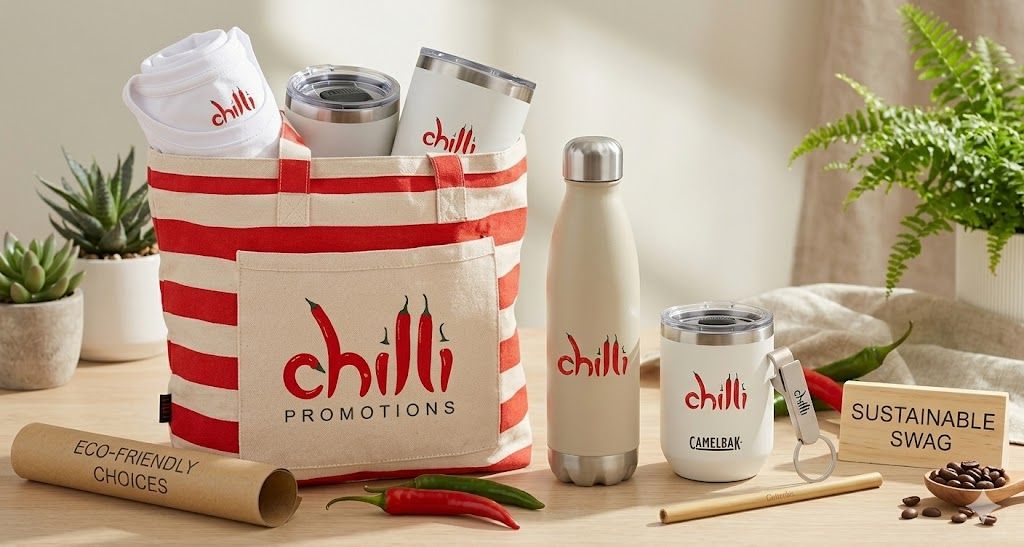
For Australian campaigns, the practical advantages are straightforward. Chilli Promotions manages stock and fulfilment locally, which means shorter lead times on standard orders and reliable delivery to events and offices across the country. The carbon-offset and sustainable product range covers rPET, organic cotton, FSC-certified paper, and bamboo options, all with verified certification documentation. Whether you are planning a summer outdoor activation, a winter EOFY gifting programme, or a year-round branded store for staff and clients, the corporate giveaway range is a practical starting point.
Ready to plan your next seasonal campaign? Request a quote or timeline review from Chilli Promotions and get a programme mapped to your calendar, budget, and brand before the next peak hits. Visit Promotional Products page to browse the full catalogue or get in touch directly.
Useful sources
- APPA: Two Studies, One Clear Picture (2025) — The primary Australian industry research on promotional product ROI and digital engagement rates; the source for the 66% digital-transition figure used throughout this article.
- The Promo Edit: Seasonal purchasing patterns in Australia — Practical guidance on Australian purchasing peaks, lead times, and off-peak ordering strategy; essential for procurement planning.
- ProfilProdukter: Seasonal promotional campaigns as year-round strategy — Covers hyper-personalisation, useful-life measurement, and the case for treating seasonal campaigns as a continuous programme rather than one-off events.
- Purplegator: Seasonal promotional product ideas — A useful reference for aligning product type with seasonal moment and campaign goals, with examples across categories.
- FameImpact: Planning branded items for Australian seasonal events — Practical guidance on matching item choice to event dynamics and attendee behaviour in an Australian context.
- Chilli Promotions: Promotional products catalogue — The starting point for sourcing seasonal merchandise across all categories, with carbon-offset and sustainable options available.
- Vain New York: Merchandise design best practices for brand managers — External perspective on design choices, layout, and material trade-offs for branded merchandise programmes.
FAQ
What is an example of seasonal promotional merchandise?
A branded insulated drink bottle distributed at a summer outdoor event is a classic example: it is season-relevant, highly practical, and used daily, which means ongoing brand impressions long after the event ends. Seed packets at a spring sustainability activation and premium planners for EOFY client gifting are two further examples that align the item with the seasonal moment and campaign objective.
What are the best promotional products for Australian campaigns?
Insulated drinkware, reusable coffee cups, tote bags, notebooks, and power banks consistently rank as the strongest performers because they combine high utility with long useful life. APPA research shows that 66% of recipients visit a brand’s digital channels after receiving a physical item, so items used daily in public generate the most downstream engagement.
What makes a promotional item good for a campaign?
The most effective items are useful in the recipient’s daily routine, durable enough to last at least six months, and relevant to the season or event context. Measuring useful life at the six-month mark is the most reliable indicator of cost-per-impression and true campaign ROI.
How far ahead should you order seasonal merchandise in Australia?
Standard orders typically need 10–15 business days from artwork approval. Complex or large-volume campaigns require 8–10 weeks, and premium programmes with custom tooling or overseas sourcing need 3–6 months. For EOFY campaigns, brief your supplier by March; for pre-Christmas, brief by August to avoid stock shortages.
How does Chilli Promotions help with seasonal merchandise programmes?
Chilli Promotions manages the full programme from brief to fulfilment: catalogue sourcing, custom decoration, warehousing, and branded online stores across Australia and New Zealand. The range includes carbon-offset and certified sustainable options, and the team works with clients at the planning stage to map seasonal calendars and set realistic lead times.