Student orientation merchandise — known in Australian universities as O-Week merch or welcome pack items — are curated branded or practical products given to incoming students during orientation to welcome them, meet their immediate needs and build a genuine sense of belonging on campus. When chosen well, these items deliver three clear outcomes: improved first-week engagement, sustained campus brand visibility and functional support that helps students settle in faster.
- What it includes: tote bags, reusable drink bottles, notebooks, lanyards, apparel, tech accessories and wellbeing items
- When it’s distributed: O-Week, Welcome Week, residence move-in days and club fairs
- Who benefits: domestic, international and residential students across Australian universities
- Why it works: students keep and use practical branded items far longer than they engage with a digital ad, creating repeated brand impressions throughout the academic year
Chilli Promotions has been supplying student engagement merchandise to Australian universities since 2001, and the planning principles in this guide reflect that accumulated experience.
Table of Contents
- What is student orientation merchandise and why does it matter?
- Popular item types for O-Week welcome packs
- What students expect from orientation merch in 2025–26
- How to choose the right orientation merchandise for your cohort
- Design and branding best practice for orientation items
- Welcome pack templates and distribution logistics
- Australian budgeting, MOQs and lead times
- Working with Chilli Promotions for university welcome kits
- Key takeaways
- The items that actually get used
- Chilli Promotions: university welcome kits, sampling and fulfilment
- Useful sources
- FAQ
What is student orientation merchandise and why does it matter?
Student orientation merchandise sits at the intersection of student welfare and university marketing. Its job is practical first: give incoming students items they will actually use during a disorienting first week. Its secondary job is brand-building: every time a student carries a branded tote or sips from a university water bottle, the institution earns an impression.
The role of merchandise in marketing is well established for corporate campaigns, but universities have a distinct advantage. Students live, study and socialise on campus, so a quality branded item generates repeated impressions in a concentrated community. A hoodie worn to a lecture, a notebook open in the library, a lanyard clipped to a bag at the student union — each one reinforces belonging and brand recognition simultaneously.
From a student engagement perspective, orientation merchandise supports three measurable outcomes your team can report on:
- Belonging and retention: Students who feel welcomed and equipped in week one are more likely to engage with campus services and persist through semester one.
- Awareness and visibility: Branded items worn and used on campus extend your institution’s visual presence beyond signage and digital channels.
- Lead generation for faculties and clubs: Packs that include club fair guides, QR codes or faculty-specific items drive sign-ups and engagement beyond orientation itself.
Pro Tip: Align your merchandise KPI to your campaign objective before you order. If the goal is student acquisition (open day follow-up), prioritise items with high perceived value and strong branding. If the goal is retention and belonging, prioritise utility and comfort — items students will use daily through semester.
Universities that track kit pick-up rates, QR code scans on pack inserts and post-orientation survey responses consistently find that high-utility items outperform novelty giveaways on every retention metric. Faculty branded merchandise research reinforces this: items students reach for repeatedly are the ones that build long-term community connection.
Popular item types for O-Week welcome packs
The best orientation programme supplies combine a high-value hero item with a set of lower-cost but genuinely useful supporting items. The table below maps common item categories to their primary use cases and sustainability indicators.
| Item category | Examples | Best use case | Sustainability note |
|---|---|---|---|
| Bags | Tote bags, backpacks | Welcome desk handout, move-in packs | RPET fabric, recycled cotton |
| Drinkware | Reusable bottles, travel mugs | Campus tours, residence packs | Stainless steel, RPET, BPA-free |
| Stationery | Notebooks, pens, highlighters | Club fairs, lecture kits | Recycled paper, soy-based inks |
| Apparel | Hoodies, tees | Residence welcome, club sign-ups | Organic cotton, unisex sizing |
| Tech accessories | Power banks, multi-cables | International student packs, tech fairs | Recycled plastics, certified components |
| Accessories | Lanyards, name badges | All orientation events | Bamboo, recycled polyester |
| Wellbeing items | Hand sanitiser, lip balm | Welcome desk, health fairs | Low-allergen formulations |
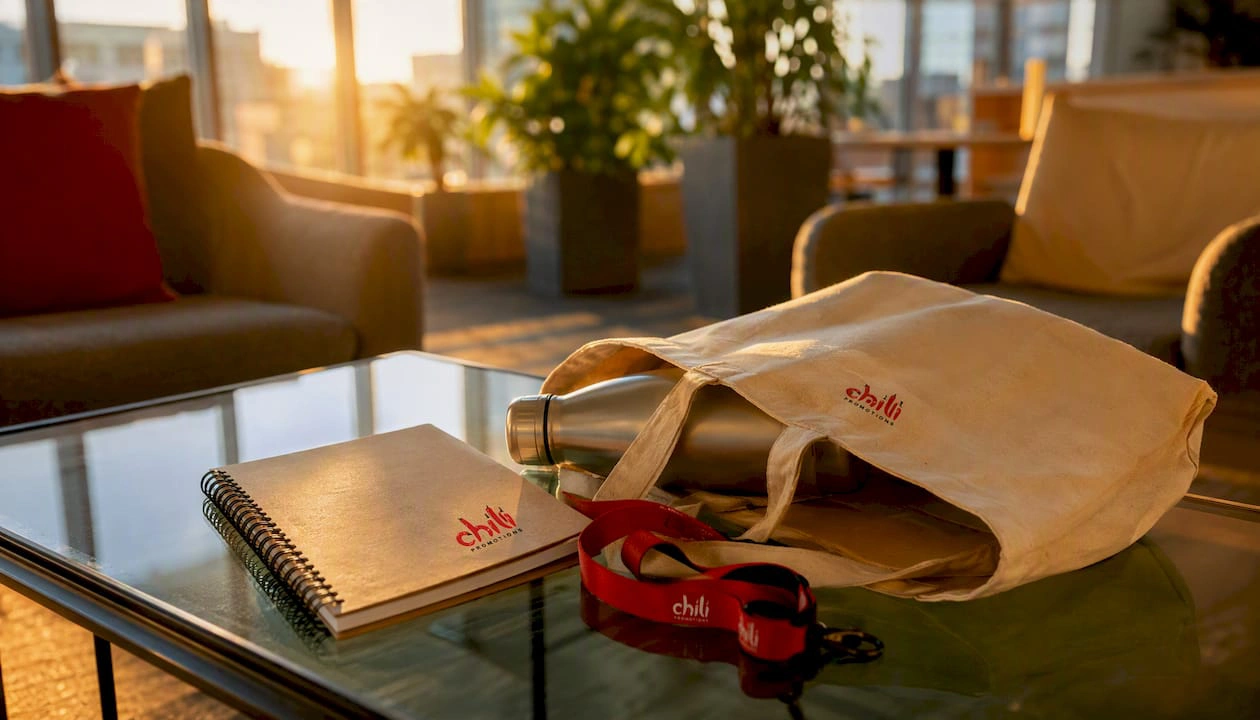
Custom branded tote bags are consistently the highest-volume item in Australian O-Week packs because they solve an immediate logistical problem: students arrive with their hands full. A quality tote carries everything else in the pack and then keeps working as a daily campus bag for months.
Drinkware is the other standout hero item. Custom branded water bottles in stainless steel or RPET deliver strong perceived value, align with campus sustainability commitments and generate daily impressions in lecture theatres, gyms and libraries. They are the item students are least likely to discard.
Lanyards and name badges earn their place at every orientation event because they solve a social problem: remembering names in a crowd of strangers. Bamboo name badges paired with a recycled polyester lanyard keep the sustainability story consistent without adding cost.
What students expect from orientation merch in 2026–27
Students now arrive at orientation with clear expectations. Useful, sustainable and inclusive items are the baseline; disposable novelty items are increasingly left on the table.
The 2026 merchandise trends planning guide identifies three dominant shifts shaping university welcome packs this year:
Eco materials and carbon offsets. RPET bottles, recycled cotton totes and notebooks made from recycled paper are no longer premium differentiators — they are expected. Students notice when sustainability credentials are absent, and procurement teams are increasingly required to document them in tender responses. Sustainability consumer cues such as RPET certification, recycled content labelling and carbon-offset documentation matter both to students and to university procurement policies.
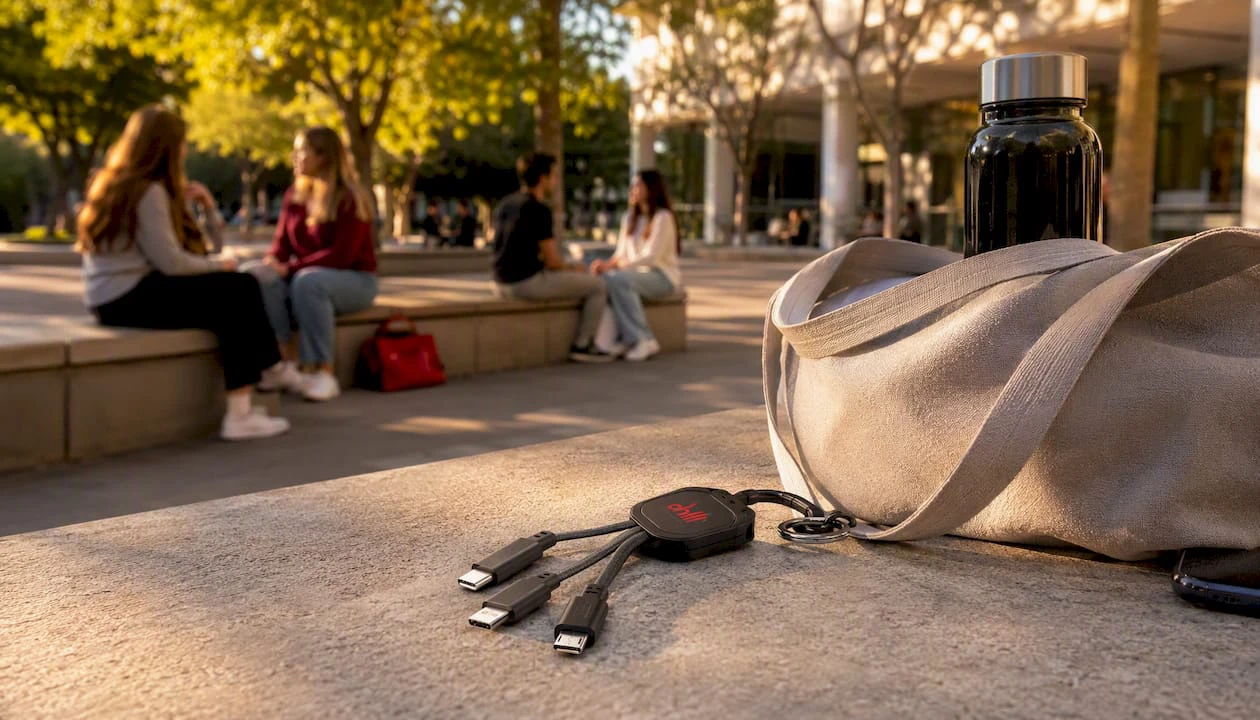
Multi-purpose tech accessories. A single multi-cable that charges USB-C, Lightning and Micro-USB devices is more useful than three separate branded cables. Power banks with university branding address a genuine daily pain point for students who spend long days on campus without access to power points.
Gender-neutral apparel and inclusive sizing. Hoodies and tees ordered in unisex cuts with extended size ranges (XS–4XL) ensure every student in the cohort receives an item they can wear comfortably. Orders that skip extended sizing leave a visible gap in the room.
To validate student preferences before you commit to a large order, run a brief focus group with current students from the previous year’s cohort, review feedback from last year’s orientation survey and monitor social media mentions during O-Week itself. What students photograph and post is a reliable signal of what they value.
How to choose the right orientation merchandise for your cohort
The most common procurement mistake is selecting items before defining the objective. A decision checklist that ranks items by audience segment, use case, brand prominence and sustainability prevents that error.
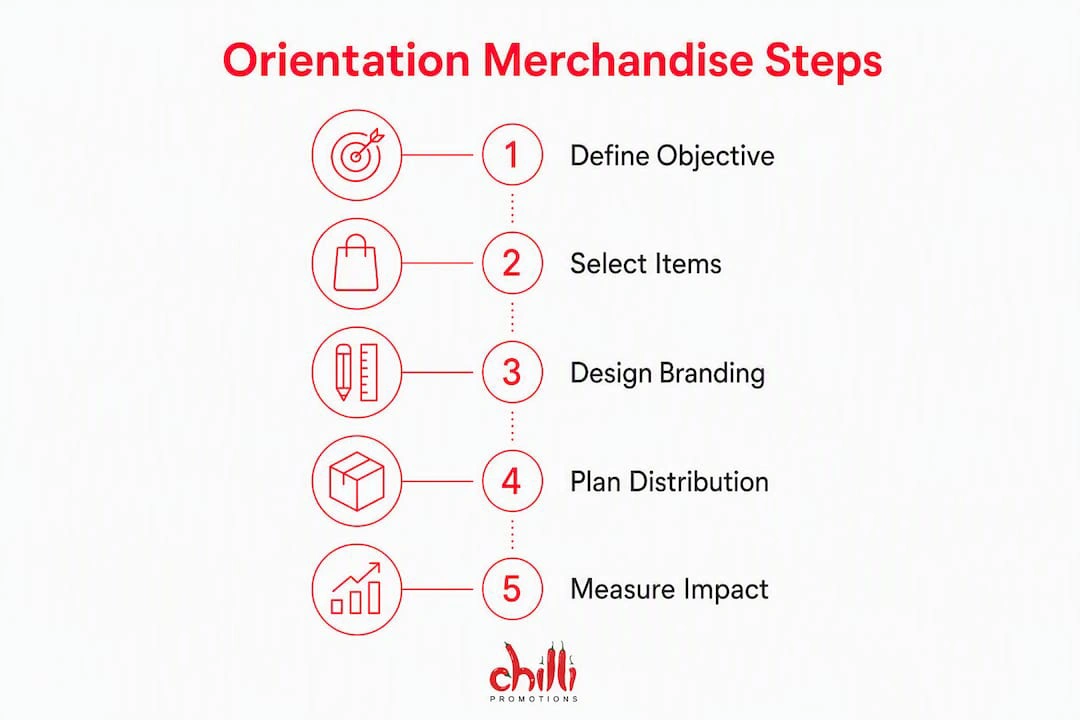
- Define your objective. Is this pack primarily a welcome gesture (belonging and comfort) or a promotional tool (brand awareness and faculty sign-ups)? The answer changes every item on the list.
- Map your recipient groups. Segment by on-campus residents, commuter students, international students and postgraduates. Each group has different immediate needs. International students, for example, benefit from practical items like adaptor-compatible cables and campus maps; commuters value bags and drinkware they can use on public transport.
- Shortlist by utility and branding level. Score each candidate item on a simple matrix: daily utility (high/medium/low) × branding visibility (prominent/subtle/none). Prioritise items that score high on both.
- Check budgets and MOQ. Most Australian suppliers set minimum order quantities (MOQs) of 50–100 units for standard items and 250+ for apparel. Budget bands typically fall into three tiers: economy (under $5 per student), standard ($5–$15) and premium ($15–$30+). Your hero item usually absorbs the largest share of the per-student budget.
- Request samples before approving production. Test imprint durability, colour accuracy and sizing on the actual substrate. This step catches the most common issues — artwork that looks sharp on screen but bleeds on fabric, or a bottle colour that reads differently under campus lighting.
- Confirm lead times and flag risks. Australian production and delivery timelines for custom merchandise typically run 3–6 weeks from artwork approval for standard items, longer for apparel or complex packs. Build in a buffer for proofing rounds.
The promotional product checklist for Australian businesses covers artwork file requirements, proofing sign-off steps and delivery confirmation — worth sharing with your procurement team before briefing any supplier.
Design and branding best practice for orientation items
Legible, unobtrusive branding that prioritises item utility is the design bottom line. An item students want to use every day is worth more than one that shouts the university logo from every angle.
Dos:
- Use sufficient colour contrast between the imprint and the substrate (minimum 4.5:1 ratio for text legibility)
- Specify PMS or Pantone references in your supplier brief to ensure colour accuracy across different materials
- Choose accessible, clean typefaces for any text on stationery items
- Include a safe area around the logo to prevent imprint distortion near seams or curves
Don’ts:
- Over-print small items (a pen barrel has limited real estate — one logo, one URL, maximum)
- Assume screen colours translate directly to embroidery or screen print; always proof on the actual substrate
- Order apparel without confirming the size run covers your full cohort
Pro Tip: Match the imprint method to the item. Screen printing suits flat surfaces like tote bags and notebooks. Embroidery adds perceived quality to hoodies and caps but requires a minimum stitch count for small logos. Full-colour transfer works well for complex artwork on bottles and tech accessories. Specifying the wrong method in your brief is the single most common cause of artwork rework.
Your supplier brief should include: vector artwork files (AI or EPS), PMS colour references, safe area dimensions, preferred imprint method and a signed-off proof before bulk production begins.
Welcome pack templates and distribution logistics
Three pack templates cover the most common recipient groups at Australian universities.
| Pack type | Core items | Distribution point |
|---|---|---|
| On-campus resident pack | Tote bag, water bottle, notebook, pen, lanyard, name badge | Residence check-in desk |
| Commuter student pack | Tote bag, travel mug, notebook, pen, campus map insert | Main campus welcome hub |
| International student pack | Backpack, water bottle, multi-cable, notebook, lanyard, local SIM card insert | International student services |
Distribution logistics matter as much as the items themselves. Practical pack fulfilment approaches include staged deliveries by cohort, pre-packed and labelled kits to reduce queue time at handout points, and a volunteer staffing plan that assigns at least two people per distribution point during peak arrival windows.
Waste reduction starts at registration. Pre-registration and opt-in pack systems mean you only produce what students have confirmed they want, cutting leftover stock significantly. Use recyclable outer packaging and include a note encouraging students to return or repurpose the packaging. For late arrivals and remote students, a mailed pack option with tracked delivery ensures no one misses out.
Pairing physical merch with digital in-venue promotional screens at distribution hubs and club fairs creates a multi-channel activation: the screen reinforces the brand story while the physical item goes home with the student.
Australian budgeting, MOQs and lead times
Per-student cost ranges vary by pack tier and item selection. Economy packs (stationery, lanyard, basic tote) typically land under $5 per student. Standard packs that include a reusable bottle or travel mug sit in the $8–$15 range. Premium packs anchored by a quality backpack or hoodie can reach $20–$35 per student, depending on apparel sizing complexity and packaging.
| Production stage | Typical timeline (Australia) |
|---|---|
| Creative brief and artwork approval | Week 1–2 |
| Supplier sampling and proof sign-off | Week 3–4 |
| Bulk production | Week 4–7 |
| Quality check and dispatch | Week 7–8 |
| Delivery to campus | Week 8–10 |
MOQs for most standard items run from 50–100 units. Apparel typically requires 50 units per style per colour, with some suppliers offering staggered rollouts across faculties to spread budget across financial periods.
For late procurement, the fastest options are locally stocked ready-made items (pens, notebooks, basic totes) that can be branded and delivered within 5–7 business days. Avoid ordering apparel or complex tech accessories with less than six weeks to your orientation date.
Working with Chilli Promotions for university welcome kits
A specialist supplier adds real value beyond simply printing a logo on a product. The right partner handles sampling, sustainable sourcing, compliance checks and pack assembly, reducing the coordination burden on your team significantly.
Chilli Promotions has supported Australian universities with higher education promotional products since 2001, offering:
- Sample runs before bulk production, so you can test imprint quality and item durability
- Branding consultancy to advise on imprint methods, colour accuracy and artwork preparation
- Pack fulfilment and assembly with cohort-labelled kits ready for distribution
- Carbon-offset options and sustainable material sourcing with supporting documentation for tender responses
- Warehousing and staged delivery to manage budget across financial periods
When briefing any supplier at tender stage, ask these questions:
- What are your standard MOQs and do you offer staggered delivery?
- What material certifications do you hold (RPET, recycled content, carbon-neutral)?
- What is your proofing process and how many rounds are included?
- Can you provide client references from Australian universities?
- What is your realistic lead time from artwork approval to campus delivery?
Key takeaways
Student orientation merchandise works when it prioritises utility, sustainability and student cohort needs over novelty, and when procurement teams plan with sufficient lead time to proof and produce quality items.
| Point | Details |
|---|---|
| Define the objective first | Decide whether the pack is a welcome gesture or a promotional tool before selecting any items. |
| Prioritise hero items | One high-utility item (water bottle or tote bag) anchors perceived value; keep supporting items practical and low-cost. |
| Build in lead time | Australian custom merchandise typically takes 8–10 weeks from brief to campus delivery; late orders limit your options. |
| Document sustainability | RPET, recycled content and carbon-offset credentials matter to students and procurement policies alike. |
| Chilli Promotions as your partner | Chilli Promotions offers sampling, pack fulfilment, carbon-offset options and university-specific branding consultancy across Australia. |
The items that actually get used
Most orientation packs contain too many items and not enough thought. The instinct to fill a bag is understandable — it looks generous — but a pack stuffed with low-quality novelty items sends a different message than one built around two or three things students will genuinely reach for every day.
The mistakes we see most often: apparel ordered in a narrow size range that excludes a visible portion of the cohort, and artwork approved from a screen proof without a physical sample, leading to colour and scale surprises on the actual item. Both are avoidable with a simple sample-first rule.
The quick wins are equally straightforward. Order samples at the start of the planning cycle, not the end. Choose one hero item that students will use for months — a quality water bottle, a durable tote — and let everything else in the pack support it rather than compete with it. On sustainability, the practical recommendation is to start with RPET drinkware and recycled-content stationery: both are widely available, competitively priced and immediately visible to students who care about where their university spends its money.
Chilli Promotions: university welcome kits, sampling and fulfilment
University marketing teams that want orientation packs done properly — on time, on brand and with sustainability credentials their procurement team can document — get a genuine advantage working with a supplier who has been doing this since 2001.
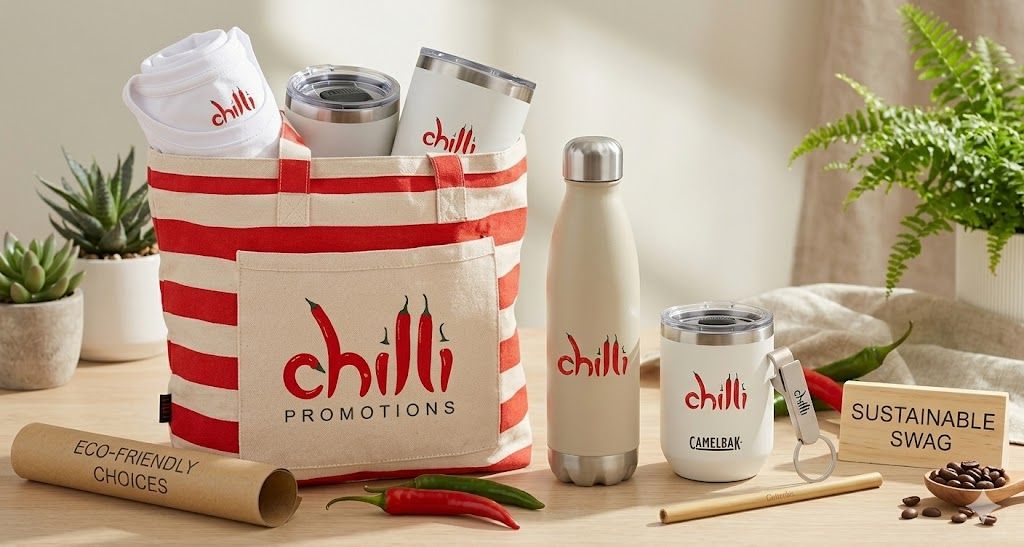
Chilli Promotions builds tailored university welcome kits from brief to delivery, including sampling, artwork consultancy, pack assembly and carbon-offset options. Browse the full promotional products range or go straight to the student engagement guide for item ideas and pack templates. Ready to get a quote for your next O-Week order? Contact the team at Chilli Promotions for a no-obligation brief review. →
Useful sources
Resources for university marketing and procurement teams planning orientation merchandise:
- Promotional items for student engagement: 2026 guide — Chilli Promotions’ item guide with pack templates and campaign ideas
- Promotional products for higher education — suitability guidance for campus events and group segmentation
- Promotional product checklist for Australian businesses — artwork, proofing, MOQ and delivery checklist
- Promotional merchandise trends 2026: your planning guide — sustainability and student preference trends for 2025–26
- Student club promotional product ideas — ideas for club fairs and on-campus activations
- How to display in-store promotions digitally — practical guidance on linking digital assets and physical merch at campus pop-up events
FAQ
What is student orientation in the Australian university context?
Student orientation is an organised programme that introduces new students to campus life, services and social activities before classes begin. In Australia, it is commonly called O-Week or Welcome Week and typically runs for five to seven days.
What should you include in an orientation welcome kit?
A well-built orientation kit includes one high-utility hero item (reusable water bottle or tote bag), supporting stationery (notebook and pen), a lanyard, and at least one item that reflects the university’s sustainability commitments. The exact mix depends on whether the recipient is a resident, commuter or international student.
What is the dress code for orientation events and how does it affect apparel merchandise?
Most Australian O-Week events are casual, though some faculty welcome sessions lean towards smart casual. When ordering branded apparel for orientation, choose unisex cuts in a full size range (XS–4XL) so every student receives an item they can wear comfortably regardless of the event’s dress expectations.
How far in advance should universities order orientation merchandise?
Allow at least 8–10 weeks from creative brief to campus delivery for custom-branded packs. Apparel and complex fulfilment packs need the full lead time; standard stationery and drinkware can sometimes be turned around in 5–7 business days if locally stocked items are available.
How do you measure whether orientation merchandise is working?
Track kit pick-up rates at distribution points, QR code scans on pack inserts, social media mentions during O-Week and responses to post-orientation surveys. These four data points give you a clear picture of reach, engagement and student sentiment to inform the next ordering cycle.