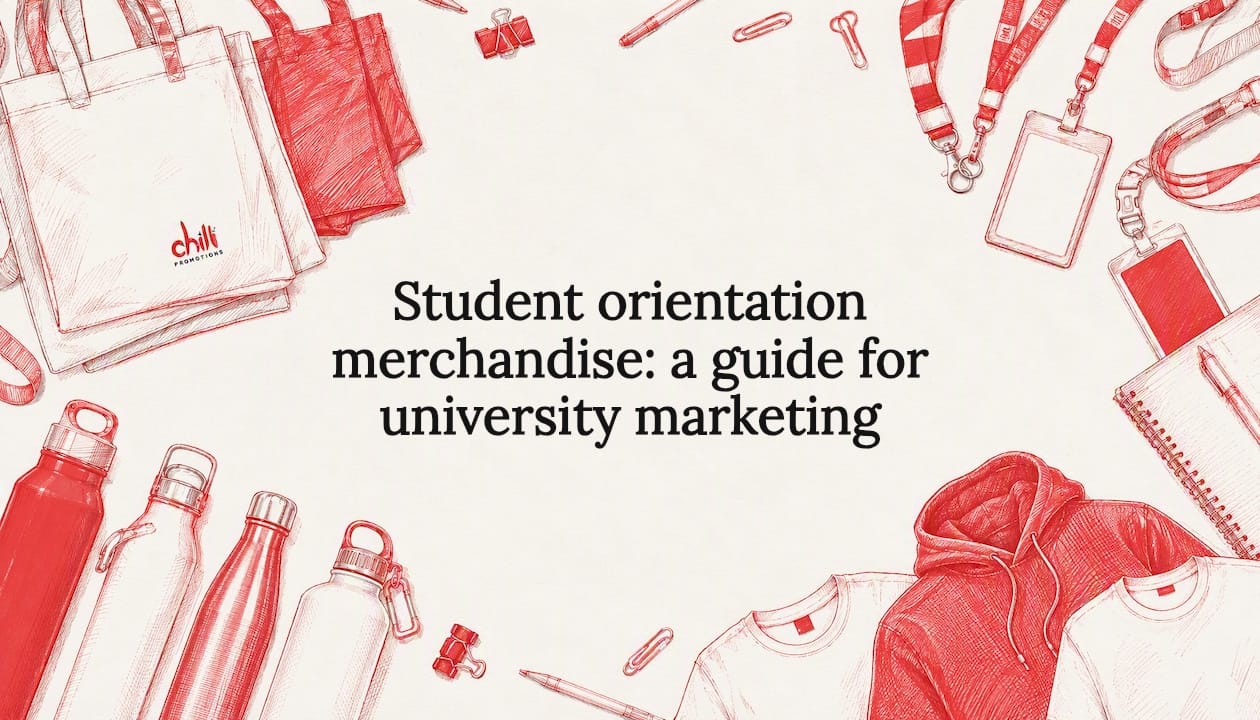
Start with three categories and you’ll cover most situations: drinkware, apparel and personalised stationery are the highest-impact student club promotional product ideas because students use them daily, carry them publicly and associate them with your club long after the event ends.
Quick shortlist to pilot first:
- Reusable water bottle (branded, BPA-free) — daily utility, high visibility, suits every club type; entry–mid budget
- Custom tote bag — carries books, groceries and gym gear; low cost, high impression count
- Personalised planner or notebook — semester-layout versions get used all year; mid budget
- Printed hoodie or tee — premium feel, strong identity signal for recruitment drives
- Sticker sheet — lowest cost per unit, Gen Z favourite for laptop and water bottle personalisation
Your next step today: confirm your university’s brand approval process before you place any order. Many Australian institutions require central marketing sign-off on any item carrying the institution’s logo, so getting that clearance early saves you from reprinting or disposing of non-compliant stock.
Table of Contents
- What are the best product categories for student club merchandise?
- How to choose the right item and what to ask before you order
- How to use promotional items to drive real engagement
- Sustainability choices and campus compliance you must check
- Budget-friendly vs premium items: when to spend more
- Tips for designing custom logos and artwork for promotional products
- Storage and distribution logistics at events
- Key takeaways
- What most clubs get wrong about promotional merchandise
- Chilli Promotions has what your student club needs
- Useful sources
- FAQ
What are the best product categories for student club merchandise?
Practical items students use daily consistently outperform novelty giveaways. The categories below cover the full range from low-cost event fillers to premium items worth saving for recruitment or alumni milestones.
Drinkware
Reusable bottles and keep cups are the single most-used category in student settings. A branded bottle sits on a desk, travels to lectures and appears in social media posts without any extra effort from your club. Look for BPA-free, double-walled stainless steel options with a powder-coat finish that holds Pantone-matched colours well. Reusable water bottles are consistently listed among the top orientation giveaways for their daily utility and repeated brand impressions.
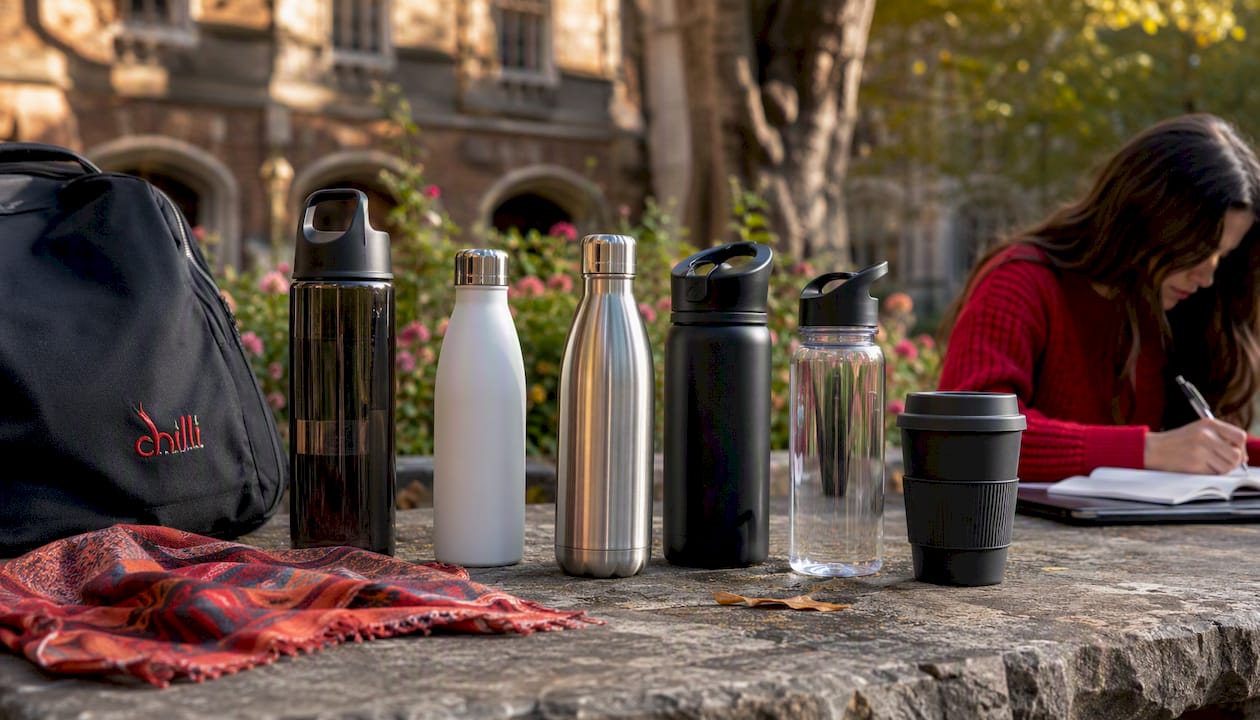
Price bands: entry (basic plastic bottle) $5–$8; mid (stainless steel, single wall) $12–$18; premium (double-wall vacuum insulated) $22–$35+
Apparel and bags
Custom tees, hoodies and caps build visible club identity on campus. Tote bags punch above their weight on cost-per-impression because students reuse them constantly. For clubs with a sustainability focus, bags made from recycled content or organic cotton signal values alignment before a word is spoken. Backpacks work well for move-in events and orientation packs where students need carrying capacity immediately.
Price bands: tote $4–$10; tee $15–$25; hoodie $35–$65; backpack $25–$55
Tech accessories
USB drives, phone wallets, cable organisers and branded earbuds suit tech-focused clubs or recruitment events where you want a premium impression. Wireless chargers and laptop sleeves sit at the higher end but generate genuine excitement. For most clubs on a tight budget, a branded phone wallet or cable tie is a practical mid-range option that gets daily use.
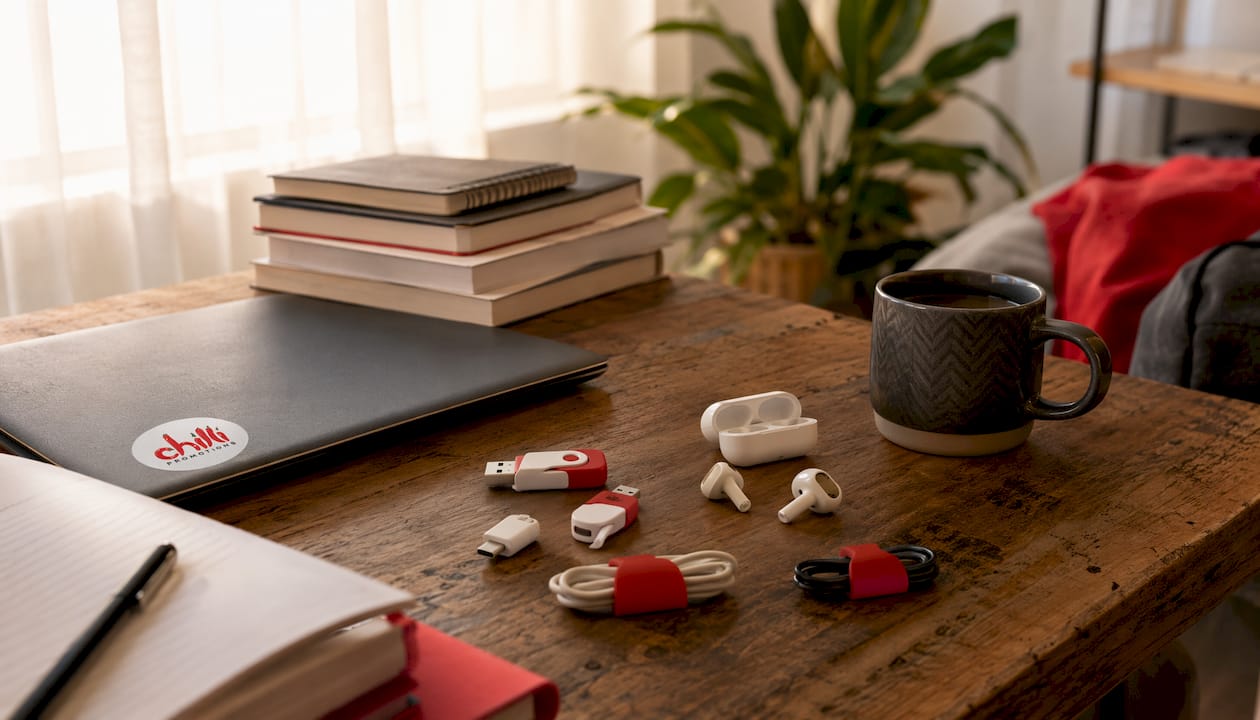
Price bands: phone wallet $4–$8; cable organiser $6–$12; wireless charger $20–$40
Stationery and planners
Custom planners with semester layouts are one of the strongest retention items because academic relevance keeps them in use for months. Branded notebooks, pens and sticky-note sets are low-cost additions to orientation kits or club fair tables. Personalisation — a student’s name, a custom cover design, or a club-specific layout — is the factor that separates items students keep from items they discard.
Price bands: pen $1–$4; notebook $5–$12; planner $10–$22
Stickers and small giveaways
Sticker sheets are the highest-engagement low-cost item for Gen Z. Students apply them to laptops, water bottles and phone cases, turning your club’s branding into ambient campus advertising. Enamel pins, keyrings and wristbands fill the same role at a slightly higher price point and suit clubs with a strong visual identity or mascot.
Price bands: sticker sheet $0.80–$2.50; enamel pin $3–$7; keyring $2–$6
Wellness items and event kits
Sunscreen sachets, hand sanitiser, lip balm and mini first-aid kits are practical additions to outdoor event packs — especially relevant for Australian campuses where UV exposure is a genuine concern. Orientation kits that bundle a bottle, a tote and a sticker sheet give new members an immediate sense of belonging.
Eco and sustainable ranges ♻
Recycled-content totes, bamboo pens, seed-paper cards and carbon-offset drinkware suit clubs with an environmental or social-justice focus. Asking your supplier for ISO 14001 certification or EcoVadis accreditation gives you verified credentials to share with members who care about supply-chain ethics.
Event-to-item mapping and budget guide
| Event type | Recommended item | Budget band |
|---|---|---|
| Orientation / move-in | Backpack or tote bundle | Mid–high |
| Club fair / O-Week stall | Branded tee or cap | Mid |
| Recruitment drive | Premium drinkware or hoodie | Mid–high |
| Sustainability event | Recycled tote or bamboo pen | Low–mid |
| Fundraiser raffle | Enamel pin or sticker sheet | Low |
| End-of-year celebration | Custom planner or cap | Mid |
Pro Tip: Order a physical sample before committing to a full run. Colour on screen rarely matches the finished product exactly, and a sample lets you check print quality, material feel and Pantone accuracy before you spend your full budget.
How to choose the right item and what to ask before you order
Pick items that match student utility, your event context and your available budget. A $40 hoodie makes sense for a recruitment drive; it does not make sense as a mass handout at a club fair with 300 attendees.
Decision flow:
- Audience first — who receives this item, and will they actually use it? A sports club’s members will use a water bottle; a law society’s members may prefer a quality notebook.
- Event context — is this a high-touch recruitment moment or a broad awareness handout? High-touch events justify premium items.
- Budget per unit — divide your total merchandise budget by expected recipients to set a realistic per-unit ceiling.
- Imprint options — screen print, embroidery, laser engraving and full-colour digital print each suit different materials and order volumes.
Supplier questions checklist:
- What is the minimum order quantity (MOQ) for this item?
- What is the standard lead time, and what is the rush lead time?
- Which imprint methods are available, and what are the setup fees?
- Can you provide a physical sample or digital proof before production?
- Do you offer Pantone colour matching?
- What sustainability certifications does this product carry (recycled content, carbon-offset, ISO 14001)?
- What is the returns or replacement policy for defective items?
A promotional product checklist aligned with your institution’s procurement rules reduces late-stage rework significantly.
Typical lead times and ordering windows
| Item type | Standard lead time | Suggested order window before event |
|---|---|---|
| Stickers / small giveaways | 5–10 business days | 3 weeks prior |
| Pens / notebooks | 7 business days | 4 weeks prior |
| Tote bags / drinkware | 10–15 business days | 5 weeks prior |
| Apparel (tees, hoodies) | — | 6–8 weeks prior |
| Premium tech items | — | 8–10 weeks prior |
Watch for suppliers who promise unusually short lead times without a confirmed proof step. Skipping the proof stage is where colour mismatches and logo errors happen, and reprinting at short notice is expensive.
How to use promotional items to drive real engagement
The difference between a giveaway and an engagement tool is structure. Tiered reward models tied to voluntary activities produce stronger, sustained participation than mass handouts at the door. When students earn an item, they value it more and associate your club with a positive experience.
Five activation formats that work:
- Scavenger hunt at O-Week — students complete campus tasks to collect stamps; a full card earns a branded tote or bottle. Drives exploration and peer interaction simultaneously.
- Tiered orientation rewards — entry-level reward (sticker sheet) for attending the first session; mid-tier (notebook or cap) for joining a committee; high-value prize (hoodie or premium drinkware) for a semester of active involvement.
- Raffle mechanics at club fairs — collect sign-ups in exchange for a raffle ticket; draw a premium item publicly. Builds your contact list while creating visible excitement at the stall.
- Service tokens — small branded tokens (pins, wristbands) given for volunteering, mentoring or event support. Wearable tokens create visible social proof of involvement.
- Social campaign integration — ask members to post a photo with their branded item using your club’s hashtag. Track the hashtag to measure organic reach without any paid spend.
Simple KPIs to track:
- Participation rate at the event (sign-ups vs. attendees)
- New member registrations in the week following the activation
- Social posts using your campaign hashtag
- Repeat attendance at the next event
Connecting your merchandise strategy to campus engagement platforms can help you track participation data and tie item distribution to measurable outcomes.
Pro Tip: Build one repeatable campaign around a single item each semester rather than ordering a different product every time. Consistency builds recognition, and you can negotiate better pricing on repeat orders.
Sustainability choices and campus compliance you must check
Check your institution’s brand and merchandise procedures before ordering any branded item. This is the step most club organisers skip, and it is the one most likely to result in wasted stock.
Compliance checklist:
- Brand approval — most Australian universities require central marketing sign-off on any item carrying the institution’s logo or colours. The University of Southern Queensland’s merchandise procedure states that all promotional merchandise must be approved by the Marketing team and sourced from preferred suppliers unless otherwise approved.
- QUT’s Corporate Identity policy requires Brand and Creative Studio approval for promotional items, including artwork and printing projects.
- Preferred supplier lists — some institutions restrict procurement to panel suppliers. Check your student guild or union’s procurement guidelines separately from the university’s, as they may differ.
- Logo and trademark rules — using a university crest or trademarked wordmark on merchandise without approval can expose your club to intellectual property issues.
- On-campus display and distribution — the University of Sydney’s promotional materials policy requires an authoriser for any promotional materials and specifies permitted and restricted display locations. Check equivalent policies at your institution before setting up a stall or distributing items in common areas.
- Adelaide University’s marketing procedure requires use of approved media agencies and specific branding details for external-facing materials, including provider numbers for international student communications.
Sustainability certifications to request from your supplier:
- Recycled or post-consumer recycled (PCR) content
- Carbon-offset or carbon-neutral production with NoCO2 documentation
- ISO 14001 environmental management certification
- EcoVadis Silver or higher accreditation
Prioritise eco options when your club’s values or event theme centres on sustainability, or when your university has a published sustainability commitment that merchandise should reflect.
Storage note: plan for secure, dry storage before and after events. Branded apparel and drinkware stored in damp conditions can be damaged before distribution. Confirm with your student guild whether on-campus storage space is available for bulk orders.
Budget-friendly vs premium items: when to spend more
Entry-level items (stickers, pens, basic totes) suit high-volume, broad-awareness moments where your goal is reach. Mid-range items (notebooks, caps, standard drinkware) balance cost and perceived value well for most club events. Premium items (hoodies, vacuum-insulated bottles, quality backpacks) are worth the investment at recruitment drives, end-of-year celebrations or alumni touchpoints where the item needs to signal quality and longevity.
A useful rule: if the item will be seen by prospective members or external stakeholders, move up one tier. A $6 tote at an internal social is fine; a $6 tote at an open day alongside a competitor club handing out $30 hoodies is a missed opportunity. For club fundraising product ideas, premium items also work well as raffle prizes or auction lots, where perceived value drives participation.
Alumni items deserve their own budget line. Graduates are more likely to keep and display quality merchandise, and a well-made alumni hoodie or engraved drinkware item becomes a long-term brand impression that outlasts any digital campaign.
Tips for designing custom logos and artwork for promotional products
Your artwork file quality determines your print quality. Supply vector files (AI, EPS or SVG) wherever possible; raster files (JPEG, PNG) are acceptable only at high resolution (300 dpi minimum at print size). A low-resolution logo stretched across a hoodie chest will look unprofessional regardless of how good the garment is.
Keep the design simple for small imprint areas. A detailed crest that looks sharp on a poster becomes illegible on a pen clip or a 30mm badge. Ask your supplier for the maximum imprint area dimensions for each item and design within those constraints from the start.
Pantone colour matching matters more than most organisers realise. Screen colours and printed colours differ, and without a Pantone reference, your club’s signature colour can shift noticeably between items. Provide your Pantone codes to your supplier and request a physical proof before approving the full run.
Check your university’s brand guidelines for approved logo versions. Many institutions provide a specific version of their logo cleared for merchandise use, separate from the version used in digital or print publications. Using the wrong version can trigger a reprint request from the marketing team.
Storage and distribution logistics at events
Plan your distribution before the items arrive, not on the day. For large events like O-Week, assign a dedicated merchandise coordinator who knows what is in each box, where it is stored and who is authorised to distribute it.
Label boxes clearly by item type and quantity. A simple spreadsheet tracking what was ordered, what arrived and what was distributed helps you reconcile stock after the event and informs future order quantities. Leftover stock that is stored correctly can be used at the next event; stock that is damaged or lost is a sunk cost.
For outdoor events, keep items in sealed containers or bags until distribution. Australian summer conditions can fade printed materials, warp cardboard packaging and damage adhesive on stickers. A portable folding table with a tablecloth keeps your stall looking professional and gives you a controlled distribution point rather than a free-for-all.
If your university requires an authoriser for on-campus promotional materials, confirm that approval in writing before the event. The University of Sydney’s policy is a useful reference for understanding what a formal distribution authorisation process looks like, even if your institution uses a different framework.
Key takeaways
The most effective student club promotional product ideas combine daily utility with clear brand identity, ordered early enough to allow for artwork proofs and compliance approvals.
| Point | Details |
|---|---|
| Start with three categories | Drinkware, apparel and personalised stationery deliver the highest daily use and brand visibility for most clubs. |
| Confirm compliance first | Check your university’s brand approval and preferred supplier requirements before placing any order. |
| Use tiered rewards, not mass handouts | Tiered reward models tied to voluntary activities produce stronger, sustained engagement than distributing items at the door. |
| Order with lead time in mind | Allow 6–8 weeks for apparel and 3–4 weeks for smaller items; always request a proof before approving production. |
| Chilli Promotions for student clubs | Chilli Promotions supplies custom drinkware, apparel, eco ranges and promotional programmes suited to Australian student clubs and universities. |
What most clubs get wrong about promotional merchandise
Most student clubs treat merchandise as an afterthought, ordered in the week before O-Week with whatever logo file someone finds in a shared drive. The result is a generic item in the wrong colour with a pixelated logo that ends up in a bin by the end of the day.
The clubs that get real value from their merchandise budget do two things differently. They order early enough to get a physical proof, and they choose items that reflect what their members actually do. A sustainability club that hands out recycled-content totes with a clean, well-matched logo is making a statement about its values. A sports club that gives members a quality water bottle at the start of season is giving them something they will use at every training session for months.
The other thing worth saying plainly: personalisation is not a luxury. Semester-layout planners, Pantone-matched colours and sticker sheets with the club’s actual aesthetic are the difference between merchandise that gets used and merchandise that gets discarded. The cost difference between a generic notebook and a personalised one is often smaller than organisers expect, particularly at mid-range MOQs.
When to upgrade from entry to premium? When the item will be seen by someone who has not yet decided whether to join. First impressions at recruitment events and open days are worth the extra spend.
Chilli Promotions has what your student club needs
Student clubs across Australia have specific constraints: tight budgets, compliance requirements, short lead times and the need to impress a Gen Z audience that can spot a generic giveaway from across the room. Chilli Promotions has been working with universities and student organisations since 2001, supplying custom promotional products across drinkware, apparel, eco ranges, stationery and tech accessories, with carbon-offset options and sustainability documentation available on request.
You get artwork proofs before production, Pantone colour matching, and clear MOQ and lead time guidance from the start. Eco-certified options carry verified credentials you can share with your members. Whether you need 50 sticker sheets for a club fair or 300 hoodies for a recruitment drive, the process is the same: clear brief, confirmed proof, on-time delivery.
Browse the full product range or request a quote directly to confirm pricing, lead times and sustainability options for your next event.
Useful sources
- University of Southern Queensland — Merchandise Procedure: confirms brand approval and preferred supplier requirements for promotional merchandise.
- QUT — Corporate Identity Policy (MOPP): outlines artwork approval and Brand and Creative Studio sign-off requirements.
- University of Sydney — Promotional and Display Materials Policy: covers authorisation steps and permitted display locations for on-campus materials.
- Adelaide University — Marketing and Communications Procedure: details approved agency use and branding requirements for external-facing materials.
- Chilli Promotions — Promotional Product Checklist for Australian Businesses: a practical checklist covering MOQ, lead time, artwork proofs and procurement steps.
- Chilli Promotions — Promotional Products for Higher Education: product ideas and procurement notes specific to university and student club contexts.
FAQ
What are the best giveaway items for student clubs in Australia?
Reusable water bottles, tote bags, custom notebooks and branded apparel are consistently the top performers because students use them daily and carry them publicly, generating repeated brand impressions.
What kind of swag do Gen Z students prefer?
Gen Z favours practical, personaliseable items with aesthetic appeal and sustainability credentials — sticker sheets, Pantone-matched drinkware and recycled-content totes outperform generic novelty items with this cohort.
What is a realistic budget per item for a student club?
Entry-level items (stickers, pens) are typically $1–$4 per unit; mid-range items (notebooks, caps, standard drinkware) generally fall in the $5–$22 range; premium items (hoodies, vacuum-insulated bottles) usually start at $35 and go upwards, depending on MOQ and imprint complexity.
How far in advance should a student club order promotional products?
Allow at least 6–8 weeks for apparel and 3–5 weeks for smaller items, factoring in artwork approval, a physical proof and your university’s brand sign-off process before production begins.
Can Chilli Promotions supply eco-friendly options for student clubs?
Yes. Chilli Promotions offers recycled-content products, carbon-offset options and items with sustainability documentation including NoCO2 certification, suited to clubs with environmental commitments or universities with published sustainability targets.