TL;DR:
- A promotional product checklist helps businesses plan campaigns by aligning goals, audience, and budget. It prevents misaligned product choices, budget overruns, and improves marketing effectiveness. Building discipline through planning and tracking over time enhances campaign ROI.
A promotional product checklist is a structured planning tool that aligns branded merchandise decisions with campaign goals, audience needs, and budget controls to maximise brand impact. Without one, businesses routinely select items that miss the mark, overspend on freight and rush orders, and have no way to measure what worked. For Australian marketing professionals and business owners, a reliable promotional product checklist is the difference between a campaign that builds lasting brand recognition and one that simply fills a storage room. Chilli Promotions has worked with businesses across Australia since 2001, and the pattern is consistent: the businesses that get the best results treat merchandise selection as a disciplined process, not a last-minute decision.
1. What belongs on a promotional product checklist for businesses
A business marketing checklist for promotional merchandise covers six core areas: campaign goals, audience profile, budget guardrails, product quality, supplier vetting, and distribution tracking. Each area feeds the next. Get the goal wrong and every other decision compounds the error. Setting SMART, measurable goals is the foundation of any focused promotional campaign. That clarity shapes product type, unit cost, print method, and delivery timeline before a single quote is requested.

The checklist format matters because promotional merchandise involves more moving parts than most marketing activities. You are coordinating design approvals, minimum order quantities, lead times, freight logistics, and event schedules simultaneously. A written checklist keeps each stakeholder accountable and prevents the most common failure mode: campaign goals not locked in early, leading to misaligned and costly product selections.
2. Define your campaign goal before selecting any product
Locking in a specific campaign goal before product selection drives every other promotional merchandise decision. A product chosen for brand awareness has a completely different cost and design profile than a premium item chosen for high-value client retention. Treating these two objectives as interchangeable is the most expensive mistake in promotional marketing.
Australian businesses typically run merchandise campaigns for one of three purposes:
- Brand awareness at scale: High-volume, lower-cost items distributed broadly at trade shows, community events, or retail activations. Think branded tote bags, pens, or lanyards.
- Lead generation: Mid-range items tied to a specific call to action, such as a QR code linking to a landing page or a product trial offer.
- Client retention and loyalty: Premium corporate gift strategies for existing clients or high-value prospects. Quality, packaging, and personalisation matter significantly here.
Each goal demands a different budget ceiling, a different product category, and a different distribution method. Mixing them produces a campaign that does none of them well.
Pro Tip: Write your campaign goal as a single sentence before you open any product catalogue. If you cannot state the goal in one sentence, the brief is not ready.
3. Know your audience segment before choosing product types
Product relevance to the audience determines whether a promotional item gets used or discarded. Irrelevant items reduce brand exposure to zero. A branded stress ball sent to a senior procurement manager communicates less care than a quality notebook or a reusable coffee cup.
Audience segmentation for promotional merchandise works on three levels:
- Demographic: Age, profession, and industry sector. A tech company’s audience responds differently to a USB drive than a construction firm’s workforce does.
- Behavioural: How does this audience interact with your brand? Are they first-time contacts or long-term clients? New contacts warrant awareness items; loyal clients warrant recognition gifts.
- Environmental: Where will the item be used? Office workers benefit from desk accessories. Outdoor or trade audiences value durable, practical items like branded drink bottles or apparel.
Audience-targeted promotional products increase the likelihood of repeated brand impressions. Every time a recipient uses a relevant item, your brand registers again. Generic items do not achieve this.
Pro Tip: Survey your top 20 clients about the items they actually use at work. The answers will reshape your next merchandise brief completely.
4. Set precise budget guardrails before requesting quotes
Budget discipline in promotional merchandise requires tracking more than the per-unit product cost. Hidden expenses such as freight, rush orders, and artwork corrections can push budgets up by 20% if not planned explicitly. That 20% overrun is not unusual. It is the predictable result of treating promotional merchandise as a line item rather than a project with multiple cost components.
Build your budget using these line items:
- Per-unit product cost (at confirmed order quantity)
- Artwork setup and revision fees
- Freight and delivery to distribution point
- Rush order premium if timeline is tight
- Storage or warehousing if items arrive before the event
- Contingency reserve of at least 10% of total spend
The table below shows how a $5,000 campaign budget breaks down when hidden costs are accounted for versus ignored.
| Budget component | Planned (with guardrails) | Unplanned (no guardrails) |
|---|---|---|
| Product cost (500 units) | $3,500 | $3,500 |
| Freight and delivery | $400 | Not budgeted |
| Artwork and setup | $250 | Not budgeted |
| Rush order premium | $0 (ordered on time) | $600 |
| Contingency reserve | $500 | $0 |
| Total spend | $4,650 | $4,100 budgeted, $4,700 actual |
Marketing budgets for growth-focused businesses typically sit at 7–12% of revenue. Promotional merchandise competes with paid advertising, SEO, and CRM investment for that allocation. Precise guardrails protect the merchandise budget from absorbing costs that belong elsewhere.
5. Conduct a vendor and quality control review
Supplier reliability directly affects campaign outcomes. A product that arrives damaged, printed incorrectly, or two weeks late does not just waste budget. It creates a negative brand impression at the exact moment you intended to create a positive one.
A thorough vendor review covers these points:
- Production lead times: Confirm the supplier’s standard lead time and their track record for on-time delivery. Ask for references from clients with similar order volumes.
- Sample approval process: Request a physical sample before committing to full production. Colour accuracy, print quality, and material feel are impossible to assess from a digital proof alone.
- Minimum order quantities: Verify that the supplier’s minimums align with your campaign volume. Ordering above your needs to meet a minimum inflates per-unit cost and creates surplus stock.
- Artwork specifications: Confirm file format requirements, colour mode (CMYK vs Pantone), and bleed requirements before briefing your designer.
- Defect and replacement policy: Understand the supplier’s process for handling damaged or misprinted items. A clear replacement policy is a sign of a mature operation.
Distribution planning and quality control reduce waste and protect brand representation. Handling damaged items after delivery is far more expensive than preventing them through proper supplier assessment beforehand. Chilli Promotions operates as a verified partner in this process, not simply a fulfilment vendor.
6. Build a distribution and tracking protocol
Effective branded merchandise does not end at delivery. The distribution method and the tracking mechanism determine whether the campaign achieves its stated goal or simply moves product out the door.
Design your distribution plan around the event or touchpoint type:
- Trade shows and expos: Pre-pack items for quick handout. Assign a team member to track approximate quantity distributed per session.
- Direct mail campaigns: Use personalised packaging to increase open rates. Include a unique URL or QR code to track digital follow-through.
- Client gifting programmes: Attach a handwritten note or personalised card. Record each recipient in your CRM to track relationship outcomes over 90 days.
- Internal staff recognition: Distribute through managers with a brief on the campaign context. Staff who understand the purpose of a gift engage with it more meaningfully.
Post-campaign reporting and iterative planning are what separate a one-off spend from a genuine marketing investment. Tracking residual reach and cost-per-impression helps you avoid repeating budget-draining mistakes in the next campaign cycle.
Pro Tip: Build a simple post-campaign report template before the campaign launches. Waiting until after the event to decide what to measure means the most useful data is already gone.
For businesses focused on client retention strategies, tracking the relationship outcomes of premium gifting over a 90-day window consistently reveals stronger ROI than broad awareness campaigns at the same spend level.
Key takeaways
A promotional product checklist works because it forces goal clarity, audience relevance, and full-cost budgeting before any product is selected or ordered.
| Point | Details |
|---|---|
| Goal clarity drives every decision | Define your campaign goal in one sentence before opening any product catalogue. |
| Audience relevance prevents waste | Match product type to audience demographics, behaviour, and environment to maximise usage. |
| Budget guardrails include hidden costs | Account for freight, artwork, rush orders, and a 10% contingency to avoid a 20% overrun. |
| Vendor review protects brand standards | Request physical samples and confirm replacement policies before committing to full production. |
| Tracking closes the loop | Record distribution data and build a post-campaign report to improve future merchandise ROI. |
What we have learned after 20+ years of promotional campaigns
The checklist is not a bureaucratic exercise. It is the mechanism that separates businesses that get measurable value from promotional merchandise from those that simply spend money on it.
The most consistent pattern we see at Chilli Promotions is this: businesses that skip the goal-setting step end up with products that look fine but do nothing. They ordered a mid-range item because it seemed safe, not because it matched an objective. The item gets distributed, the budget gets spent, and six months later nobody can say whether it worked.
The second pattern is budget shock. A business allocates $4,000 for merchandise, does not account for freight or artwork, and ends up either cutting the order quantity or absorbing an unexpected cost from another budget line. Neither outcome is acceptable when the fix is a 30-minute budget planning session at the start of the project.
The third pattern is the hardest to address: treating each campaign as a standalone event rather than a cycle. Promotional campaigns treated as cyclic activities with tracking and feedback loops significantly improve ROI over time. The data from one campaign is the brief for the next. Businesses that build this habit consistently outperform those that start from scratch each time.
The checklist is not the end of the process. It is the beginning of a discipline that compounds over years. Planning your marketing in advance is what makes this compounding possible. Start with the checklist. Refine it after every campaign. The results will reflect the discipline.
— Chilli Promotions Team
Chilli Promotions: your promotional product partner in Australia
Chilli Promotions has supplied and manufactured promotional products for Australian and New Zealand businesses since 2001. The team works across every campaign type, from high-volume trade show giveaways to premium corporate giveaway programmes for key client relationships.
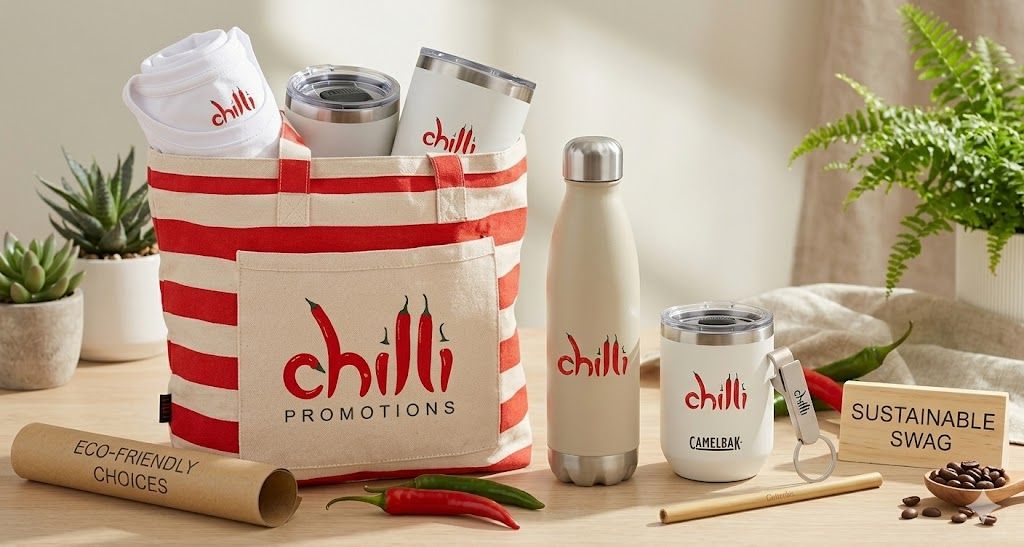
Whether you are building a business marketing checklist from scratch or refining an existing programme, Chilli Promotions offers expert consultation, curated product categories, and verified supplier relationships. The full promotional products range covers every campaign goal and budget tier. Contact the team to discuss your next campaign and receive a tailored product recommendation aligned with your objectives.
FAQ
1. What is a promotional product checklist for businesses?
A promotional product checklist is a structured planning tool that guides businesses through goal setting, audience profiling, budgeting, supplier vetting, and distribution tracking before selecting branded merchandise. It prevents misaligned product choices and budget overruns.
2. How do I choose the right promotional items for my audience?
Match product type to your audience’s profession, daily environment, and relationship stage with your brand. Audience-targeted items are used more frequently, generating more brand impressions than generic giveaways.
3. What hidden costs should I budget for in a promotional campaign?
Freight, artwork setup, rush order premiums, and storage costs regularly push campaign spend beyond the per-unit product cost. Planning a 10% contingency reserve prevents a budget overrun of up to 20%.
4. How do I measure the success of a promotional product campaign?
Track distribution volume, cost-per-impression, and relationship outcomes over 90 days post-campaign. For digital-linked items, monitor QR code scans or unique URL visits to quantify engagement.
5. How often should businesses update their promotional product checklist?
Review and update the checklist after every campaign using post-campaign report data. Treating promotional merchandise as a cyclic activity with feedback loops consistently improves ROI over successive campaigns.