Customer loyalty merchandise is branded physical product chosen deliberately to build emotional connection, encourage repeat behaviour, and extend brand visibility beyond the point of sale. It is the industry term for what many marketers call “loyalty merch” or “branded gifting within a loyalty programme.” A welcome kit sent to a new subscriber, a limited-edition tote released at a brand event, and a milestone gift mailed to a customer on their third anniversary are all examples. For marketing teams, the business case is direct: customer loyalty raises lifetime value and lowers acquisition costs, and merchandise is one of the most tangible levers available to accelerate both.
Understanding loyalty rewards through a physical lens matters because a well-chosen object does something a discount code cannot. It occupies space in someone’s daily life, carries the brand into new environments, and signals that the relationship is worth investing in.
Key takeaways
Customer loyalty merchandise works when it is designed to communicate brand values, not just carry a logo, making quality, sustainability, and relevance the three non-negotiable procurement criteria.
| Point | Details |
|---|---|
| Definition | Loyalty merchandise is branded physical product chosen to build emotional connection, repeat behaviour, and brand visibility. |
| Reciprocity drives return behaviour | Surprise, timely, and relevant gifts trigger reciprocity, prompting repeat purchases and referrals. |
| Measure with five KPIs | Track repeat purchase rate, redemption rate, member NPS, referral lift, and average order value. |
| Sustainability is now baseline | APPA’s 2025 review confirms poorly chosen non-sustainable items damage brand sentiment in Australia. |
| Chilli Promotions | Supplies design-led, sustainable loyalty merchandise and tailored programmes across Australia and New Zealand. |
Table of Contents
- How does gifting trigger reciprocity and repeat behaviour?
- Why everyday merchandise creates lasting brand exposure
- How does merchandise build emotional loyalty rather than just transactional habits?
- Can merchandise build community and brand identity?
- What merchandise types deliver the highest loyalty impact?
- How do you integrate merchandise into a loyalty programme and measure results?
- Best practices and common pitfalls in loyalty merchandise
- What does the Australian market tell us about loyalty merchandise trends?
- An editorial perspective on what loyalty merchandise actually does
- Chilli Promotions: design-led loyalty merchandise for Australian brands
- Sources
- FAQ
How does gifting trigger reciprocity and repeat behaviour?
Gifting works because it activates reciprocity, one of the most consistent patterns in human behaviour. When a brand gives something of genuine value, the recipient feels a pull to respond in kind, most often through a repeat purchase, a referral, or a positive review. The mechanism is not manipulation; it is the natural rhythm of a relationship.
Four gifting variables determine how strong that pull is:
- Surprise: An unexpected gift lands harder than a promised reward. A surprise upgrade gift at the point of despatch, for example, creates a moment of delight that a scheduled discount never matches.
- Timeliness: A welcome gift sent within 48 hours of sign-up reinforces the decision the customer just made. A milestone reward delivered on the exact anniversary date shows the brand was paying attention.
- Perceived value: The item does not need to be expensive, but it must feel considered. A recycled-cotton tote with a clean design reads as more valuable than a cheap pen with a logo stamped on it.
- Relevance: A gift that connects to the customer’s actual interests or purchase history signals that the brand knows them. Generic swag signals the opposite.
In practice, these four variables map to three programme moments: a welcome kit that surprises and reassures a new customer, a surprise upgrade gift that rewards a loyal buyer mid-cycle, and a milestone reward that acknowledges longevity. Each moment is a prompt for the customer to reciprocate.
Why everyday merchandise creates lasting brand exposure
Physical items that earn a place in daily routines become regular brand touchpoints. A reusable coffee cup used every morning, a quality tote carried to the farmers’ market, or a USB hub sitting on a desk delivers brand exposure with every use, without any additional media spend.
The shelf life of a well-chosen promotional product is measured in months, not days. Research on brand visibility consistently shows that high-utility items are kept longer and used more frequently than decorative ones, which means the cost-per-impression drops sharply over time. Drinkware, tech accessories, and quality apparel sit at the top of that utility curve.
Stat to know: Promotional products are among the most cost-effective advertising media available, generating repeated impressions across the product’s lifespan at a fraction of the cost of a single digital ad placement.
Social sharing extends the reach further. A well-designed limited-edition piece worn at an event or photographed for Instagram carries the brand into audiences the programme never directly reached. That organic amplification is one of the reasons branded merchandise boosts awareness in ways that purely digital loyalty mechanics cannot replicate.
How does merchandise build emotional loyalty rather than just transactional habits?
Emotional loyalty is deeper and more durable than behavioural loyalty. A customer who stays because of a points balance will leave the moment a competitor offers a better rate. A customer who feels genuinely connected to a brand will absorb a price increase, forgive a service hiccup, and recommend the brand unprompted.
Merchandise shifts the relationship from transactional to emotional when three design decisions align:
- Quality signals values. A poorly made item communicates that the brand cut corners. A well-crafted piece, especially one made from recycled or certified sustainable materials, communicates that the brand cares about the same things the customer cares about.
- Story creates attachment. An item that carries a narrative, whether it is a limited-edition design tied to a cause, a co-branded piece with an artist the community loves, or a personalised gift that references the customer’s history with the brand, becomes an object with meaning rather than a promotional token.
- Personalisation deepens relevance. Addressing the customer by name, referencing their tier or milestone, or tailoring the product to their known preferences moves the gift from generic to personal. The 4 Cs framework, which identifies communication, choice, control, and connection as the pillars of post-purchase loyalty, treats personalised communication as non-negotiable. Returning customers in that dataset spent significantly more than new customers, a figure that underlines why deepening the relationship pays.
Merchandise aligned with brand values converts buyers into advocates. The object becomes a daily reminder of why the customer chose the brand, and that reminder compounds over time.
Can merchandise build community and brand identity?
Exclusive or event-linked merchandise does something beyond gifting: it signals membership. Wearing a limited-edition piece from a brand event, carrying a member-only tote, or receiving an early-access drop before the general public communicates that the holder belongs to an inner circle. That sense of belonging is one of the most powerful drivers of advocacy.
In Australia, the live music and sport sectors have demonstrated this clearly. Platypus Shoes’ Kicks Club programme, developed in partnership with Live Nation, uses event access and experience-led rewards rather than discount-first mechanics to build fandom. The B&T coverage of that partnership reported very high engagement for event-related merchandise and member-only experiences, supporting the case that experience-linked merch creates more durable loyalty than price-based incentives.
University clubs, sporting teams, and music communities across Australia operate on the same principle. A co-branded drop with a local artist, an event-only colourway, or an access pass that doubles as a collectible piece all reinforce identity and shared experience. The merchandise becomes the physical proof of belonging.
What merchandise types deliver the highest loyalty impact?
Choosing the right item is a procurement decision with strategic consequences, as it must reflect the brand’s core values and messaging according to what is a beauty brand identity?. These categories consistently perform across Australian loyalty programmes, ranked by typical impact:
- Apparel and wearables: T-shirts, caps, and jackets worn in public extend brand reach organically. Quality and design matter most; a piece people actually want to wear is worth ten times a piece they stuff in a drawer.
- Drinkware: Reusable coffee cups, water bottles, and insulated tumblers are used daily, kept for years, and carry strong sustainability credentials when made from recycled or certified materials. They suit welcome packs, tier rewards, and B2B client gifting equally well.
- Eco utility items: Recycled totes, bamboo stationery sets, and plant-based accessories signal environmental values and align with the shift Australian buyers are making toward sustainable promotional products. These items are particularly effective for brands whose customer base skews toward environmentally conscious demographics.
- Tech accessories: Branded USB hubs, wireless chargers, and cable organisers sit on desks and travel in bags, delivering daily impressions in professional environments. Well-suited to B2B client gifting and high-tier rewards.
- Curated gift kits: A thoughtfully assembled box combining two or three complementary items, a handwritten note, and branded packaging creates an unboxing experience that amplifies perceived value. Effective for onboarding, milestone rewards, and VIP recognition.
For event exclusives, limited-edition apparel and collectible accessories work best. For B2B client gifting, drinkware and tech accessories tend to land well. Welcome packs benefit from a mix of utility and warmth, typically a quality drinkware item paired with a branded notebook or eco accessory.
Pro Tip: Before briefing a supplier, define the item’s primary job. Is it daily visibility, emotional reward, community signal, or sustainability statement? The answer should drive every design decision, from material choice to packaging.
How do you integrate merchandise into a loyalty programme and measure results?
Treat merchandise as an instrument across the full loyalty funnel, not a one-off campaign. Allocate it deliberately to four touchpoints:
- Acquisition: A branded gift with a first purchase or sign-up reduces buyer hesitation and creates an immediate positive association.
- Onboarding: A welcome kit sent within the first week reinforces the customer’s decision and sets the tone for the relationship.
- Retention: Milestone rewards at six months, one year, or a spend threshold acknowledge loyalty and prompt continued engagement.
- Advocacy: Referral incentives and exclusive drops reward customers who bring others into the programme.
The 4 Cs framework reinforces this structure: communication, choice, control, and connection each map to a programme touchpoint where merchandise can play a role.
Measuring the impact of loyalty merchandise requires tracking the right KPIs. The table below covers the metrics that matter most.
| KPI | How to measure | What improvement signals |
|---|---|---|
| Repeat purchase rate | Compare purchase frequency before and after merchandise touchpoint | Merchandise is reinforcing return behaviour |
| Redemption rate | Track how many eligible customers claim a merchandise reward | Programme relevance and perceived item value |
| Member NPS | Survey members on likelihood to recommend after receiving merchandise | Emotional loyalty and advocacy potential |
| Referral lift | Count new sign-ups attributed to existing members post-gift | Merchandise is prompting word-of-mouth |
| Average order value | Compare spend of merchandise recipients vs. non-recipients | Merchandise is deepening financial commitment |
Best practices and common pitfalls in loyalty merchandise
The single most important rule is this: invest in relevance, quality, and storytelling before you invest in volume. A smaller run of well-designed, ethically sourced items will outperform a large run of generic logoed swag every time.
Pro Tip: Write a one-page creative brief before approaching any supplier. Specify the item’s job (utility, emotion, community signal), the recipient’s values, the sustainability standard required, and the brand elements that must appear. A brief that answers these four questions produces far better outcomes than a catalogue browse.
Common pitfalls and their fixes:
- Cheap logoed swag: Items that feel disposable damage brand perception. Fix: set a minimum quality threshold and test items before ordering at scale.
- Poor fit for recipient: A branded golf umbrella sent to a city-based millennial misses. Fix: segment your audience and brief items to each segment’s lifestyle.
- Ignoring sustainability: Non-sustainable items increasingly generate negative sentiment among Australian consumers, particularly younger demographics. Fix: specify recycled content, certified materials, or carbon-offset production as a baseline requirement. Sustainable merchandise is no longer a premium option; it is a brand expectation.
- Over-personalisation that reduces utility: Printing a customer’s full name on a tote bag makes it unusable as a gift and reduces its public visibility. Fix: personalise at the packaging or message level, keep the item itself broadly usable.
- Inconsistent brand presentation: Merchandise that looks off-brand erodes trust. Fix: apply brand consistency standards to every item, including colour matching, logo placement, and typography.
What does the Australian market tell us about loyalty merchandise trends?
Australian industry data points clearly in one direction. The APPA’s 2025 industry review confirms that successful programmes are moving away from low-cost logoed swag toward design-led, high-utility, and sustainable items. The same review warns that poorly chosen non-sustainable items can actively hurt brand sentiment, a finding that should sit at the top of every procurement brief.
Australian market signal: APPA’s industry review identifies design-led, high-utility, and sustainable merchandise as the standard for programmes that protect and build brand equity in 2025 and beyond.
The experience-led loyalty trend reinforces this. Australian retail cases, including the Platypus Kicks Club model, show that merchandise used as access to exclusive events builds deeper fandom than discount-driven rewards alone. For brands targeting Gen Z and culture-led segments, this is particularly relevant: the item is not just a gift, it is a ticket to belonging.
Practical recommendations for Australian marketers:
- Pilot a sustainable welcome kit with your next cohort and measure NPS against your current kit.
- Link at least one merchandise touchpoint to a live experience, whether that is an event, a product launch, or an exclusive preview.
- Survey recipients 30 days after receiving merchandise to capture sentiment uplift and identify which items are being used.
An editorial perspective on what loyalty merchandise actually does
Most loyalty programmes treat merchandise as a reward mechanism. The more useful frame is to treat it as a communication medium. Every item you send is a physical message about what your brand values, how much you value the relationship, and what kind of community you are building. A cheap pen says one thing. A well-made, sustainably sourced drinkware piece with a clean design and a handwritten note says something entirely different.
The programmes that consistently outperform are not the ones with the biggest budgets. They are the ones where someone made a deliberate decision about what the item should communicate before they briefed the supplier. That decision, made upstream, is what separates merchandise that builds loyalty from merchandise that fills a bin.
For Australian brands, the sustainability dimension is no longer optional. Consumers here are paying attention to material choices, and the APPA data confirms that the market has moved. The brands that treat sustainable sourcing as a baseline, not a premium, are the ones building the kind of trust that survives a price increase or a competitor’s discount campaign.
Chilli Promotions: design-led loyalty merchandise for Australian brands
Chilli Promotions has been manufacturing and supplying custom-branded promotional products across Australia and New Zealand since 2001. For marketing teams ready to move from generic swag to merchandise that genuinely builds loyalty, the range covers everything from eco-friendly corporate gifts and sustainable drinkware to curated welcome kits and event-exclusive drops, all produced with carbon-offset options and verified sustainable sourcing.
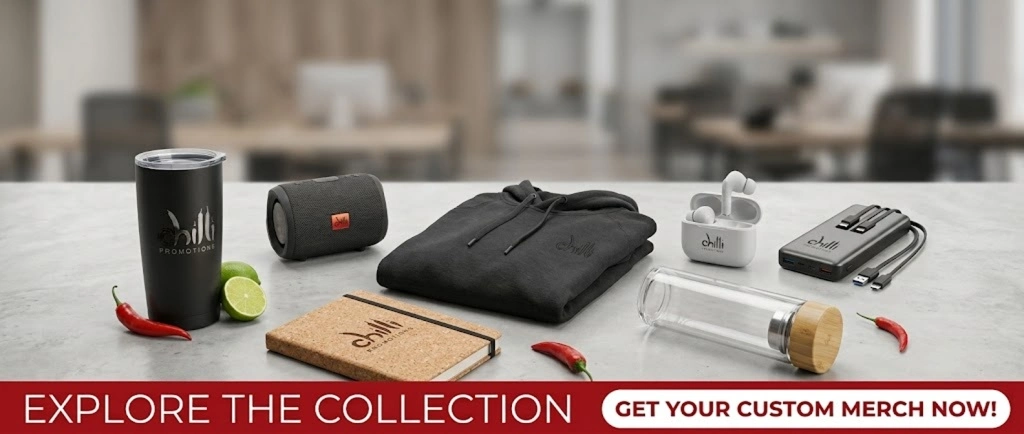
The team works as a strategic partner, not just a supplier, helping you brief items to specific loyalty touchpoints, whether that is onboarding, milestone rewards, or advocacy incentives. Every order is backed by two decades of experience delivering programmes that make a measurable difference to brand perception and repeat behaviour.
Browse the full promotional products range or request a quote to start building a loyalty merchandise programme your customers will actually remember.
Sources
- Two studies, one clear picture: what the promotional products industry looks like in 2025 – APPA
- Why Platypus’ new loyalty scheme promotes free gigs over discounts – Inside Retail
- What is customer loyalty? How to build & measure | Salesforce
- Customer loyalty definition | Emarsys
- Building customer loyalty with the 4 Cs – Narvar
- Customer loyalty examples and strategies – Yotpo
- Live Nation’s Kristy Rosser: Platypus Shoes’ big bet on live-music loyalty – B&T
FAQ
What does customer loyalty mean for a business?
Customer loyalty is the ongoing commitment a customer demonstrates through repeat purchases, referrals, and preference for a brand over competitors. It raises lifetime value and reduces the cost of acquiring new customers.
What is an example of customer loyalty merchandise?
A welcome kit sent to a new programme member, a limited-edition item released at a brand event, or a milestone gift mailed on a customer’s anniversary are all examples of loyalty merchandise in practice.
What are the 4 Cs of customer loyalty?
The 4 Cs framework identifies communication, choice, control, and connection as the four building blocks of post-purchase loyalty. Each maps to a programme touchpoint where merchandise can reinforce the relationship.
Is customer loyalty an intangible asset?
Customer loyalty is recognised as an intangible asset because it generates measurable future value through repeat revenue, lower acquisition costs, and referral growth, even though it does not appear as a line item on a balance sheet.
How do you measure the impact of loyalty merchandise?
Track repeat purchase rate, redemption rate, member NPS, referral lift, and average order value among merchandise recipients, then compare those figures against a control group that did not receive the item.