TL;DR:
- Branded giveaways are promotional products customized with a company’s logo designed to create positive impressions and engagement. These tangible items outperform digital advertising in brand recall, cost-efficiency, and consumer preference while having a lower carbon footprint. Practical items like drinkware and bags generate the most impressions, making deliberate selection essential for marketing success.
Branded giveaways are promotional products customised with a company’s logo or message, designed to create positive impressions and lasting engagement with customers. The industry term for this category is promotional merchandise or promotional products, and the discipline sits firmly within below-the-line marketing. The Advertising Specialty Institute (ASI) 2026 Ad Impressions Study, surveying nearly 5,000 consumers, confirms that nearly 80% of consumers who receive a promotional item report a more favourable impression of the advertiser. That single finding explains why companies use branded giveaways more than any other channel comparison can. This guide breaks down the marketing advantages, sustainability benefits, and practical selection strategies that make promotional products one of the most cost-efficient tools available to marketing professionals today.
What marketing advantages do branded giveaways give companies?
Branded giveaways deliver measurable marketing advantages that most digital channels cannot match at the same cost. The core benefits fall into four areas: consumer favourability, cost efficiency, longevity, and channel preference.
Consumer favourability and purchase intent
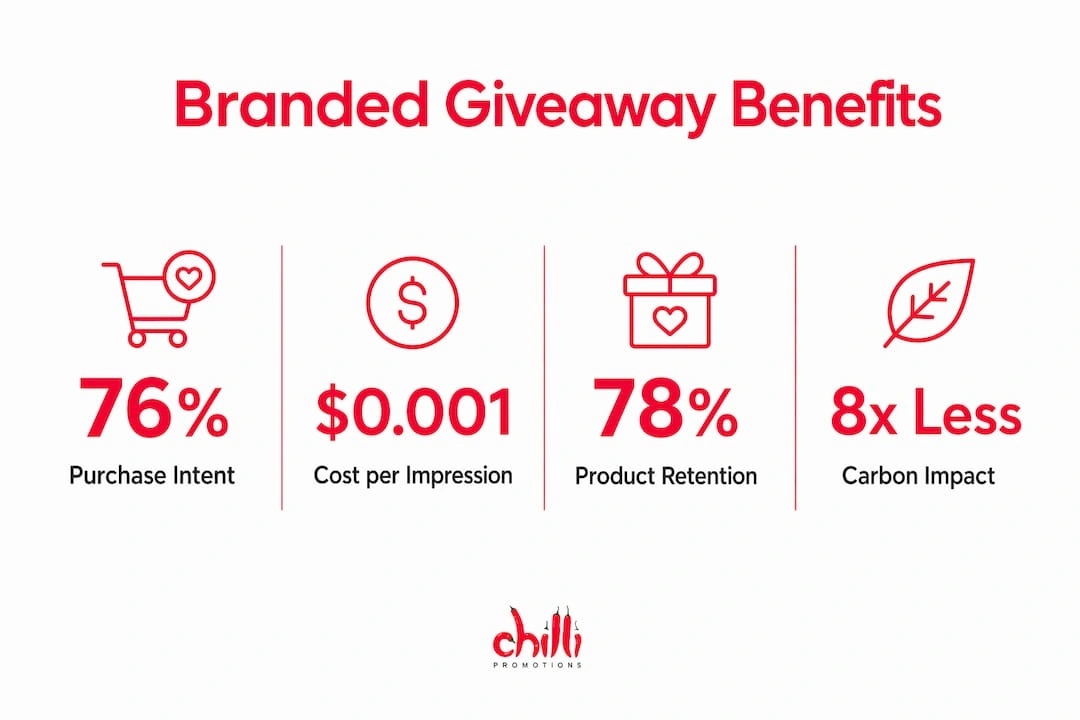
76% of consumers who receive a promotional product say they are more likely to do business with that company. That is not a soft sentiment metric. It is a direct signal of purchase intent generated by a physical object. The connection between receiving a useful gift and feeling goodwill toward the giver is well established in behavioural psychology, and branded giveaways exploit that connection at scale.
Cost efficiency that outperforms digital
A $6 tote bag generates around 5,000 impressions over its lifetime, producing a cost-per-impression of $0.001. Compare that to the cost of a single digital display ad impression, and the economics become difficult to ignore. ASI CEO Ashish Mittal describes promotional products as one of the most cost-efficient measurable channels available under budget pressure. That framing matters for marketing decision-makers who must justify spend to finance teams.
Consumer channel preference
Promotional products outrank television and digital as consumers’ most preferred advertising channel, with 85% remembering the advertiser who gave them a logoed product. Recall at that level is extraordinary. Most digital campaigns measure recall in single digits after 24 hours.
Key benefits at a glance:
- Brand recall: 85% of recipients remember the advertiser
- Purchase intent: 76% are more likely to do business with the brand
- Consumer favourability: nearly 80% report a more positive impression
- Cost-per-impression: as low as $0.001 for practical items like tote bags
- Channel preference: ranked above TV and digital by consumers
How does sustainability affect the value of branded giveaways?
Sustainability is no longer a secondary consideration in promotional product selection. It is a primary one, and the data backs that position.
ASI’s 2026 Promotional Product CO2 Project found that promo products generate up to eight times less carbon impact per memorised impression than digital advertising, including social media and online display ads. That finding reframes the entire sustainability conversation. A branded tote bag carried daily for two years produces far fewer emissions per brand impression than a retargeting ad served thousands of times to the same person.
The metric that matters here is emissions per memorised impression, not raw material weight or production carbon. PPAI CEO Drew Holmgreen notes that sustainability-focused promotional products combine marketing impact with a low carbon footprint, making them attractive to environmentally aware consumers and companies alike. For Australian businesses operating under increasing ESG scrutiny, this is a compelling argument.
“Sustainable branded merchandise combines marketing impact with low carbon footprint, making it attractive to environmentally-aware consumers and companies.” — PPAI CEO Drew Holmgreen
Practical sustainability considerations for product selection:
- Choose items made from recycled content, plant-based materials, or certified sustainable sources
- Prioritise longevity. A product used for three years generates more impressions and fewer emissions per impression than a novelty item discarded in a week
- Request carbon-neutral or carbon-offset documentation from your supplier
- Align product choice with your brand’s published sustainability commitments
For marketing professionals working with eco-friendly promotional products, the environmental argument now reinforces the commercial one rather than competing with it.
What types of branded giveaways generate the most value?
The primary driver of value in any branded giveaway is usefulness. 78% of consumers keep promotional products because they find them useful. Usefulness drives retention, and retention drives repeated brand impressions without any additional spend.
ASI’s 2026 Ad Impressions Study confirms that practical items like drinkware, bags, and outerwear generate the highest number of impressions over their lifetime. These categories share one characteristic: people use them in public, repeatedly, and for years.
| Product category | Why it works | Best use case |
|---|---|---|
| Drinkware (bottles, mugs) | Used daily, visible in offices and gyms | Corporate gifts, health and wellness brands |
| Tote bags | High public visibility, long lifespan | Retail, events, trade shows |
| Outerwear (jackets, vests) | Worn repeatedly in public | Premium client gifts, team branding |
| Notebooks and stationery | Daily desk use, consistent brand exposure | B2B, education, professional services |
| Tech accessories | High perceived value, frequent use | Tech brands, premium giveaways |
Novelty items sit at the opposite end of this spectrum. A stress ball or plastic keyring may generate a moment of delight at a trade show, but it rarely survives the trip home. The impression lifetime concept from ASI’s research makes this concrete: the marketing value of a giveaway ties directly to how long recipients keep and use it.
Pro Tip: Match the product to the recipient’s daily routine, not your brand’s aesthetic. A reusable coffee cup works for almost every professional. A branded fidget spinner works for almost none.
When selecting items, consider three factors: how often the recipient will use it, where they will use it (private vs. public), and how long it will last. A branded drink bottle used at the gym five days a week generates more impressions in a month than a digital ad campaign running for the same period.
How do branded giveaways fit into broader marketing strategies?
Branded giveaways work across multiple marketing objectives when integrated deliberately rather than treated as an afterthought. The four primary applications are brand loyalty, lead generation, purchase incentives, and employee engagement.
- Brand loyalty programmes. Gifting customers with useful branded items creates positive associations that reinforce repeat purchase behaviour. Branded giveaways build loyalty by generating goodwill that persists long after the transaction. A customer who uses your branded water bottle every day is reminded of your brand without any additional marketing spend.
- Lead generation at events and trade shows. Practical giveaways at trade shows attract foot traffic and give sales teams a reason to start conversations. The item becomes a physical reminder of the interaction after the event ends. This is why car brands use branded giveaways at motor shows and test-drive events. A branded cap or jacket worn home extends the brand’s reach beyond the event venue.
- Purchase incentives. Offering a free gift with purchase increases perceived value and can tip a buying decision. This tactic works particularly well in retail, subscription services, and B2B contracts where the gift signals appreciation and reinforces the relationship.
- Employee engagement and internal branding. Branded merchandise given to employees builds team identity and turns staff into brand ambassadors. Work-from-home employee gifts have become a significant category since 2020, with companies using branded packs to maintain culture across distributed teams.
- Event and conference marketing. Delegates who receive quality branded items associate that quality with the organising brand. The item travels home with them, extending brand exposure well beyond the event itself.
Pro Tip: Set a clear objective before selecting a product. A trade show giveaway optimised for foot traffic looks different from a loyalty gift designed for your top 50 clients. Conflating the two produces mediocre results for both.
Understanding how branded merchandise boosts awareness across these touchpoints helps marketing teams allocate budget more precisely and measure outcomes more accurately.
Key takeaways
Branded giveaways are one of the most cost-efficient advertising channels available, delivering measurable brand recall, consumer favourability, and purchase intent at a fraction of the cost-per-impression of digital or television advertising.
| Point | Details |
|---|---|
| Consumer favourability | Nearly 80% of recipients report a more positive impression of the advertiser after receiving a promotional product. |
| Cost-per-impression | A $6 tote bag generates around 5,000 impressions at $0.001 per impression, outperforming digital and TV. |
| Sustainability advantage | Promo products generate up to eight times less carbon impact per memorised impression than digital advertising. |
| Usefulness drives retention | 78% of consumers keep promotional products because they find them useful, generating repeated brand impressions. |
| Strategic integration | Giveaways serve brand loyalty, lead generation, purchase incentives, and employee engagement when planned deliberately. |
What we have learned from 20+ years of promotional product campaigns
The most common mistake we see marketing teams make is selecting a giveaway based on what looks good in a catalogue rather than what the recipient will actually use. A beautifully printed novelty item that ends up in a bin after three days is not a marketing investment. It is a waste of budget and materials.
The research from ASI’s 2026 studies confirms what we have observed working with Australian and New Zealand companies for over two decades. Practical items win. Drinkware, bags, and outerwear consistently outperform novelty categories because they integrate into daily routines. When your brand travels with someone to the gym, the office, or the supermarket, you are generating impressions that no digital retargeting campaign can replicate.
The sustainability dimension has shifted significantly in the past few years. Clients now ask about recycled content, carbon-neutral certification, and supplier ethics as standard questions, not afterthoughts. That shift is good for the industry and good for brands. Choosing a product with genuine sustainability credentials gives you a story to tell, not just a logo to display.
One thing the data does not fully capture is the emotional weight of a well-chosen gift. A premium branded jacket given to a long-term client communicates respect and appreciation in a way that an email or a digital ad never will. That emotional dimension is where brand exposure through promotional materials creates value that sits outside any cost-per-impression calculation.
Our advice to marketing decision-makers is straightforward. Define the objective first. Select the product second. Measure the outcome. Then repeat what works.
— Chilli Promotions Team
Chilli Promotions: promotional products built for real marketing impact
Chilli Promotions has supplied promotional products and programmes across Australia and New Zealand since 2001. The product range covers everything from corporate giveaways selected for maximum retention and impressions, through to certified sustainable merchandise for brands with active environmental commitments.
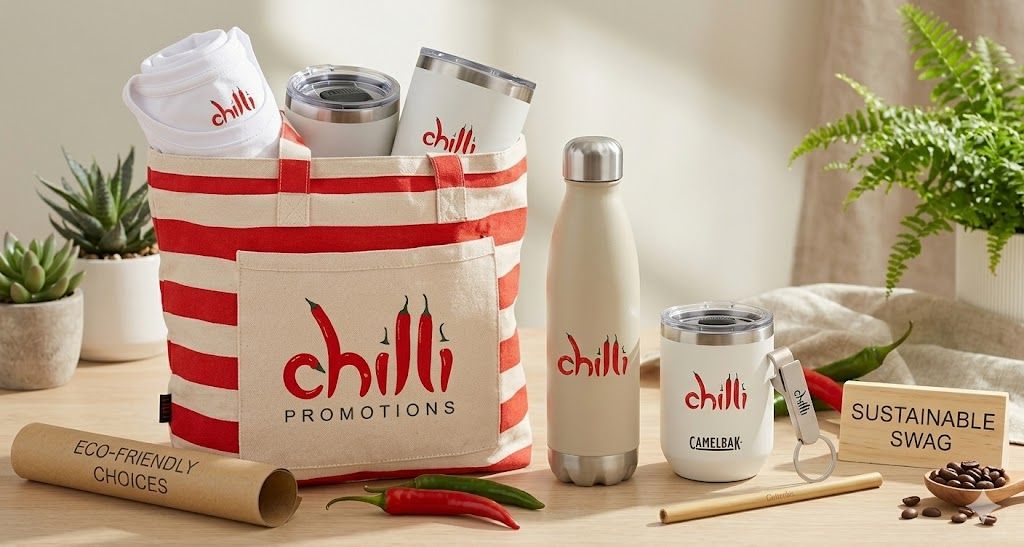
Whether you are planning a trade show, a client loyalty programme, or an employee engagement campaign, Chilli Promotions works as a partner in your marketing strategy, not just a supplier filling an order. The team brings category knowledge, sustainability expertise, and a product range that covers every budget and occasion. Explore the full promotional products range or request a consultation to match the right product to your next campaign.
FAQ
What are branded giveaways in marketing?
Branded giveaways are physical products customised with a company’s logo or message and distributed to customers, prospects, or employees. The industry term is promotional products or promotional merchandise.
Why do companies use branded giveaways instead of digital ads?
Promotional products outrank digital and television as consumers’ most preferred advertising channel and deliver a cost-per-impression as low as $0.001, making them more cost-efficient than most digital formats.
What branded giveaways generate the most impressions?
Practical items including drinkware, bags, and outerwear generate the most impressions because recipients use them frequently and in public over extended periods.
Are branded giveaways environmentally responsible?
Promo products generate up to eight times less carbon impact per memorised impression than digital advertising. Choosing items made from recycled or certified sustainable materials strengthens that advantage further.
Why do car brands use branded giveaways at events?
Car brands use branded giveaways at motor shows and test-drive events to extend brand exposure beyond the venue, give sales teams a conversation starter, and create a physical reminder of the brand experience that travels home with the prospect.