TL;DR:
- Promotional products generate a high ROI by delivering impressions at a significantly lower cost than other advertising channels. Consumers tend to remember and favor brands through physical items that last longer and are used repeatedly. Proper measurement and quality focus enhance the effectiveness of promotional merchandise in marketing campaigns.
Promotional product ROI is defined as the measurable return a business generates from branded merchandise investments, expressed through cost per impression, brand recall, and revenue attribution. Research shows promotional products deliver approximately $6.41 in value for every $1 spent, with 76–80% of consumers more likely to do business with a brand after receiving a promotional item. For Australian marketing professionals and business owners, understanding this return is not optional. It is the difference between a merchandise budget that gets cut and one that gets increased.
How is promotional products ROI calculated?
ROI for promotional merchandise is measured through a combination of quantitative metrics and qualitative evidence. No single number tells the full story, but cost per impression (CPI) is the most widely used starting point.

CPI formula: Divide the total cost of the item by the estimated number of brand impressions it generates over its useful life. A $6 tote bag that generates roughly 5,000 lifetime impressions produces a CPI of $0.001. A fleece jacket generating 9,000 impressions at a $30 cost delivers a CPI of $0.003. Both figures are well below what most digital or broadcast channels charge per impression.
Beyond CPI, the metrics that matter most for calculating promotional product ROI are:
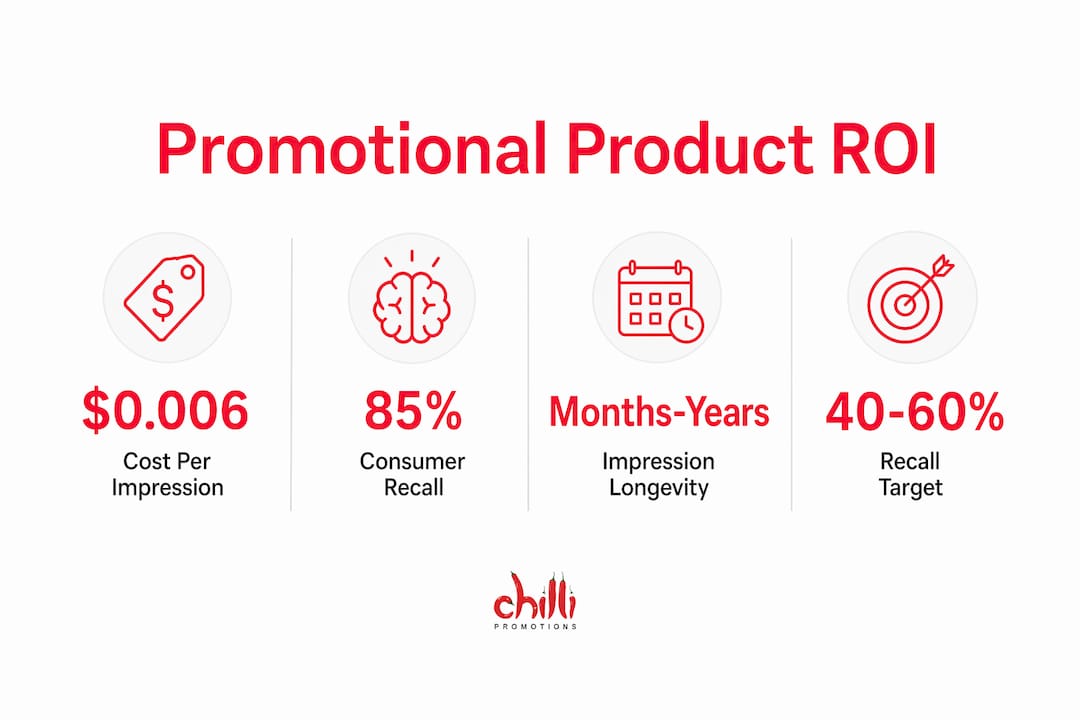
- Unaided brand recall rate. This measures whether recipients remember your brand without prompting. A well-executed merchandise campaign should target a recall rate of 40–60%.
- Redemption rate. For items linked to a digital call to action, such as a QR code or unique URL, track how many recipients take the next step. Strong campaigns achieve redemption rates of 70–90%.
- Lead attribution. At trade shows or events, count the leads generated by staff or booths using branded merchandise and compare them against events where no merchandise was distributed.
- Revenue cohort comparison. Compare the average order value or retention rate of customers who received a promotional item against those who did not. This is one of the clearest ways to demonstrate merchandise ROI to a finance team.
- Conversion rate lift. Call-to-action merchandise doubles conversion rates compared to traditional digital promotions when the product is relevant and the offer is clear.
Qualitative evidence also counts. Social media posts featuring your branded merchandise, customer feedback mentioning a gift, and event staff reports on booth traffic all build the case for ROI when hard attribution is difficult.
Pro Tip: Set your measurement framework before you order. Decide which KPIs you are tracking, whether that is recall lift, redemption rate, or lead volume, and build the tracking mechanism into the campaign from day one.
What makes promotional products deliver better ROI than digital ads?
Promotional merchandise outperforms digital advertising on cost per impression by a significant margin. ASI research shows promotional products generate brand impressions at an average of $0.006 each. Prime-time TV and national magazines cost around $0.018 per impression. That is a threefold cost advantage before accounting for the longevity of a physical item.
Digital ads disappear the moment a campaign ends. A branded water bottle or jacket continues generating impressions for months or years. That compounding effect is what makes the ROI of marketing merchandise so compelling for budget-conscious Australian businesses.
Consumer behaviour data reinforces this. 85% of consumers recall the advertiser from a promotional product they received. 78% report a more favourable view of the company after receiving branded merchandise. No digital format consistently produces those recall and sentiment numbers.
| Channel | Average CPI | Impression longevity |
|---|---|---|
| Promotional products | $0.006 | Months to years |
| Prime-time TV | $0.018 | Seconds |
| National magazines | $0.018 | Days to weeks |
| Digital display ads | Variable, often higher | Seconds |
The table above makes the case plainly. Promotional merchandise is not just cheaper per impression. It is the only advertising format that recipients keep, use, and display in front of others repeatedly.
What are best practices for maximising promotional product ROI?
The most common mistake in promotional merchandise investment is focusing on unit cost rather than business outcomes. Shifting the conversation to ROI per dollar spent and tracking booth traffic, lead volume, and customer retention produces far better results than chasing the cheapest item in the catalogue.
The following practices consistently improve returns:
- Align the product with the audience. A branded reusable coffee cup resonates with office professionals. A logoed sunscreen works at an outdoor event. Relevance drives retention, and retention drives impressions.
- Prioritise quality over volume. Wasting budget on low-quality, high-volume giveaways reduces ROI. A smaller number of well-made items that recipients actually use generates more impressions and better brand sentiment than a large batch of throwaway items.
- Implement quality control standards. Using an Acceptable Quality Limit (AQL) framework prevents defective batches from reaching recipients. A faulty product damages brand perception far more than no product at all.
- Use digital-linked merchandise. QR codes and unique URLs printed on promotional items connect physical distribution to measurable digital outcomes. Visible placement on apparel generates scan rates of 12–18%, compared to 3–5% for hidden or poorly placed tags.
- Account for total landed cost. Procurement-first models that include decoration, freight, and any applicable tariffs give you a true cost per item. Budgeting on unit price alone consistently underestimates actual spend and distorts ROI calculations.
- Time distribution to key moments. Merchandise distributed at contract renewal, onboarding, or a major event creates a positive association at a high-value touchpoint. Timing amplifies the emotional impact and increases the likelihood of retention.
Pro Tip: When kitting merchandise for corporate gifting or event packs, calculate the total landed cost per kit including packaging, assembly, and delivery. This figure is your true investment baseline for any ROI calculation.
Understanding the benefits of branded merchandise goes beyond impressions. The right product at the right moment builds the kind of brand association that no banner ad can replicate.
How can Australian businesses measure promotional product ROI in 2026?
Australian consumers tend to keep useful branded items for extended periods, which increases the lifetime impression value of well-chosen merchandise. Brand exposure through promotional materials in the Australian market benefits from this retention behaviour, particularly for practical items like drinkware, bags, and apparel.
The measurement approach that works best for Australian businesses in 2026 combines direct attribution with passive impression tracking.
- Assign unique discount codes or URLs to each campaign. This creates a direct link between merchandise distribution and online conversions. Track redemptions in your CRM or e-commerce platform.
- Run unaided recall surveys post-event. Ask recipients to name brands they associate with the event without prompting. A result in the 40–60% range confirms the merchandise is doing its job.
- Compare revenue cohorts. Pull data on customers who received merchandise versus those who did not. Differences in average order value, repeat purchase rate, or contract renewal rate provide hard evidence of ROI.
- Track social media mentions. Search for posts featuring your branded items. User-generated content featuring your merchandise is both free advertising and qualitative proof of product quality and recipient engagement.
- Use event-based attribution. For trade shows and conferences, compare lead volume and quality from events where merchandise was distributed against those where it was not. The difference is attributable to the merchandise investment.
A useful benchmark: about 85% of promotional product ROI comes from passive brand impressions rather than direct digital attribution. This means direct tracking methods like QR codes capture only a fraction of the true return. Build your measurement model to account for both passive and active attribution, and present both figures to leadership.
Pairing digital marketing metrics such as brand recall lift and conversion rate data with physical merchandise distribution gives Australian marketing teams a complete picture of campaign performance.
Key takeaways
Promotional merchandise delivers measurable ROI through cost-efficient brand impressions, strong consumer recall, and direct revenue attribution when campaigns are planned with clear KPIs and quality controls.
| Point | Details |
|---|---|
| CPI advantage is significant | Promotional products average $0.006 per impression versus $0.018 for TV and magazines. |
| Consumer recall is high | 85% of recipients recall the advertiser; 78% report a more favourable brand view. |
| Quality beats volume | Fewer, well-made items generate more impressions and better brand sentiment than bulk giveaways. |
| Digital linking improves attribution | Visible QR codes achieve 12–18% scan rates, connecting physical items to measurable digital outcomes. |
| Total cost must include all components | Decoration, freight, and tariffs belong in your cost baseline, not just the unit price. |
The measurement mistake most Australian marketers are still making
After more than two decades working with Australian businesses on promotional merchandise, the pattern I see most often is this: a marketing team orders a great product, distributes it well, and then has no answer when the CFO asks what it delivered. The campaign was not the problem. The measurement plan was.
The fix is not complicated, but it requires discipline before the order is placed. Decide on two or three KPIs, build the tracking into the campaign, and report on those specific numbers. A unique URL on a branded notebook. A post-event recall survey sent to attendees. A cohort comparison pulled from your CRM three months after a client gifting programme. These are not difficult to execute, and they change the entire conversation about merchandise budgets.
The other lesson I keep coming back to is the quality argument. Businesses that treat promotional merchandise as a volume exercise consistently get disappointing results. The ones that treat it as a quality investment, choosing fewer items that recipients genuinely want to keep, consistently report stronger recall, better sentiment, and more social media evidence of impact. The data supports this. The experience confirms it.
Promotional merchandise is not a soft marketing spend. It is one of the most cost-efficient impression channels available to Australian businesses. The ROI is there. You just need to measure it properly.
— Chilli Promotions Team
Chilli Promotions and your promotional product ROI
Chilli Promotions has been helping Australian and New Zealand businesses get real returns from branded merchandise since 2001. The team works as a partner in your campaign planning, not just a supplier filling an order.

Whether you are planning a trade show kit, a client gifting programme, or an employee recognition campaign, Chilli Promotions brings the product knowledge, quality controls, and logistics experience to make your investment count. Browse the top corporate giveaway products to find merchandise that aligns with your campaign goals and audience. For the full range of branded merchandise available across Australia, visit the Chilli Promotions product catalogue and speak with the team about building a campaign with measurable outcomes.
FAQ
What is a good cost per impression for promotional products?
Promotional products average $0.006 per impression, which is well below the $0.018 per impression typical of prime-time TV and national magazines. Items like tote bags and fleece jackets can achieve even lower CPIs due to their long useful life and high visibility.
How do I calculate ROI for a promotional merchandise campaign?
Divide the total campaign cost (including decoration, freight, and distribution) by the number of measurable outcomes, such as leads generated, redemptions recorded, or impressions estimated. Compare this figure against your other advertising channels using the same cost-per-outcome metric.
What recall rate should I target for a promotional product campaign?
Target an unaided brand recall rate of 40–60% among recipients. This benchmark indicates the merchandise has created a genuine brand memory rather than a passing impression.
Do QR codes on promotional products actually get scanned?
Yes, but placement matters significantly. Visible positions on apparel generate scan rates of 12–18%, while hidden or poorly placed QR codes achieve only 3–5%. Plan the placement before production, not after.
Why do 85% of consumers recall the advertiser from a promotional product?
Physical items engage multiple senses and are used repeatedly over time, which reinforces memory encoding far more effectively than a digital ad viewed once. That repeated exposure is the core reason promotional merchandise consistently outperforms other advertising formats on recall metrics.