Short answer: yes, bamboo can be genuinely sustainable, but only if the fibre was processed responsibly. Otherwise, no. A 2025 life cycle assessment found bamboo pulp scores lower environmental impact than wood or cotton pulp in viscose production, yet most soft “bamboo” fabric on shelves skips the closed-loop lyocell route that makes that number possible. Chilli Promotions emphasizes the need to understand processing methods, blends, and careful checks before purchase when sourcing bamboo merchandise.
TL;DR:
- Most bamboo fabric on the market is made through chemical-intensive viscose processing, which can negate the plant’s low-impact cultivation benefits.
- A 2025 life cycle assessment shows bamboo pulp has a lower environmental impact than wood or cotton pulp, but only when chemical processing is sustainable and energy use is managed.
- Genuine sustainability claims depend on verified processing methods, such as closed-loop lyocell, rather than on the plant itself or vague labels like “bamboo.”
- Blended bamboo garments with synthetics do not fully biodegrade and can produce methane in landfills, reducing their end-of-life environmental benefits.
- Buyers should look for certifications like OEKO-TEX, FSC, or explicit “bamboo lyocell” labels and demand supplier documentation to avoid greenwashing.
Table of Contents
- Is bamboo sustainable? The quick pros and cons
- How bamboo grows: the cultivation benefits and their limits
- Processing methods: why the fabric matters more than the plant
- What does the lifecycle data actually show?
- Will it actually break down? Biodegradability and end of life
- How to choose a genuinely lower-impact bamboo product
- Sourcing bamboo merchandise without the greenwash
- Why the “is bamboo sustainable” debate misses the real question
- FAQ
Is bamboo sustainable? The quick pros and cons
Bamboo earns its reputation as a crop, not as a finished fabric. Those are two different questions, and the gap between them is where most confusion lives.
What bamboo has going for it:
- Grows up to a metre a day and regenerates from its own root system without replanting
- Needs little to no pesticide or irrigation compared with conventional cotton
- Matures for harvest in three to five years, far faster than most hardwood plantations
Where the sustainability story gets complicated:
- Turning raw stalk into soft, wearable fibre usually means viscose processing, which relies on chemical solvents
- Supply chains are often opaque, so a “bamboo” label tells you almost nothing about how the fibre was actually made
- Energy and water use during processing can offset the low-impact farming stage entirely
Compared with cotton, bamboo cultivation generally uses less water and pesticides. Compared with polyester, bamboo is more biodegradable, at least in its unblended form. But the fabric you’re holding in a t-shirt or a drink bottle sleeve is rarely just “bamboo.” It’s bamboo plus a manufacturing process, and that process decides most of the outcome.
How bamboo grows: the cultivation benefits and their limits
Bamboo’s growing reputation is well earned. It regrows from an existing root network after harvest, so there’s no tilling, no reseeding, and no bare soil left exposed between crops the way there often is with cotton. Stands can produce usable stalk within three to five years, a fraction of the decades needed for most timber used in wood pulp fibre.
The plant also sequesters a meaningful amount of carbon while it grows, and healthy stands can help stabilise soil on slopes prone to erosion. It typically needs far less irrigation than cotton and rarely requires the pesticide programs conventional cotton depends on, a point ShunWaste’s analysis backs in its comparison of the two crops.
None of that is universal, though. Where bamboo is grown on land cleared of native forest or converted from mixed farmland into dense monoculture, some of those soil and biodiversity benefits shrink or disappear. Regional water tables, soil type, and farming practice all shift the picture, so “bamboo is grown sustainably” is a claim about a specific farm, not the species.
Processing methods: why the fabric matters more than the plant
This is where bamboo’s environmental story splits in two, and it’s the single most important thing to understand before buying anything labelled “bamboo.”
- Mechanical or bast processing. Stalks are crushed and combed to separate natural fibres, similar to how linen is made from flax. It uses minimal chemical input but produces a coarser, less silky fabric, so it’s rarer in fashion and often reserved for rougher textiles.
- Viscose or rayon processing. The stalk is broken down into cellulose, then dissolved using chemicals such as carbon disulfide and sodium hydroxide before being spun into fibre. This is how almost all soft, drapey “bamboo” clothing and towels are actually made. A review of bamboo fibre manufacturing confirms this chemical route dominates commercial production, and it flags widespread labelling inaccuracy as a real problem for shoppers.
- Lyocell processing. A different, less hazardous solvent is used inside a closed-loop system that recaptures and reuses the majority of the chemical input rather than discharging it. This is the version worth seeking out specifically as “bamboo lyocell,” and it’s the closest thing to matching the plant’s low-impact reputation all the way through to finished fabric.
Open-loop viscose facilities can discharge solvent-laden wastewater if effluent treatment is weak, and the energy load of chemical processing is substantial. That’s the hidden cost behind a shirt that feels sustainable but was never verified.
Pro Tip: If a bamboo product feels silky and drapes like rayon, assume it’s viscose unless the brand explicitly states “lyocell” or “closed-loop” on the label. Silky bamboo and mechanically processed bamboo almost never look or feel the same.
What does the lifecycle data actually show?
The clearest empirical answer so far comes from a 2025 life cycle assessment comparing bamboo pulp against wood pulp and cotton pulp in viscose fibre production.
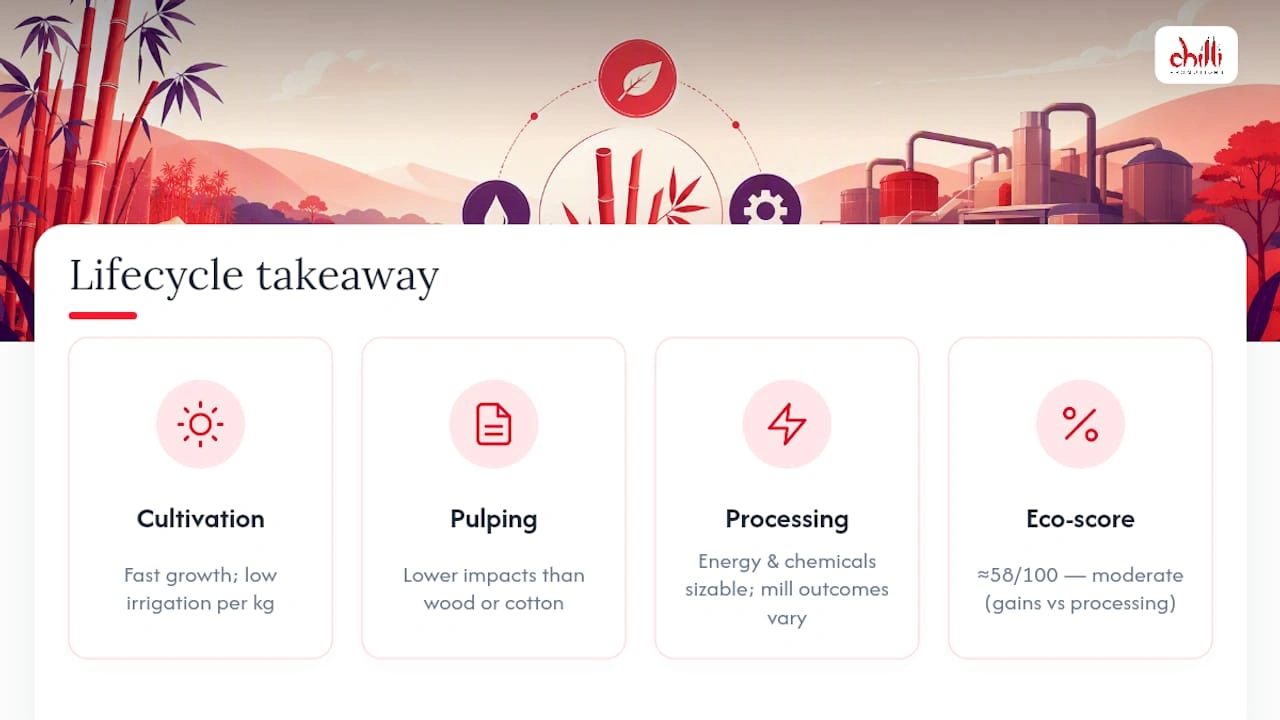
The key figure: that LCA found bamboo pulp delivered a lower overall environmental impact than either wood or cotton pulp, including reduced greenhouse gas emissions and lower blue water consumption per kilogram of fibre compared with conventional cotton.
The gains showed up mostly at the cultivation and pulping stages, where bamboo’s fast growth and low irrigation need translate directly into fewer inputs per kilogram of finished pulp. Processing energy and chemical use remained a meaningful share of total impact regardless of feedstock, which is exactly why the fibre source alone doesn’t guarantee a low-impact garment.
That result also doesn’t generalise automatically to every mill or every bamboo product on the market. A single LCA reflects the production conditions it modelled. A factory with weak effluent treatment or a coal-heavy energy grid can still produce bamboo viscose with a worse footprint than a well-run cotton mill elsewhere. Tap lands bamboo fabric at a moderate eco-score, roughly 58 out of 100, precisely because cultivation strengths and processing weaknesses tend to cancel each other out in practice.
Will it actually break down? Biodegradability and end of life
Pure, unblended bamboo cellulose fibre is biodegradable under aerobic composting conditions, breaking down the way cotton or linen would. That’s a genuine advantage over synthetic textiles.
Real-world garments complicate this. Many bamboo blends include polyester or elastane for stretch and durability, and those synthetic fibres don’t break down at all, so the finished product only partially biodegrades no matter how compostable the bamboo component is on its own. Dumped in a landfill, any organic textile decomposes anaerobically, which produces methane rather than the carbon dioxide and water you’d get from aerobic composting. Industrial composting facilities manage temperature and oxygen levels well enough to process cellulosic textiles properly; most home compost bins can’t reliably match that, especially with woven fabric rather than loose fibre.
Before binning a bamboo item, check the care label for blend content, and favour take-back or textile recycling schemes over general waste where they exist.
How to choose a genuinely lower-impact bamboo product
Buying well means asking a handful of specific questions before checkout, not trusting the word “bamboo” on its own.
Look for these signals:
- OEKO-TEX certification, which limits harmful chemical residues in the finished fabric
- FSC certification on the source material, confirming responsible forestry or land management upstream
- Cradle to Cradle certification or explicit closed-loop solvent recovery claims
- The specific phrase “bamboo lyocell” rather than just “bamboo” or “bamboo viscose”
Ask suppliers directly: how is the fibre extracted, is solvent recovered in a closed loop, and can they provide mill-level documentation rather than a marketing claim. Good On You’s guide makes the same point: the plant is sound, but the market is flooded with viscose sold as though it were something greener.
Where a supplier can’t answer those questions, consider alternatives with clearer verification, including organic cotton, hemp, or branded TENCEL™ Lyocell. Comparing bamboo against wheat straw and sugarcane options for drinkware is worth doing before locking in a material choice.
Certified fibre and closed-loop processing both cost more to produce, so a rock-bottom price usually means neither happened.*
Sourcing bamboo merchandise without the greenwash
Chilli Promotions treats bamboo the way this article does: as a crop with real promise that only delivers on that promise when the processing is verified. Procurement teams ordering bamboo drinkware, apparel, or stationery should request the same documentation covered above, mill audits, chemical management evidence, and closed-loop or certified claims, before committing to a bulk run.
Our sustainable promotional products guide walks through exactly how we vet suppliers, and our 10-point eco promo checklist gives your team a practical audit tool for any eco-branded order. If you’re weighing bamboo against other eco-friendly promotional products for an upcoming campaign, our range of branded merchandise includes verified lower-impact options across drinkware, apparel, and stationery, backed by supplier documentation rather than a label alone.
Why the “is bamboo sustainable” debate misses the real question
The wrong question gets asked constantly: is bamboo sustainable? The right one is rarely asked at all: which bamboo, processed how, verified by whom?
Most of the public argument treats bamboo as a single material with a single verdict, when it behaves more like two entirely different products sharing one name. Mechanically processed bamboo and closed-loop lyocell genuinely earn the crop’s reputation. Open-loop viscose, which still dominates the commercial market, borrows that reputation without doing the work to deserve it. That’s not a minor labelling quirk. It’s the difference between a fabric with a defensible environmental case and one riding on a plant’s PR.
What gets underestimated is how much this puts the burden on the buyer rather than the industry. Certification schemes like OEKO-TEX and Cradle to Cradle exist precisely because “bamboo” alone tells you nothing enforceable. Until labelling standards catch up, asking a supplier for mill-level evidence isn’t excessive diligence. It’s the only way to tell the two bamboos apart.
— Allissar Tawadros
FAQ
How environmentally friendly is bamboo?
Bamboo as a crop is genuinely low-impact, needing little water or pesticide and growing fast without replanting. Whether the finished fabric stays low-impact depends entirely on whether it was processed as viscose or as closed-loop lyocell.
Is bamboo more ethical than cotton?
Cultivation-wise, bamboo generally uses less water and far less pesticide than conventional cotton, and the 2025 LCA found lower emissions and blue water use for bamboo pulp. Processing can narrow or erase that advantage depending on the mill.
Why do experts warn against bamboo?
The warning isn’t about the plant, it’s about labelling. Most soft “bamboo” textiles sold today are viscose made with hazardous solvents, marketed with the plant’s eco reputation despite the chemical-heavy process behind them.
Is bamboo 100% biodegradable?
Pure, unblended bamboo cellulose fibre biodegrades under aerobic conditions. Blends with polyester or elastane won’t fully break down, and landfill conditions produce methane rather than clean decomposition.