Sustainable merchandise is defined as branded promotional products made from eco-conscious materials, designed for durability and repeated use, with a measurable reduction in environmental impact across their lifecycle. Understanding why sustainable merchandise matters 2026 is no longer optional for Australian business leaders. The dual role these products play, delivering genuine brand recall while supporting corporate sustainability commitments, makes them a strategic priority. Organisations like the Promotional Products Association International (PPAI), the Australian Competition and Consumer Commission (ACCC), and the Australian Government’s procurement framework are all shaping the rules of engagement for eco-friendly branded merchandise this year.
Why sustainable merchandise matters in 2026: the carbon and marketing case
Sustainable promotional products, also called eco-branded merchandise, generate up to 8x less carbon impact per memorised impression than digital advertising. That finding, from a 2026 study conducted by PPAI in partnership with Climate 51toCarbonZero, reframes how marketing teams should think about channel selection.

A “memorised impression” is the measure of brand recall per recipient over time, not just a single exposure. Digital ads generate impressions in milliseconds, but most are forgotten within hours. A well-made reusable water bottle or recycled tote bag sits on a desk or travels on public transport for months, generating repeated brand exposure with no additional carbon cost.
Elizabeth Wimbush of PPAI has noted that the marketing and carbon equation are inseparable when evaluating promotional channels. The study found that durable branded merchandise outperforms digital, television, radio, and print advertising on carbon efficiency per brand recall event. That is a significant finding for any sustainability officer trying to reconcile marketing spend with emissions reduction targets.
Gen Z audiences, who now represent a growing segment of both consumers and employees, actively prefer brands that demonstrate environmental responsibility. Industry research confirms that durable, useful branded merchandise aligns with the values of this cohort while meeting rising employer sustainability expectations. For Australian businesses competing for talent and customer loyalty, this alignment is a concrete commercial advantage.
“Sustainable promotional products are not just a feel-good choice. They are a measurably better marketing investment when carbon impact and brand recall are both on the table.” — Elizabeth Wimbush, PPAI
Pro Tip: When briefing your merchandise supplier, ask for carbon impact data per memorised impression, not just per unit produced. That metric gives you a direct comparison against your digital advertising spend.
What does australia’s 2026 regulatory environment require?
The compliance framework for environmental claims in Australia has become significantly more demanding. Sustainability officers who treat merchandise procurement as a low-risk activity are exposed to real legal and reputational consequences.
The Australian Government’s Environmentally Sustainable Procurement (ESP) policy, active since 2024 and expanded in 2025, mandates that public sector agencies and their suppliers meet documented environmental standards. Contracts above defined thresholds now require Supplier Environmental Sustainability Plans and ongoing environmental metric reporting. For any business supplying merchandise to government clients, this is a hard compliance requirement, not a voluntary gesture.
The ACCC defines greenwashing as false or misleading environmental claims and actively enforces against businesses that use vague or unsubstantiated language. Terms like “eco-friendly,” “sustainable,” or “carbon-neutral” carry legal weight. Each claim must be backed by documented evidence.
The 2026 Federal Court decision in ACCR v Santos reinforced this position. The court ruled that climate-related marketing claims require reasonable grounds and contextual disclosures to avoid being misleading. The Santos decision signals that businesses can communicate climate targets, but only with proper substantiation and framing. Vague aspirational language without evidence is a liability.
For sustainability officers, the practical compliance checklist looks like this:
- Obtain Supplier Environmental Sustainability Plans from all merchandise suppliers before contract execution.
- Document environmental metrics for each product category, including materials sourcing, recycled content percentages, and end-of-life options.
- Review all marketing copy for merchandise, including product labels, packaging, and digital descriptions, to confirm every claim is substantiated.
- Apply contextual disclosures when making carbon-neutral or offset claims, referencing the specific programme or certification used.
- Establish an audit trail for each claim, so your team can respond quickly if the ACCC or a procurement auditor requests evidence.
Pro Tip: Before any merchandise campaign goes live, run all sustainability claims through your legal or compliance team using the ACCC’s published guidance as the benchmark. A pre-review process costs far less than an enforcement action.
How do you choose sustainable merchandise that delivers results?
Selecting eco-friendly promotional products requires more than ticking a “recycled materials” box. Retention must be a core design requirement, not an accidental outcome. Retention as a design goal is what multiplies marketing impressions and maximises the carbon-efficiency advantage of sustainable merchandise.
What makes merchandise worth keeping?
Products that recipients actually use and keep deliver more brand impressions per unit of carbon than products that end up in landfill within weeks. Desirability and durability are the two non-negotiable design attributes. A recycled pen that breaks after a fortnight is neither sustainable nor effective marketing.
When evaluating merchandise options, apply these criteria:
- ♻ Material credentials: Confirm recycled content percentages, plant-based materials, or certified sustainable sources. Ask for documentation, not just claims.
- Durability standards: Specify minimum product lifespans in your brief. A product designed to last two or more years generates far more impressions per gram of carbon than a single-use alternative.
- Versatility of use: Products that serve multiple purposes, such as a recycled canvas bag that works for groceries, gym gear, and work, generate more daily impressions.
- Supplier certifications: Look for ISO 14001 environmental management certification, EcoVadis Silver ratings, or NoCO2 documentation from your supplier. These are verified, not self-declared.
- End-of-life options: Products with composting, recycling, or take-back programmes reduce total lifecycle impact and support your ESP reporting obligations.
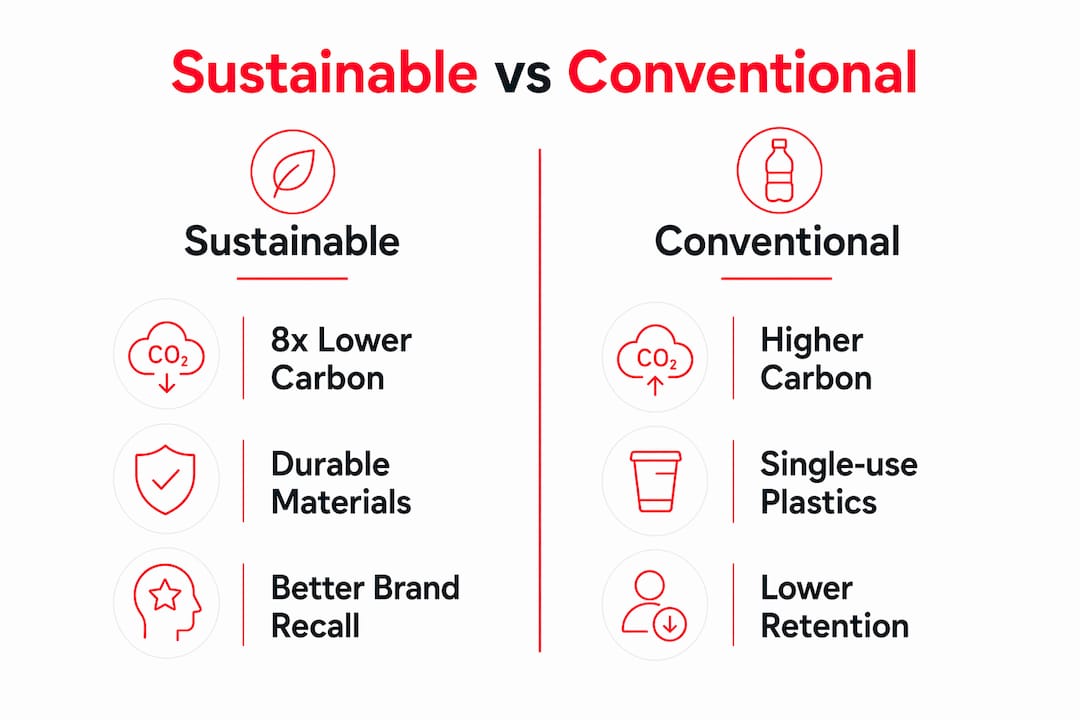
Sustainable vs. conventional merchandise: a direct comparison
| Attribute | Sustainable Merchandise | Conventional Merchandise |
|---|---|---|
| Carbon impact per impression | Up to 8x lower | Higher, especially for short-lived items |
| Brand recall duration | Months to years | Days to weeks |
| Regulatory risk | Low, with proper documentation | Higher, especially with vague claims |
| Consumer perception | Positive, especially with Gen Z | Neutral to negative if sustainability is absent |
| ESP compliance | Supported with certified suppliers | Requires additional documentation effort |
| Lifecycle cost | Lower over time due to longevity | Higher due to frequent replacement |
The table makes the business case plainly. Sustainable merchandise is not a premium add-on. It is the lower-risk, higher-return choice when evaluated across the full marketing and compliance picture.
Eco-friendly promotional products designed for durability and certified materials give your team a defensible procurement position while delivering better marketing outcomes. That combination is rare in any channel.
Sustainable vs. traditional promotional products: the business case
The shift from conventional to sustainable promotional merchandise is not driven by sentiment alone. The impact of sustainable retail choices now carries measurable financial, legal, and reputational consequences for Australian businesses.
Traditional promotional products, such as single-use plastic items or low-quality giveaways, carry a hidden cost structure. They generate short-lived impressions, require frequent replacement, and create waste disposal costs. More critically in 2026, they expose your brand to reputational damage if your sustainability narrative does not match your merchandise choices.
Sustainable merchandise, by contrast, reduces waste at the source. A product designed for retention and made from recycled or certified materials generates brand impressions for months without additional spend. The carbon-efficiency advantage compounds over the product’s life, making the cost per impression lower than almost any other marketing channel.
Brand loyalty is also a measurable outcome. Consumers who receive a genuinely useful, well-made product associate quality and care with the brand behind it. For Australian businesses operating in competitive sectors, that association is worth protecting. Choosing merchandise that reflects your corporate values is not a soft benefit. It is a brand positioning decision with hard commercial consequences.
The risks of non-compliance are equally concrete. Greenwashing enforcement by the ACCC carries financial penalties and public naming. Reputational damage from a misleading sustainability claim can erode years of brand equity. The Santos decision confirmed that the courts will scrutinise environmental marketing claims with the same rigour applied to financial disclosures. Sustainable merchandise, sourced and communicated correctly, removes that risk entirely.
For businesses supplying the public sector, ESP policy compliance is a contract condition. Failing to meet it costs you the contract. Meeting it with well-documented sustainable merchandise strengthens your supplier relationship and positions your business as a preferred partner for future tenders.
Key takeaways
Sustainable merchandise delivers superior marketing outcomes and lower compliance risk than conventional promotional products, making it the definitive choice for Australian businesses in 2026.
| Point | Details |
|---|---|
| Carbon efficiency advantage | Sustainable merchandise generates up to 8x less carbon per memorised impression than digital advertising. |
| Retention drives results | Design merchandise for durability and desirability to multiply impressions and maximise carbon efficiency. |
| Compliance is non-negotiable | ACCC greenwashing enforcement and ESP policy require documented evidence for every sustainability claim. |
| Legal precedent is set | The ACCR v Santos decision confirms climate claims need reasonable grounds and contextual disclosures. |
| Business case is clear | Lower lifecycle costs, stronger brand loyalty, and reduced regulatory risk make sustainable merchandise the strategic choice. |
Sustainable merchandise strategy: what i’ve learned working with australian brands
After working closely with Australian businesses across procurement, marketing, and sustainability functions, the pattern I see most often is this: organisations treat sustainable merchandise as a communications decision rather than a strategic one. They pick a recycled product, add a green leaf to the packaging, and consider the job done. That approach is precisely what the ACCC is targeting.
The businesses that get this right treat merchandise sustainability the same way they treat financial reporting. They build audit trails. They brief suppliers with specific material and certification requirements. They review product claims before anything goes to print. And they connect their merchandise choices to their broader sustainability reporting, whether that is under the Australian Government’s ESP framework or a voluntary standard like ISO 14001.
What surprises most marketing leaders is the carbon efficiency data. When you show them that a well-made branded product outperforms digital advertising on carbon per brand recall event, the conversation shifts. Sustainability stops being a cost centre and becomes a marketing argument. That reframe changes procurement decisions at the executive level.
The missed opportunity I see most often is in product design briefs. Teams specify materials and branding but say nothing about retention. A product that recipients discard within a month is not sustainable, regardless of what it is made from. Retention is a design outcome. You have to specify it, test for it, and select suppliers who understand it.
My advice to sustainability officers in 2026 is to get your marketing and procurement teams in the same room before any merchandise brief goes out. Align on what “sustainable” means for your organisation, what evidence you need to support each claim, and what product attributes will drive genuine retention. That conversation, held early, prevents the compliance problems and wasted spend that come from treating merchandise as an afterthought.
— Priyadarshani
Discover sustainable promotional products for your australian business
Chillipromotions has been supplying Australian and New Zealand businesses with promotional products since 2001, and sustainable merchandise is now central to what we offer. Our eco-friendly product range covers corporate giveaways, event merchandise, and employee gifts, all designed with durability, certified materials, and compliance documentation in mind.
We understand the Australian regulatory environment, including ESP policy requirements and ACCC greenwashing guidance, and we work with you to select products that are both effective and defensible. Whether you need Supplier Environmental Sustainability Plans, material certifications, or carbon-offset documentation, our team is equipped to support your procurement process. Explore our corporate giveaway collection to find sustainable options that deliver genuine brand impact. Get in touch with Chillipromotions today →
FAQ
What is sustainable merchandise?
Sustainable merchandise refers to branded promotional products made from eco-conscious, recycled, or certified materials, designed for durability and repeated use to reduce environmental impact across their lifecycle.
Why does sustainable merchandise matter for australian businesses in 2026?
A 2026 PPAI and Climate 51toCarbonZero study shows sustainable promotional products generate up to 8x less carbon per memorised impression than digital advertising, making them both a marketing and environmental priority.
What is greenwashing and how does the ACCC regulate it?
The ACCC defines greenwashing as false or misleading environmental claims. Businesses face enforcement action for vague or unsubstantiated sustainability claims on products, packaging, or marketing materials.
What is the ESP policy and does it affect merchandise procurement?
The Australian Government’s Environmentally Sustainable Procurement policy requires suppliers on contracts above defined thresholds to submit Environmental Sustainability Plans and report environmental metrics, directly affecting merchandise purchasing decisions.
How do i choose sustainable merchandise that is compliant and effective?
Select products with verified certifications such as ISO 14001 or EcoVadis Silver, confirm recycled content with documentation, and review all sustainability claims against ACCC guidance before any product goes to market.