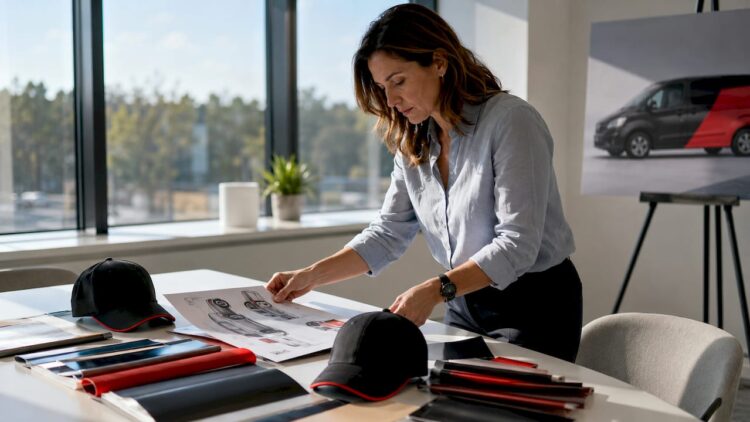
Fleet company branded merchandise is defined as the full range of logoed apparel, promotional items, and vehicle graphics that a fleet operation deploys to build brand visibility and staff cohesion. Done well, it turns every driver, technician, and field worker into a moving brand ambassador. Done poorly, it wastes budget and sits unused in a storeroom. This guide covers what merchandise works best for fleet environments, how to select the right suppliers, how to roll out a programme without the usual headaches, and how to avoid the quality pitfalls that undermine your investment.
What types of branded merchandise best suit fleet companies?
The most effective fleet branding products fall into three categories: staff apparel, small promotional items, and vehicle graphics. Each serves a distinct purpose, and the strongest programmes use all three together.
Staff apparel is the backbone of any fleet merchandise strategy. Polo shirts and jackets are the workhorses here. Durable uniform fabrics like high-density cotton-poly piqué blends with reinforced vents and drop-tail hems hold up through lifting, bending, and daily field work. That level of construction matters when your team is on the road or at a job site every day, not sitting at a desk.
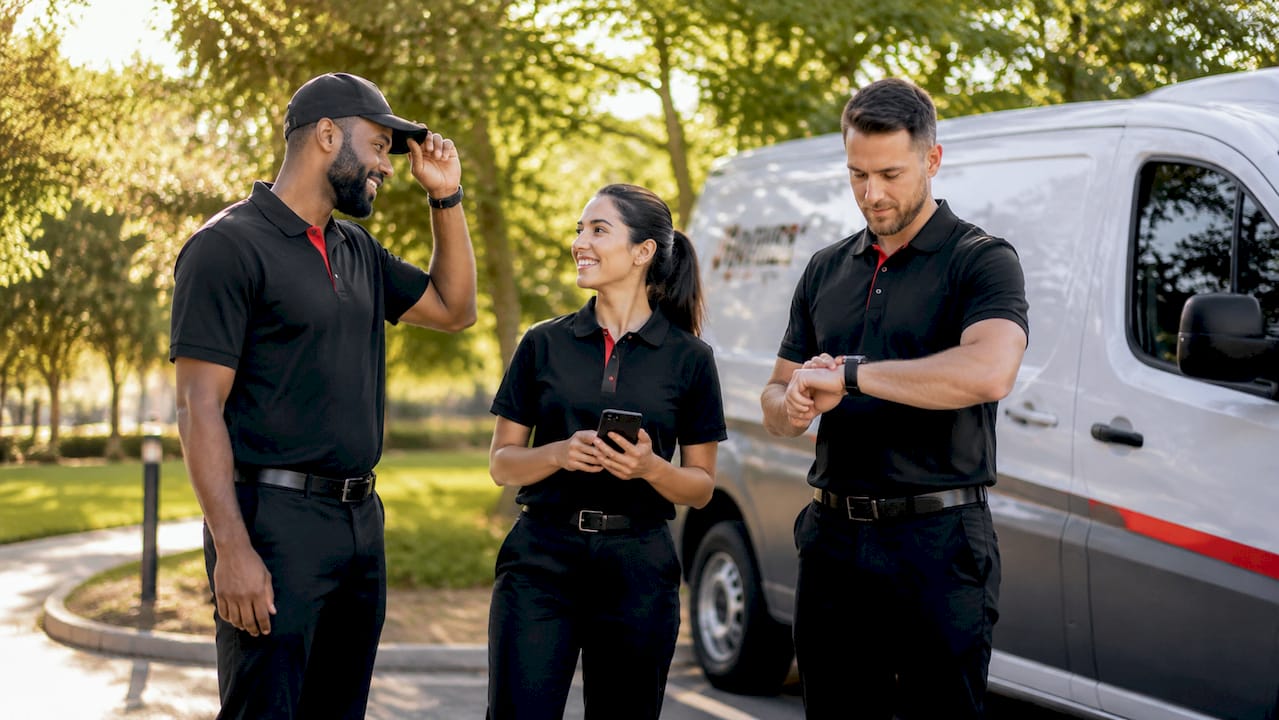
Vehicle graphics and decals extend your brand far beyond the workplace. Weather-resistant vinyl graphics with vibrant logos and high-contrast text remain legible and professional through sun, rain, and road grime. Noble Outdoor Services is a well-documented example of a fleet operation that achieved cohesive, road-ready branding through precisely applied vehicle wraps.
Small promotional items such as branded pens, stickers, notepads, and drink bottles serve a different function. They work best as client-facing giveaways, onboarding gifts, or recognition rewards rather than daily-use field equipment.
| Merchandise Type | Durability | Primary Use Case |
|---|---|---|
| Cotton-poly polo shirts | High | Daily staff uniform, field operations |
| Branded jackets | High | Cold-weather uniform, client-facing roles |
| Vehicle vinyl graphics | Very high | Fleet vehicle branding, road visibility |
| Branded pens and stickers | Low to medium | Client giveaways, onboarding kits |
| Drink bottles and caps | Medium to high | Staff recognition, corporate gifting |
Pro Tip: Order a sample garment before committing to a bulk run. Fit, fabric weight, and colour accuracy on the actual item often differ from what you see in a digital mockup.
Multi-placement branding options across chest, back, sleeve, and collar give you consistent logo exposure regardless of how a staff member is positioned. A driver walking away from a vehicle still carries your brand on their back.
What prerequisites do you need before ordering?
A successful branded merchandise programme starts well before you place an order. Fleet managers who skip the preparation stage are the ones who end up with mismatched colours, wrong sizes, and delayed deliveries.
The non-negotiables to sort out first:
- Brand guidelines: Confirm your exact Pantone or CMYK colour codes, approved logo files in vector format (.AI or .EPS), and any placement restrictions your marketing team has set.
- Budget and quantity: Bulk orders reduce per-unit cost significantly. Know your fleet size, expected staff turnover rate, and whether you need a one-off order or an ongoing replenishment programme.
- Minimum order quantities (MOQs): Most quality suppliers set MOQs of 12–50 units per item. Factor this into your budget planning.
- Delivery timelines: Production for embroidered garments typically runs 2–4 weeks. Add freight time for regional or remote locations.
- Sizing data: Collect accurate sizing from all staff before ordering. A sizing chart sent out two weeks before the order deadline prevents the most common rollout problem.
Choosing vendors with bulk order experience and design mockup support is the single most important vendor criterion for fleet operations. You need a supplier who can handle 50 or 500 units with the same level of quality control.
Precise embroidery using polyester threads and industrial printing processes preserves logo clarity and resists cracking or fraying on textured piqué fabrics. Ask your supplier specifically about their embroidery thread specification and whether they use heat-transfer or screen printing for flat logos.
Pro Tip: Request a pre-production sample with your actual logo applied before approving a full run. This one step catches 90% of colour and placement errors before they become expensive mistakes.
Knowing how to choose promotional products that maximise brand exposure is a skill worth developing before you brief any supplier. The best merchandise is the kind your staff actually want to wear and use.
How do you roll out fleet branded merchandise effectively?
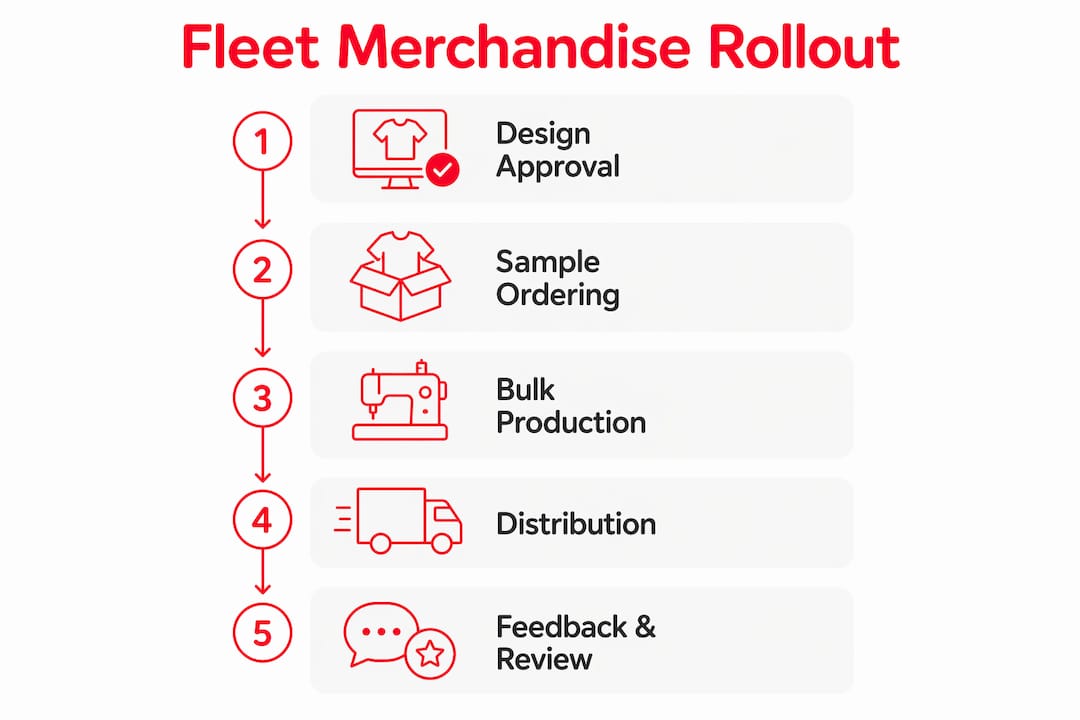
Execution is where most fleet merchandise programmes succeed or fail. A clear rollout process keeps quality consistent, staff engaged, and budget on track.
Step-by-step rollout process
- Finalise design files. Submit vector logo files and confirm colour codes with your supplier. Approve a digital mockup showing all placement positions.
- Collect staff sizing. Send a sizing form to all staff with a firm deadline. Include a size guide with measurements, not just S/M/L labels.
- Place the order with a buffer. Order 10–15% above your current headcount to cover new hires and replacements in the first six months.
- Review the pre-production sample. Check logo placement, colour accuracy, and fabric quality before approving the full run.
- Organise distribution. For geographically dispersed fleets, work with your supplier to arrange direct-to-site delivery where possible.
- Integrate into onboarding. Branded apparel in onboarding kits gives new hires an immediate sense of belonging and sets a professional tone from day one.
- Set a replenishment schedule. Review stock levels every six months and reorder before you run out, not after.
| Rollout Stage | Timeline | Key Checkpoint |
|---|---|---|
| Design approval | Week 1 | Vector files confirmed, mockup signed off |
| Sizing collection | Week 1–2 | 100% of staff data received |
| Pre-production sample | Week 3–4 | Logo, colour, and fit approved |
| Full production | Week 4–6 | Order confirmed with supplier |
| Delivery and distribution | Week 6–8 | All sites receive correct quantities |
| Onboarding integration | Ongoing | New hire kits include branded apparel |
Corporate apparel in onboarding kits is a proven tool for employer branding and staff retention. When a new driver receives a quality polo shirt and jacket on their first day, it communicates that the company takes its brand and its people seriously.
Pro Tip: Assign one internal contact per site as the merchandise coordinator. This person handles sizing, distribution, and replacement requests, which removes the administrative burden from the fleet manager entirely.
What common challenges arise and how do you fix them?
Even well-planned merchandise programmes hit problems. Knowing the common failure points in advance lets you address them before they affect your brand or your budget.
Poor quality control is the most damaging issue. Colour inconsistencies and logo distortion make your fleet look unprofessional and undermine the investment you have made in branding. The fix is straightforward: always request a pre-production sample and insist on a written quality assurance process from your supplier.
Common mistakes and their corrective actions:
- Skipping the sample stage. Corrective action: make pre-production samples non-negotiable in your supplier contract.
- Ordering exact headcount quantities. Corrective action: always add a 10–15% buffer for replacements and new hires.
- Using rasterised logo files. Corrective action: supply vector files only (.AI or .EPS) to prevent pixelation in embroidery digitisation.
- Ignoring staff input on fit and comfort. Corrective action: run a fit trial with a small group before the full order. Staff who find uniforms uncomfortable will not wear them.
- No replenishment plan. Corrective action: set calendar reminders for six-monthly stock reviews and keep a small reserve for urgent replacements.
“Employee engagement increases significantly when branded merchandise is presented during onboarding, contributing to employer branding and retention.” — Alma Mater Store
Poor staff uptake is a separate but related challenge. If your team does not wear or use the merchandise, the brand visibility benefit disappears entirely. The solution is to involve staff in the selection process. Let them choose between two or three approved options for jacket style or colour. That small act of inclusion dramatically increases uptake and pride in the uniform.
Ordering misalignment with fleet size changes is another common issue. Fleets grow, contract, and turn over staff regularly. A merchandise programme that does not account for this ends up with some sites over-stocked and others running out. A centralised inventory system, even a simple spreadsheet, solves this problem.
Key takeaways
Fleet company branded merchandise delivers measurable brand visibility and staff engagement when the right products, suppliers, and rollout processes are in place.
| Point | Details |
|---|---|
| Choose durable merchandise first | High-density cotton-poly uniforms and vinyl vehicle graphics withstand daily fleet conditions. |
| Prepare thoroughly before ordering | Confirm brand guidelines, sizing data, and supplier MOQs before placing any order. |
| Integrate apparel into onboarding | Including branded apparel in new hire kits builds belonging and strengthens employer branding. |
| Insist on pre-production samples | Reviewing a sample before full production prevents costly colour and placement errors. |
| Plan for replenishment from day one | Order a 10–15% buffer and schedule six-monthly stock reviews to avoid shortfalls. |
Why durability and culture are the two metrics that matter most
I have worked with fleet operators across Australia for long enough to know that most branded merchandise programmes are evaluated on the wrong metric. Fleet managers tend to focus on cost per unit. Marketing professionals focus on logo visibility. Both matter, but neither is the metric that determines whether a programme actually works.
The two metrics that matter are durability and cultural uptake. A polo shirt that fades or pills after ten washes is not a cost saving. It is a brand liability. Every time a staff member wears a degraded uniform, it communicates something about the company’s standards. Selecting durable fabrics and precise embroidery methods is not a premium option. It is the baseline requirement for any fleet operation that takes its brand seriously.
Cultural uptake is harder to measure but equally important. I have seen companies spend significant budgets on custom fleet merchandise that ends up in the back of a locker because the staff found it uncomfortable or unflattering. The fix is not complicated. Involve your team early. Show them options. Ask for feedback on fit. When people feel ownership over their uniform, they wear it with pride, and that is when the brand visibility benefit actually materialises.
My honest advice: establish your brand guidelines in writing before you brief any supplier. Colour codes, logo placement rules, approved garment styles. This document saves you from the most common and most expensive mistakes in the entire process. Suppliers who receive a clear brief deliver better results, faster, and with fewer revisions.
— Priyadarshani
Discover quality branded merchandise for your fleet with Chillipromotions
Chillipromotions has been supplying promotional products and branded merchandise across Australia and New Zealand since 2001. For fleet companies, that means access to durable staff apparel, corporate giveaway products, and custom fleet merchandise backed by professional design support and pan-Australia delivery.
Whether you are outfitting a team of ten or a national fleet of hundreds, Chillipromotions works with you as a partner, not just a supplier. From design mockups to final delivery, the process is managed to protect your brand standards at every step. Explore Chillipromotions’ full range of branded promotional products or contact the team directly for a personalised quote tailored to your fleet size and budget. You will notice a difference when you add Chilli.
FAQ
What is fleet company branded merchandise?
Fleet company branded merchandise covers logoed staff uniforms, promotional items, and vehicle graphics used to build brand visibility and team cohesion across a fleet operation. It includes everything from embroidered polo shirts and jackets to weather-resistant vehicle decals.
What fabric is best for fleet staff uniforms?
High-density cotton-poly piqué blends are the recommended choice for fleet uniforms. They withstand the physical demands of field work and hold embroidered logos without fraying or distortion.
How do branded onboarding kits help fleet companies?
Branded apparel in onboarding kits gives new hires an immediate sense of belonging and reinforces employer branding from day one. It is one of the most cost-effective ways to improve early staff engagement.
How many units should i order for my fleet?
Order your current headcount plus a 10–15% buffer to cover new hires and replacements. Review stock every six months and reorder before supplies run out to avoid gaps in uniform consistency.
What logo file format should i supply to my merchandise supplier?
Always supply vector files in .AI or .EPS format. These formats allow your supplier to scale and digitise your logo without pixelation, which is critical for clean embroidery results on textured fabrics.